
Caught in time in west Buckinghamshire

DUE TO BE DEMOLISHED in 1900, the newly established National Trust (founded in 1895) saved it from this terrible fate that year. The building is a long, narrow half-timbered, brick and wattle structure in the attractive village of Long Crendon in the west of Buckinghamshire. Built sometime between the 14th and 15th century, it served as the manorial courthouse.

Meetings of the manorial court of Long Crendon are believed to have begun before the 13th century. Until 1233, they were held in the lord of the manor’s house, which was demolished that year. In 1275, the manor was divided equally among three female heirs, and courts were held in the farmhouses of their families. By 1558, the courts of the three lords of the manors combined, and it must have been around this time that the courthouse began being used for judicial procedures. The building was not only used by the court but also as a facility for the poor. By the 19th century, it was used by one family to store wool. Some historians question this. In Victorian times the courtroom was used as a Sunday school and a place where occasional public lectures were given.

In 1900, the National Trust purchased the venerable edifice and began repairing it to keep it standing.  The Arts and Crafts architect and designer Charles Robert Ashbee (1863-1942) and his wife lived in the courthouse. They used to invite groups of apprentices from London for arts-based holidays lasting a fortnight. In 1902, the Ashbees, whose bohemian activities disturbed the locals, left for Chipping Camden where they established the Guild of Handicrafts. In 1918, Ashbee was sent to Jerusalem as civic adviser to the British Administration for Palestine.  In 1937, the courthouse became used as a clinic by the area’s District Nurse. This continued after the NHS was established in 1948. The courtroom then served as a Welfare Clinic.

Between 1985 and 1987, the building was intensively restored. Now, the long room, which occupies most of the upper floor, and was once the court room, is now a village museum. It is reached by a steep flight of wooden stairs. The upper rooms are the only part of the building open to the public. The long courtroom has a timber floor made with irregularly shaped planks. The arched ceiling is supported by massive timber crossbeams. Each one differs in shape from the others. Various exhibits and boards with historic photographs line the walls of this otherwise empty room, in which long ago trials were held.

We visited Long Crendon to see the courthouse. However, many other buildings in this village are incredibly picturesque and well-worth exploring.

The forgotten wig in the west of Devon

TAVISTOCK IS A SMALL town just west of the Dartmoor National Park. Between the year 974 and 1539, when it was closed by King Henry VIII, there was a vast abbey in the centre of the town. A few remnants of the abbey buildings can be seen today, but most of the complex has disappeared. The Guildhall, built in 1848, stands upon land where the abbey once stood. Today, this edifice houses a well organised museum, which illustrates various aspects of the town’s history. Visitors can see the courtroom and the old prison cells beneath it.

Within the courtroom, there is an intriguing exhibit: a judge’s wig in a glass case. This wig was discovered recently when the Guildhall was being restored a few years ago. It is the kind of wig worn by judges in the 1840s. The wig contained its owner’s name: Mr JW de Longueville Giffard.

The researchers connected with the museum discovered that Mr Giffard attended court one day in October 1888. He had been presiding at Okehampton the week before, and had fallen ill. Unwilling to cancel his session at Tavistock, the conscientious judge attended the court on that October day, feeling extremely unwell. He died the following day. Because he was in such a bad state on the day before his death, he must have forgotten to take his wig back home with him.

130 years later, the unfortunate judge’s wig was found in a cupboard in what had once been the judges’ robing room.

Where Mahatma Gandhi met Vallabhai Patel in Ahmedabad

THE GUJARAT CLUB, the oldest club in Ahmedabad, stands opposite the Ahmed Shah Masjid, the oldest mosque in the city. The club was founded in 1888 by Rao Bahadur Nagarji Desai. With over 1000 members, the much used clubhouse is in an unmodernised condition. Located next to the recently constructed (2020) City Civil and Session’s Court, the Club is a ‘hang-out” and informal meeting place for many senior advocates. In former times, the place was frequented by Ahmedabad’s wealthy Mill owners and high ranking Britishers. It was the first Indian club that admitted Indians as well as Europeans from the moment it was established.

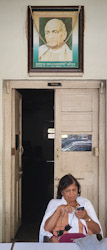
Vallabhai Patel above a doorway at the Gujarat Club

The Club is located close to a house where Sardar Vallabhai Patel (1875-1950) lived. Patel frequented the Club regularly and played bridge there. It was where he first met Mahatma Gandhi in 1916. A tree marks the spot where they chatted.

After having passed the Bar Examination at London’s Middle Temple, where my wife achieved the same thing many years later, Patel came to live in Ahmedabad. The first meeting with Gandhi at the Club marked the start of Patel’s attachment to the Mahatma’s cause. Years later, Patel played a key role in uniting the former Princely States with what had been British India to form the India of today. An important freedom fighter for Indian independence, he became a senior member of the country’s government after 1947. A close associate of Gandhi, the two men chose to differ on how to deal with certain issues, for example the creation of Pakistan.

We sat under the verandah of the Gujarat Club and enjoyed cups of tea. From where we sat we could see a large rectangular open space, which was being used as a car park. The ground was marked out with tennis court lines and a couple of nets were stretched between rows of parked cars.

We began conversing with an advocate at the next table. When he learned that my wife was a barrister, he kindly offered to show us around the neighbouring court building.

We spent well over an hour sitting in various court rooms. Most of these had two layers of glass screens, separating the judges and the court officials from the rest of the room: a covid precaution.

Several things impressed my wife as being different from what happens in British courtrooms. First, the plaintiffs are permitted to speak directly with the judges, rather than via intermediaries such as barristers. Secondly, the judges seemed to be handed the papers of a case at the moment it was about to be heard, rather than in advance. Thirdly, each judge was able to switch seamlessly between fluent Gujarati, Hindustani, and English. Also, they made decisions far more rapidly than their counterparts in the UK.

After our fascinating visit to the court house, our host and a charming advocate from his firm invited us to return to the court and the Club to celebrate Republic Day on the following morning, the 26th of January 2023. We accepted, and I will describe the events in another essay.

Our visit to the vibrant Gujarat Club proved far more exciting than we had anticipated. What was once a place where mill owners rubbed shoulders with British officers and officials, where Patel first met Gandhi, is now a congenial place where advocates meet, converse, read, and relax.