An artist from Pakistan at an Indian art gallery in London

THE CHEMOULD ART Gallery was founded in Bombay (Mumbai) in 1963, and ever since then it has been an important player in India’s modern art world. Until 8 June 2025, it is holding a temporary exhibition at London’s Frieze at number 9 Cork Street. The exhibition is of works by Rashid Rana (born 1968).

Rana was born in Lahore (Pakistan), where he is currently the Dean of the School of Visual Arts and Design at BNU (Lahore). Apart from being an artist, he is also a curator and an educator. He is considered to be one of Pakistan’s most innovative artists.

The exhibition in Cork Street includes 4 intriguing images. Each one consists of a mosaic of thousands of tiny photographic images, each one not much larger than a passport photograph. The photographs are not arranged randomly and subjects in neighbouring photographs seem to be unrelated to each other. They are put together in ways that when seen from a distance, form either large objects or abstract patterns. The resulting images are both fascinating and unusual.

Rana has exhibited in many parts of the world. These places are listed on the gallery’s handout and on the artist’s website. However, as far as I can determine, India is not one of these places. I wondered whether this related to the fact that an Indian gallery is displaying his works not in India but in London.

Three generations of artists in one family

SIR WILLIAM ROTHENSTEIN (1872-1945) was born of German-Jewish parents in the Yorkshire city of Bradford.  His father was involved in Bradford’s textile business. Trained at the Slade School of Art (part of London’s UCL), William became a well-known painter and cultural figure. Between 1920 and 1935, he was director of the Royal College of Art. Rabindranath Tagore dedicated his work “Gitanjali” to William. One of William’s sons, Michael Rothenstein (1908-1993), who was born in Hampstead, became a noted printmaker. He married Betty Mona Desmond Ayers (née FitzGerald; 1915-2017), who was known as ‘Duffy Ayres’. She was an English portrait painter.

Michael and Duffy had two children, one of whom is Anne Rothenstein (born 1949). She is a self-taught artist, who lives and works in London. Until 12 April 2025, there is an exhibition of her paintings at the Stephen Friedman Gallery in London’s Cork Street. Her attractive paintings, which seem deceptively simple when compared with those made by her grandfather William, depict portraits, interiors, and landscapes. However, they are far from simple. They are subtle and sometimes dreamlike. And as the gallery’s handout noted, her portrayal of perspective is unusual: the landscapes seem flattened. The paintings on display are oddly compelling and this along with their somewhat muted colouring, enhanced my enjoyment of Anne’s art.

As soon as we entered the gallery and I saw the artist’s name, I wondered whether she is related to the famous Sir William Rothenstein. When the gallery assistant informed us that she is from the same family, I was excited. Already, I knew of William’s connections with Hampstead and that he hosted Tagore, when the great Bengali visited London, but I had no idea that both his son and his granddaughter were artists (although far less well-known than him).

AMAZING SCULPTURES AND COLLAGES BY A BRITISH POP ARTIST

HUMOUR, IMAGINATION, PLAYFULNESS, wit, social criticism, and creativity – these are all words that can be applied to the works of the artist Peter Blake, which are on show in a superb exhibition at the Waddington Custot gallery in London’s Cork Street until the 13th of April 2024.

Blake was born in 1932 in Dartford (Kent). He studied art at Gravesend Technical College, and then at the Royal College of Art in Kensington. He is a leading British exponent of Pop Art, which, according to Wikipedia:

“… is an art movement that emerged in the United Kingdom and the United States during the mid- to late-1950s.The movement presented a challenge to traditions of fine art by including imagery from popular and mass culture, such as advertising, comic books and mundane mass-produced objects. One of its aims is to use images of popular culture in art, emphasizing the banal or kitschy elements of any culture, most often through the use of irony.”

One of Blake’s most familiar works is the album sleeve for the Beatle’s LP “Sgt. Pepper’s Lonely Hearts Club Band”, which he designed along with Jann Haworth, his wife between 1963 and 1979. I wonder how many Beatle’s fans know that Blake was involved with making the image on this.

The exhibition at Waddington Custot is dedicated to Blake’s sculptural works. There has not been one during the last 20 years. Although there are many of his sculptures in the gallery’s three interconnecting rooms, many of his ingeniously witty collages are also on display. Employing images from comics, old books, and other printed matter, these collages are so carefully assembled that unless one looks at them closely and extremely obliquely, it is difficult to realise that these artefacts are not prints but collages.

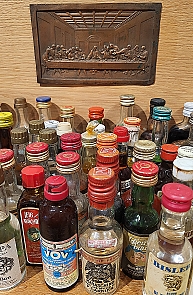
The sculptures are with only a very few exceptions, wonderful assemblages or tableaux constructed with found objects. For example, one of these is a shelf overloaded with miniature booze bottles, all positioned beneath a miniature image of Leonardo da Vinci’s depiction of the Last Supper. There are several model sailing boats, on which Blake has placed plastic models (toys) of people expressing a range of behaviours. Other sculptural assemblies are more complex and need to be seen rather than described. I mentioned ‘exceptions’ at the beginning of this paragraph. This refers to four objects – they look like large stones (one of which is a carved stone head) – which Blake called “Found Sculpture”. Each of these is mounted on its own plinth. By doing so, the artist has ‘elevated’ these natural objects to the status of ‘fine art’, and as the gallery’s hand-out said, they challenge:

“… conventional notions of artistic materials …”

I loved the exhibition. Every exhibit is both interesting and beautiful … and great fun. As the show’s hand-out correctly stated, Blake’s sculptures are:

“… by turns quirky, endearing or engaged with conceptual concerns.”

His creations:

“… offer starting points for imagined narratives, each with a glimmer of Blake’s typically gentle, English sense of humour.”

And this is quite correct. Skilfully conceived and executed, Blake’s works provide nourishment for both the eye and brain in a delightfully digestible form.  If you view the exhibition with an open state of mind, you are bound to gain great enjoyment from it.

An artistic British Nigerian in Mayfair

WHEN WE ARE IN LONDON, we make regular visits to the commercial art galleries, many of which are to be found in and around Mayfair. Not only can one get to see some of the most recent works of contemporary artists, but also those that will eventually end up in private collections that are usually inaccessible to the general public. Today, the 12th of October 2023, we were walking along Cork Street, heading towards the Waddington Custot Gallery when we passed a gallery, the Stephen Friedman, which we had never entered before. Through its window, we saw works by an artist, whose oeuvre we enjoy, and entered.

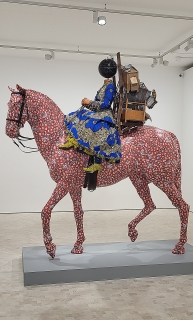
Much of the exhibition at Stephen Friedman is dedicated to creations of the British Nigerian artist Yinka Shonibare. He was born in London in 1962. His Nigerian parents took him to Lagos in Nigeria when he was 3 years old, and he lived there until he was 17. A year later, he developed transverse myelitis, which left him paralysed on one side of his body. Despite this, he went on to study fine art at the Byam Shaw art school, and then later at Goldsmith College (part of the University of London). Because of his disability, Yinka directs a team of assistants to create his artworks (sculptures, photographs, fabrics, and much more). He has become a widely exhibited and highly acclaimed artist.

Yinka’s works are visually engaging and highly imaginative. They are also full of meaning. He uses his creations to:

“… question the validity of contemporary cultural and national identities within the context of globalisation. Through examining race, class and the construction of cultural identity, his works comment on the tangled interrelationship between Africa and Europe, and their respective economic and political histories.” (see https://yinkashonibare.com/biography/)

Although one can easily enjoy the aesthetics of his creations without understanding the artist’s messages contained within them, a good knowledge of colonial and post-colonial history will enhance the viewer’s experiences of them.

The exhibition is on until the 11th of November 2023. In addition to Yinka’s works, he has curated a small, but fascinating, collection of artworks by several artists from the African diaspora.