
A pianist in London’s National Gallery during wartime

THE SAINSBURY WING of London’s National Gallery is stark, almost clinical, compared with the older nineteenth century rooms in the rest of the place. Although the pictures in the new wing can be seen without the eye being distracted by the rooms’ decorative features, I found that the paintings felt more ‘at home’ in the older, highly decorated galleries. One of these rooms, Room 36 has a central octagon topped by circular, glazed dome. In contrast to the Sainsbury Wing, this octagonal and the rooms leading of it, the Barry Rooms, are gloriously decorative in a Victorian baroque style. This and the rooms adjoining it were designed by the architect Edward Middleton Barry (1830-1880). His creations in London include The Royal Opera House and the Charing Cross Hotel.
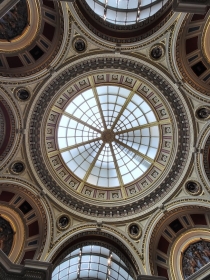
There are several paintings by great artists such as Claude and Turner in the octagon. If you avert your eyes from these masterpieces, you might notice a small commemorative plaque that reads:

Dame Myra Hess. On 10 th October 1939 in this room the pianist Myra Hess performed the first of many music concerts for the enjoyment of Londoners during wartime”.

Myra Hess, who was born in South Hampstead in 1890, died in London in 1965. She studied music at the Guildhall School of Music and at the Royal Academy of Music. Her concert debut was in 1907. During WW2 when most concert halls were out of action, she organised almost 2000 lunchtime concerts in the National Gallery: Monday to Friday for six years. She played in 150 of them, and never took a fee for her playing. In recognition of her work in keeping up the morale of those who heard her, King George VI made her a Dame Commander of the Order of the British Empire in 1941.

At the time of her death in 1965, Myra Hess was residing at 48 Wildwood Road in Hampstead Garden Suburb. Although I lived not far from her in the Suburb during my childhood, then I was unaware of both her existence and the fact that she was almost a neighbour. It was only during the twenty-first century that I spotted her creeper covered commemorative plaque on the house in Wildwood Road. Although I am glad that I did not have to live through WW2, I would have enjoyed listening to a concert in the gloriously decorative octagonal room at the National Gallery.

Crypto … coffee

ST MARTINS IN THE FIELDS church is a prominent landmark located on the east side of London’s Trafalgar Square. This 18th century church, which first opened in 1724 and was designed by James Gibbs (1682-1754), hosts many concerts, mostly of classical music.

There is a large crypt beneath the church. Its vaulted brickwork ceilings are supported by sturdy masonry pillars. There are many gravestones flush with the floor. The floor is covered with tables and chairs, which are used by the many customers of the café which uses the crypt as its home. It is a pleasant place to while away the time of day.

The café serves food and drink. The coffee served there is slightly below average in quality and is priced a just little bit higher than average for London. Regardless of price or quality, the crypt provides a pleasant ambience to meet friends or simply to relax peacefully.

A house where music has been played for many centuries

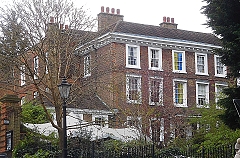
Burgh House, Hampstead, London

Burgh House stands high above the southwest end of Well Walk in north London’s historic village of Hampstead. Here is a little bit about it, an extract from my new book about Hampstead:

“… Burgh House is entered from a steep side street called New End Square. The house, built in 1704, is close to the Hampstead Well Spa (see below). According to Bohm and Norrie, the House is named after its 10th owner, The Reverend Allatson Burgh (1769-1856), who was the vicar of St Lawrence Jewry in the City of London. Burgh, who was keener on music than looking after his parishioners, neglected both them and his house. Thomas Barratt wrote:

“Mr. Burgh was a rector in the city, and the composer of a work on church music, published by Longmans. Burgh House is depicted on five pieces of the Wedgwood service, made in 1774, for Catherine II., Empress of Russia.”

Between 1858 and 1884, Burgh House became the headquarters of the Royal East Middlesex Militia. After having been put to a variety of uses, the house became used as a cultural centre in 1979. It now contains a small art gallery, a café, a shop, and a Hampstead Museum. The Reverend Burgh would have been pleased to know that today his former home also hosts many fine concerts of classical music.

From the bottom of the garden of Burgh House, the ‘Wells Tavern’ pub can be seen dominating the view along the gently inclined Well Walk. Known as ‘The Green Man’ until 1850, when it was rebuilt and renamed the ‘Wells Tavern’, a pub has stood on his spot since at least 1762. The pub’s name reflects one of the reasons that Hampstead became popular in the 17th century.  Apart from enjoying clean air, people were attracted to the mineral water springs issuing chalybeate (iron-rich) water that were beginning to be exploited in Hampstead at that time…”

My book is called

“BENEATH A WIDE SKY: HAMPSTEAD AND ITS ENVIRONS”

YOU CAN BUY the paperback or ebook (Kindle) from Amazon:

https://www.amazon.co.uk/dp/B09R2WRK92