Graffiti of historic interest in a church in Cambridgeshire

LITLINGTON IS A SMALL village in the south of Cambridgeshire. Its parish church, St Catherine’s, dates from about 1150. Between then and the 15th century, it underwent many modifications. As in many old buildings, people have inscribed graffiti into the church’s stone walls. One stone in one of the south windows has some especially interesting graffiti.

The neatly carved inscription (in Latin), which refers to the great sailor Sir Francis Drake (c1540 – 1596) reads:

“Francis Drake, knight, about to set sail in the thirty-seventh year of the reign of the most august and serene princess Elizabeth, by the grace of God Queen of England, France and Ireland, defender of the faith. 1595. Always the same. The same always. John Sherman, April the tenth.”

The date refers to the year of Drake’s final voyage, from which he never returned (he was ‘buried’ at sea near Portobelo (now in Panama)). Drake had set out from Plymouth in September 1595 to carry out activities against the Spanish in Puerto Rico and other places in and around the Caribbean.

John Sherman lived in Litlington, as did his son-in-law, Robert Bownest, who died during Drake’s final voyage. In “A History of the County of Cambridge and the Isle of Ely: Volume 8” (published in 1982), we can read:

“John Sherman died in 1599, having transferred his manor and other purchased lands in 1597 to his eldest son William”

John’s father, William, was a wealthy landowner in Litlington. What is not clear is whether this John Sherman wrote the inscription and if he participated in in Drake’s ill-fated expedition of 1595, as did his son-in-law.

Tiny details such as the inscription I have described help to make visits to places in England really interesting, and, in a way, help to give vitality to what are otherwise simply historical events.

The church that became a boat in northwest London

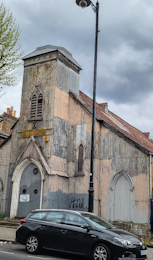
EVER SINCE THE early 1960s, I have travelled along Cambridge Avenue, which runs between Edgware Road and Kilburn Park Underground Station. I have always been in a car or bus. So, whenever I have passed what I am about to describe, I have never stopped to look at it carefully.  Yesterday (14 April 2025), we stopped outside it to change buses.


What I am referring to is an edifice made from sheets of corrugated iron, which looks like a Victorian gothic church. It looks slightly shapbby. Notices attached to it inform passers-by that it is a meeting place of the Sea Cadet Corps and it is now the ‘TS Bicester’, ‘TS’ standing for ‘Training Ship’. Known as the Tin Tabernacle, its history has been related on several websites including http://tintabernaclekilburn.org/history/ and https://englishbuildings.blogspot.com/2013/04/cambridge-avenue-london.html .


The church was erected as a temporary structure in 1863, when Kilburn was on the edge of the countryside. According to the Tabernacle’s own website, a local developer called James Bailey:

“… granted a lease to Rev. Woodhouse and the Trustees of Cambridge Road Chapel to build an iron church for Church of England worship at a cost of £1000. The agreement was to build a stone church or a row of 3 terraced houses by Michaelmas 1868. The church paid a yearly rent of £32.”

That deadline has long passed, and the tin church is still standing. The galvanised corrugated iron covers a timber and iron frame, and iron columns support the roof.


1863, the Tin Tabernacle was constructed and was initially called St James Church. It was probably intended to be a stop-gap church to be used while the nearby St Augustine’s Church was being built (it was completed in 1870). In 1948, the tin church, which was then known as ‘Cambridge Hall’, was assigned to the Willesden Sea Cadets for use as a social centre and training centre. In 1956, the HMS Bicester was scrapped. Between 1956 and the 1960s, the church was fitted out to reproduce the scrapped HMS Bicester, and the place was renamed TS Bicester. Sometime between 1960 and 1980, the church lost its spire. In 1998, the building was listed as Grade II, which gives it some protection against being demolished.


The Sea Cadets ceased using the church in 2011. Its naval interior has been preserved, and now the church is used occasionally for community and other events. Although I have seen its exterior, I would love to see inside this unusual edifice.

Pierced by a bullet while praying in the pews

BEVERLEY IN YORKSHIRE is best known for its cathedral-like Minster. Our friend Colin recommended that while in Beverley, we should not miss visiting the church of St Mary. We went there and enjoyed exploring this magnificent medieval gothic parish church. We were shown around by a volunteer who pointed out something we had never seen in any other church.


The bullet hole

In WW2,  during an air attack on Beverley, a German aeroplane strafed the town. One of the bullets from the ‘plane made a hole in a stained glass window on the south side of the church, and went straight through one of the worshippers, killing him. The volunteer showed us the hole in the wooden pew made by the bullet after it had passed through the unfortunate parishioner. The wooden pew behind the one with a hole has a hollowed out spot caused by the bullet after it had penetrated the pew in which the victim had been seated.


Years later, the volunteer related, a woman from Australia visited St Mary’s,  and when she saw the damage caused by the bullet, she burst into tears.  The man who had been killed while praying had been her grandfather.

LIBERTÉ ÉGALITÉ (MAYBE) FRATERNITÉ IN A FORMER FRENCH COLONY

PONDICHERRY IN SOUTHERN India was a French colony between about 1674 and 1954. This picturesque city is still divided into White Town, where the French lived, and Black Town, where the Tamils and other Indians resided.  The segregation of Europeans and non-Europeans persisted after the French Revolution  of 1789. It was during (or soon after) this historic uprising that  the motto ‘Liberté, Egalité, Fraternité’ came into existence. However, it was during a visit to the lovely church of Notre Dame des Anges in White Town that we discovered that the motto might not have applied to the Non-European inhabitants of the Pondicherry colony.


Within the neoclassical church, there is an informative panel outlining the church’s history.  The present edifice was constructed in 1855, but the parish is older. It was established by Capuchin monks in the seventeenth century. In 1699, the Capuchins established a Tamil Christian community. Soon, the Jesuits took over the Tamil community, and the Capuchins began a parish for Europeans and “Eurasians” (people with both Indian and European heritage). The Capuchin church of Notre Dame des Anges served Europeans and Eurasians, but not Tamils, who attended another church.


In 1887, almost 100 years after the French Revolution,  Archbishop Lauennen decreed that Notre Dame des Anges was for the exclusive use of Europeans and Eurasians. So much for the ‘égalité’ and ‘fraternité’, which was so dear the the French.


In 1984 Fr. Dusseigne, of the Société des Missions Étrangères de Paris (M.E.P) was the last M.E.P. Parish Priest, to serve the parish. He served until 2007, and was the last of a long line of Capuchin priests to lead the parish.


Dusseigne was succeeded by Fr. Michael John Antonsamy, who was the first Indian priest to lead the parish. Although he was the first Indian parish priest, I  have not yet discovered when non-Europeans began to be allowed to worship in this church in White Town.


Near the church, there is small walled cemetery where Capuchin monks have been buried. The earliest person to have his tomb there died in 1703. Sadly, the graveyard was closed, but we managed to see the well maintained funerary monuments through gaps in the locked gate.

  Colour bars were common in European colonies in Asia and elsewhere. Some of the clubs and schools founded by the British in India forbade entry of Indians even until several years after independence. So, one should not be surprised that colour bars existed in churches such as St Marie des Anges.  But what amazed me somewhat is that even after the French Revolution,  racial inequalities were not frowned upon in a French colony such as Pondicherry.

Off with his head in the centre of Norwich

THE CHURCH OF St Peter Mancroft stands above the marketplace in the centre of Norwich. Built between 1430 and 1455, it is an elegant example of the Perpendicular style. It was constructed to show off the wealth of the 15th century citizens of Norwich. It is filled with interesting features. I will discuss two of them.

The church contains a Resurrection tapestry, which is in fine condition. It was woven by Flemish weavers in 1573, and might have once been used as an Easter Day covering for the front of the high altar. The tapestry depicts the Easter story in three episodes. The central panel shows Christ emerging from his tomb. In another panel of the tapestry, Jesus is depicted as a gardener, which is how he appeared to Mary after he had left his tomb (John, chapter 20).

The tapestry is kept at the west end of the church close to the font. The other feature that I will describe is in the chancel in the eastern half of the church. It is a memorial to the polymath and writer Sir Thomas Browne (1605-1682), who was a parishioner of St Peter Mancroft. He was buried in the church and lay undisturbed until 1840, when workmen accidentally broke open his coffin. Then, his skull was removed from the rest of his skeleton for phrenologists to study it. It was only in 1922 when the detached skull was reburied in St Peter Mancroft, but not in the same place as the rest of Browne’s body. The burial register for 1922 recorded the skull as being aged 317 years,

Browne, who was interested in everything in a scholarly way, would most likely have approved of having his skull investigated by phrenologists.

Although visiting the Anglican cathedral is one of the highlights of a trip to Norwich, St Peter Mancroft should not be missed.

Holy rollers in the centre of Norwich

DURING OUR LAST HOUR in central Norwich, we explored an alley, which we had not noticed before. It led downhill to a churchyard. This surrounded two sides of a mediaeval (late 15th century) church: St Peter Parmentergate. A ‘parmenter’ was a tailor or someone who made facings and trimmings for clothes. The doorway at the southeast corner of the church was open, and two men were standing outside it. We asked them whether we could look inside the church. They said that we could do so, but did not tell us what to expect inside.

The interior of the church maintains many of its original church-related features, but in all other respects it is quite unusual. The nave of the church has no pews, but instead there is a new wooden floor that curves up at both its east and west ends. The chancel is filled with skateboards, magazines about skateboarding, and a variety of toys. Where there were once kneelers in the choir stalls, there are now skateboards. Elsewhere in the church, there were skateboards galore and helmets for skateboarders. The church is a mecca for skateboarders.

Since 2021, the church has become a skateboarding rink and a shop for skateboards. The owner of this extraordinary establishment told us that he knows of only four churches that have become converted for the use of skateboarders, and one of them is currently out of use.

The church ceased being used as a place of worship in 1980. Since then, it has been maintained by the Norwich Historic Churches Trust (‘NHCT’). Before it became used as a skateboarding centre, it served various purposes. From 2007 until 2017, it housed a centre for martial arts. Next, it was let out to the NHCT. After that, it was used by a counselling specialist.

A few hours before seeing St Peters Parmentergate, we had visited St Gregory’s, a church converted to an antiques shop. That surprised us, but not as much as St Peters Parmentergate, which must be seen to be believed. It is good to see those churches in Norwich, which have ceased serving the purpose for which they were built, are being both looked after and being kept alive as part of the city’s life.

A redundant church by the River Thames in Oxfordshire

WALLINGFORD IN OXFORDSHIRE stands on a bank of the River Thames. There is a bridge across the river. If you stand on it, facing the town, you will notice a church with an unusual spire standing near the river. This is the church of St Peters. It was built between 1763 and 1769 on the site of an earlier church, which had been demolished by Parliamentary forces in 1646, when the town was being besieged by them.

Largely unaltered since it was constructed, the church contains the grave of the famous lawyer Sir William Blackstone (1723-1780), a judge who was the author of the still influential “Commentaries on the Laws of England”. He was elected as one of the first church wardens of St Peters. Sir William contributed generously to the construction of the steeple and the installation of a clock on the south face of the tower.

On the 29th of June 1969, the last service to be held in the church took place. St Peters became officially redundant in April 1971, and its care was taken over by the Redundant Churches Fund a year later. This organisation was founded in 1969. In 1994, the organisation was renamed The Churches Conservation Trust. This admirable group currently look after more than 350 redundant churches in England, and keep them open to the public and in an excellent state of preservation. We have visited many of their churches over the years, and found them to be interesting and usually very beautiful.

A baptismal font in with stone carvings a church in Hertfordshire

WARE IS AN ATTRACTIVE small town on the River Lea in Hertfordshire. Coaches travelling between London and Kings Lynn passed through Ware because it was on the route of the Old North Road (now followed approximately by the modern A10). The parish church of Ware, St Mary the Virgin, is large and spacious as befits the size of the town. Much of what we can see today was built over several centuries, from the 12th to the 15th. It was the church’s stone font that attracted my attention.

The octagonal font is believed to have been donated to the church in 1408 by the then Lord of the Manor, Thomas Montagu (1388-1428), Earl of Salisbury. Each of its eight sides contains fine bas-relief carvings. Many of them depict saints connected with birth, baptism, and childhood. For example, ther is a carving of St Christopher carrying the young Jesus across a river. Most of the faces on the carvings are in remarkably good condition considering their age and that they were in place long before the iconoclastic activities of Protestants took place. The church’s guidebook mentioned that in the 1540s, the faces of the statues were attacked, but fortunately the workmen, who might well have been men of Ware, responsible for defacing did a “token job”, only defacing the faces of the Virgin and St Margaret because they could be seen by people entering the church. Luckily for us living in the 21st century, these workmen managed to protect what is an attractive piece of church art.

From Flanders to Devon and  thence to an island in Essex

FROM FLANDERS TO DEVON AND THENCE TO ESSEX

THE MEDIAEVAL CHURCH of St Edmund King and Martyr in the tiny village of East Mersea, on an island close to the coast of Essex, is a joy to visit.

The south wall of the church has some relatively modern windows, which are mostly glazed with clear glass. However, parts of the windows contain small pieces of stained glass, which look quite old. Chris Parkinson at the museum in West Mersea told us that these small fragments of what had once been larger window range from the 15th to the 18th centuries. They were brought to Essex from Devon by the Sunnock family, who came from Topsham and nearby Exeter.

The Sunnocks were a prosperous family. In the 19th century, after the Napoleonic Wars, English gentlemen toured France and the Low Countries, buying up antiques including bits of stained glass from religious establishments. The Sunnocks acquired a large collection of old stained glass this way, and brought it with them when they bought a home on Mersea Island.

During WW2, their Essex home was requisitioned by the military, and the glass was stored in a truk. After the war, some of the glass was restored in Norwich, and then installed in the windows of the church in East Mersea, where it can be seen today.

History scratched in stone in a village in Hertfordshire

HISTORY SCRATCHED ON A WALL IN HERTFORDSHIRE

I HAVE WRITTEN ABOUT this before, but because I found it so interesting I will write about it again. In August 2024, we revisited the picturesque village of Ashwell in Hertfordshire on our way between London and Cambridge. Apart from being an extremely attractive place, its parish church of St Mary ccontains an intriguing image scratched into the internal surface of the north wall of the bell tower.

The image is a drawing of London’s old St Paul’s Cathedral, which was destroyed during the Great Fire of London (1666). By comparing this picture with other pre-1666 drawings of the old cathedral, it can be seen to be an accurate depiction of the long since destroyed edifice. It is likely that the drawing in Ashwell was scratched into the wall sometime before 1930s, when the old cathedral was modified by Inigo Jones.

Above the image of the old cathedral, there are some inscriptions recoding plagues that occurred during the 14th century, including what is known as the Black Death.

Apart from the drawing and the inscriptions described above, the church contains a few other inscriptions, which have been partially deciphered.

For the information of those visiting the church, it is near to Day’s bakery, where delicious snacks can be purchased. The village also contains a small museum, part of which is housed in a half-timbered building. However, for me, the highlight of the village is the drawing of old St Paul’s Cathedral in the church.