
Portraying American women who married British nobility

WHEN A FRIEND invited us to join him at London’s Kenwood House to view an exhibition of portraits by the artist John Singer Sargent (1856-1925), I had some misgivings. In the not-too-distant past I saw an exhibition of his portraits at the Tate Britain, and I left it unimpressed. In that show, the portraits were displayed alongside the dresses that the sitters had worn for their pictures. In contrast, the show, which is on at Kenwood until 5 October 2025, was very satisfying.

Between 1870 and 1914, 102 American women married men in the British peerage, and more than this married into the British upper class. Put bluntly, the men were enriched by their American brides’ money, and the ladies acquired social positions that were highly regarded in British society. Regarding these marriages, Theodore Rooseveldt said:

“I thoroughly dislike … these international marriages … which are not even matches of esteem and liking, but which are based upon the sale of the girl for her money and the purchase of the man for his title.”

Sargent, the artist, made portraits of more than thirty of these brides, and it is a selection of these that are on display at Kenwood in an exhibition appropriately named “Heiress. Sargent’s American Portraits”. Each picture is accompanied by an information panel that gives interesting biographical details about the ladies.

Undoubtedly, Sargent’s grand portraits made with oil paints on canvas are superb. However, even better than these, and there are several on display at Kenwood, are his charcoal sketches. Unlike the paintings that required the subject to attend 6 or more sittings, the charcoal portraits were completed in one sitting. Despite or maybe because of the rapidity of completing the charcoal images, these portraits seem to be even more expressive than the oil paintings upon which he had spent far more time. During a period of 20 years, he completed almost 700 charcoal portraits. Although there might have been one or two of his charcoal portraits at the Tate exhibition, a great proportion of the exhibits at Kenwood were examples of Sargent’s superb charcoal technique. For me, the highlights of this small exhibition were the works executed in charcoal.

I left the show at Kenwood feeling pleased that I had been, and with a greater appreciation of Sargent’s talent than I had before.
Feeding the faithful at a Hindu temple in Kutch (Gujarat)

THE DHRABUDI TRMPLE complex is near the sea about 5 miles east of the town of Mandvi (Kutch, Gujarat). It is located ated next a small Freshwater lake, where pilgrims can bathe. Our driver told us that baby boys are brought to be blessed at the temple when they reach their first birth anniversary. When we visited, we saw a group of people doing a puja in the open air. They were respecting the first death anniversary of one of their relatives.

While wandering around the temple compound, we saw a group of Rabari women seated in the shade, under a large banyan tree. The Rabari are nomadic cattle and camel herders, as well as shepherds. In India, they aremost frequently found in Gujarat, Punjab, and Rajasthan.

Worshippers come from far and wide to do pujas at the mandir. The temple offers free meals to pilgrims. These are served in a large dining hall. One wall of this is lined with numerous portraits of people who have died. We were told that diners pick up a thali and other eating utensils before lining up to be served food.

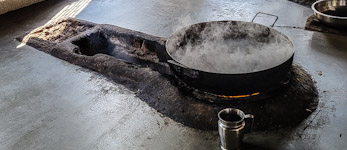
Pit containing glowing charcoal for cooking

The kitchen, which is next door to the dining hall is vast. It was spotlessly clean. I saw a few gas rings, but what really fascinated me was the other method by which food is heated up. I saw three or four pits sunk into the floor. Each one is shaped like a large spoon. Glowing charcoal is heaped in the bowl of the ‘spoon’, and can ve spread along the stem. Pots are placed above the charcoal. The arrangement reminded me of the Turkish ocakbaşı. I imagine that the cooking speed can be adjusted by varying the amounts of glowing charcoal beneath each of the enormous cooking pots.

We did not stay to join the pilgrims having lunch. Although the temple cooks kindly invited us, we had lunch awaiting us at my wife’s cousin’s home.

I always enjoy visiting place of worship. What made Dhrabudi special for me was being shown its wonderful kitchen.

More than meets the eye on the moor

FROM OUTSIDE IT looked like a ‘bog standard’ pub on Dartmoor. The kind of pub in which you would expect to find weary walkers and cyclists, all dressed in appropriate outdoor gear splattered with mud. The sort of place where the customers wear walking boots and thick woolly socks that reach halfway up their calves. An old-fashioned country pub with a roaring open fire. You know the kind of place, quaintly decorated with folks objects such as horse brasses, copper bed pans, Toby jugs and so on. A pub where you would find sandwiches and chips as the only solid fare. However, despite looking like the kind of hostelry just described, The Dartmoor Inn Merrivale is  quite a different ‘kettle of fish’.

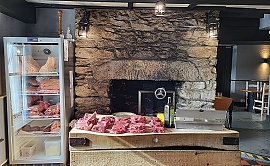
On stepping through its entrance door, the first thing you will notice is a large wooden butcher’s slap piled with raw steaks of various kinds and cuts: sirloin, rumps, chateaubriand, rib eyes, huge tomahawks, and other tasty chunks of meat. Behind this in what was formerly a fire place, there is a sophisticated charcoal grill for cooking these meaty offerings. A chef coats the meat with sprinkling of salt, oil, and herbs before grilling it. 

The pub’s decor is far from traditional.  It is simply decorated in a contemporary style with a few good artworks on the walls. The pub is owned by a local organic farm, which also has shops in Marlborough, Totnes, Tavistock, and London (in Selfridges Food Hall).

For our midday meal, we ordered a Ploughman’s Lunch contains amongst other things excellent cheddar and locally made ham, and a plate of superb barely cooked roast beef. The food could not be faulted. The staff were enthusiastic about food and were very attentive.

The Dartmoor Inn has reasonably priced rooms for overnight stays. We hope to return, spend the night, and sample the excellent looking steaks on offer.

Just as it is unfair to judge a book by its cover, one should not rate a pub by its external appearance.