
Ceilings with perforations in the home of William Morris

THE RED HOUSE in south-east London’s Bexley Heath was the only residence that William Morris (1834-1896) owned, rather than rented. The architect Philip Webb (1831-1915) designed it in a style that resembled that of the Arts and Crafts Movement, which only became prevalent in the last quarter of the 19th century. It was completed in 1860, before Morris began his now famous decorative arts company (in 1861). The house is now maintained by the National Trust, which organises guided tours though its interior. The visitor gets to see art and furniture created by Morris, his wife Jane, Edward Burne-Jones, Dante Gabriel Rossetti, and others associated with the Pre-Raphaelite Movement.

Amongst the many interesting things that the guide pointed out, one feature particularly intrigued me. That is, many of the ceilings in the house can be seen to have numerous tiny holes or perforations. If you look closely, these holes are not random, but are arranged in patterns. These patterns vary from room to room. In the large entrance hallway, which contains a couple of door panels with paintings by Morris, the ceiling is now painted white, but the perforations are arranged in a discernible pattern.

Other ceilings not only have these perforations, but are also covered with colourful hand-painted patterns. Apparently, these were painted by friends of William and Jane Morris. They used to be invited as house guests, fed, and lodged, and then expected to climb on ladders to paint patterns on the ceilings. If you look at these patterned ceilings carefully, you will notice that the painted shapes correspond to the patterns of tiny holes that perforate the ceiling panels. This is no accidental coincidence. Before the ceiling panels were installed, the perforations were made using pieces of wood in which nails had been arranged to create the pattern required for a particular ceiling. The panels were then pressed with these beds of nails to produce the desired pattern on the panels. The perforations helped the painters to create the designs that Morris had chosen for them. Although at first sight, the ceilings look as if the patterns  were mass produced, careful examination reveals that the hand painted elements of each design are not precisely identical. The painters probably tried to reproduce the elements of the designs accurately, but being hand-painted rather than mechanically reproduced, tiny differences can be discerned. This is what Morris wanted: his ideal was old-fashioned craftsmanship rather than industrial mass-production.

While showing us the ceiling above the stairwell, our guide pointed out something that Morris might not have wanted. Hidden behind a beam, and quite difficult to see, there is what we now call a ‘smiley face’ instead of an element of the pattern seen on the rest of the ceiling. It might possibly have been put there by one of his unpaid friends, who was getting bored.

The Red House, which is now embedded in the aesthetically unexciting suburban sprawl of south-east London, was once in open countryside. It is well worth visiting this place, which is one of the earliest examples of what was later to become known as the Arts and Crafts style, but you do need to book your tour in advance.

The naked ceiling at Osterley Park

WHEN THE BANKER Sir Francis Child (1642-1713) acquired Osterley Park in the 18th century, its Elizabethan manor house was in a poor state of repair. His grandsons, Francis and Robert, employed the famous architect, Robert Adam (1728-1792) to give the house a major ‘makeover’ including adding a grandiose neo-classical front portico. And that is what he did on a grand scale. Adam was no ordinary architect. Not only did he plan buildings (and modifications to them), but he also designed their interiors: everything from ceilings and wall decorations to furniture and doorhandles. Osterley Park offers a magnificent display of his wide-ranging skills.

Long gallery at Osterley Park

The visitor to Osterley Park, now managed by the National Trust, usually gets to see a series of wonderful rooms on the ground floor of the house. All the rooms except one have beautifully decorated ceilings, all designed by Adam. Some of them have paintings created by Adam’s favourite painter, the Venetian Antonio Zucchi (1726-1795). Amongst my favourite ceilings are those in the Etruscan Dressing Room and the Drawing Room. The latter has a fantastic ceiling that was inspired by drawings in “The Ruins of Palmyra otherwise Tedmor in the Desert” by James Dawkin and Robert Wood (published in 1753).The ruins were those that were recently badly vandalised by the IS group. In each of the rooms, except the long gallery, the visitor’s attention is dominated by the eye-catching ceilings.

The ceiling of the long gallery is devoid of decoration. It was in this room that the Child family’s collection of fine paintings used to be displayed. The gallery’s ceiling was left plain, without decoration, deliberately, so that the viewer’s attention would be concentrated on the paintings.  Sadly, the paintings are no more. After WW2, the house’s owner, George Francis Child-Villiers, 9th Earl of Jersey (1910 -1998) gave the house and its grounds to the National Trust. He moved to Jersey, taking with him most of the paintings that had hung at Osterley. Unfortunately, many of these works were destroyed in a warehouse fire soon after he donated the house. The artworks in the gallery have since been replaced with other paintings and because the ceiling is naked, you can give them your full attention.

Lift your eyes

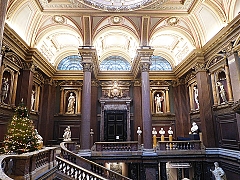
IT IS TEMPTING to concentrate on the wonderful collection of exhibits in Cambridge’s Fitzwilliam Museum, but you should spare some of your attention for the magnificent decoration of some of its galleries. Look up from the paintings and display cases to see superb ceiling decorations above you, and also around you when using the grand staircase. You are sure to be amazed.

The museum is housed in a neo-classical edifice initially designed by George Basevi (1794-1845), architect of London’s Grosvenor Square. After Basevi’s death, the planning of the structure was completed by Charles Robert Cockerell (1788–1863). Built to house the collection bequeathed to the University of Cambridge by Richard FitzWilliam, 7th Viscount FitzWilliam (1745-1816), the present museum was opened to the public in 1848. Over the years since then, the museum has been enlarged by adding newer buildings and now it is home to about 500,000 artefacts.

Years ago, I remember reading (I cannot remember where) a comparison of a museum in the USA designed by Ludwig Mies van der Rohe (1886-1969) with another one, the Guggenheim in Manhattan, designed by Frank Lloyd Wright (1867-1959). Both buildings are elegant but that by Mies Van der Rohe modestly allows the exhibits to grab the viewer’s attention more than the architecture, whereas the unusual design of Wright’s building competes with the artworks for the viewer’s attention. The internal decoration of the older galleries of the Fitzwilliam are sufficiently eye-catching to be able to compete with the exhibits housed in them, but somehow, they hardly do this. That is why I am asking you to take your eyes off the exhibits if only to glance briefly at the décor of the galleries,