
WHILE VISITING THE RUINS of the fort of Golconda near Hyderabad (India), my eyes fell on an old cannon lying beside a footpath. I stopped to examine the markings on the disused artillery piece, and noticed it bore a logo consisting of the interlocked letters V, O, and C. I recognised that this was the logo of the Dutch East India Company (‘Vereenigde Oostindische Compagnie’: ‘VOC’). I wondered why it was at the fort.
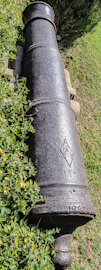
I knew that the VOC had had trading stations along the Hooghly River in Bengal (eg at Chinsura and Cossimbazar) and Gujarat (Surat), but until today (21 January 2025), I was unaware that the Dutch had factories (trading stations) in Telengana and Andhra Pradesh: in what was once the Sultanate of Golconda. The ruined fort was in the Sultanate’s first capital, Golconda, between 1519 and 1591, and then the capital was moved to nearby Hyderabad (capital from 1591 to 1687).
The VOC had factories along much of the Coromandel Coast (the east coast of south India). The first of these was established at Pulicat (Tamil Nadu) in 1613. In 1634, they opened a factory in Golconda, where there were many diamonds and other wares worth trading. The Dutch Golconda factory continued until they abandoned it in 1733 when local disturbances made the enterprise unprofitable.
Having learned about the Dutch trading post at Golconda, I begin to understand why there is at least one cannon with the VOC logo in the Golconda Fort archaeological site. Had I not noticed this logo while walking along, I might have remained ignorant of the former Dutch presence in what is now the Indian State of Telengana.


 yamey
yamey 