
Art for all ???

I HAVE ATTENDED many art festivals. These have included the biennales at Cochin and Venice, and the trienniale at Folkestone. At each of these, the visitor is made to feel that the event is planned to encourage his or her interest in artistic endeavours.
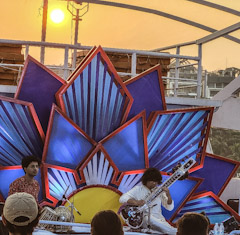
This December (2022) we happened to be in Panjim, Goa, during the Serendipity Arts Festival (‘SAF’).

At the SAF, each event is swarming with volunteers wearing orange jackets. Attendees are required to complete an online registration in addition to registering for many of the various events in the programme. The poorly trained, often ill-informed, volunteers are obsessed with checking visitors’ registration passes (on mobile phones). Yet, we discovered that many of the visitors to the exhibits and shows have neither bothered to register nor been stopped from entering the SAF venues.

Yesterday, having made an online booking for seats on what promised to be a pleasant musical cruise on the Mandovi River, we turned up at the embarkation point well in advance of the departure Time, only to discover that the bookings were irrelevant and it was ‘first come, first served’. Furthermore, despite the boat being full to capacity, so-called VIPs and the ubiquitous volunteers were permitted to come on board. By force of personality, we managed to board the crowded vessel. I am not sure that after the struggle to get on board that I derived much, if any, enjoyment from the cruise.

It appears to me that unlike what we have experienced at Cochin, Folkestone, and Venice, the arts festival at Panjim seems to be mainly for the benefit of the organisers and the numerous volunteers, rather than for the members of the public who have travelled all the way to Goa to experience it.

However, I wish to conclude this on a positive note. We were fortunate to have been shown around one of the exhibitions by its curator, who seemed very pleased that we had come to see her show.
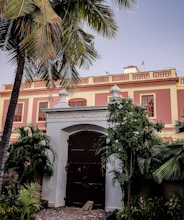
So near, yet so far

THE FLIGHT FROM BANGALORE to Chennai (Madras) is short: about forty minutes flying time. Some friends collected us from the airport in Chennai, and plied us with a tasty lunch. They recommended hiring an Uber taxi to ferry us from Chennai to Pondicherry (now ‘Puducherry’), a distance of about 100 miles. After three abortive attempts, a fourth driver pitched up and we set off for Pondicherry.

Our Uber driver was excellent and drove carefully. After just over two hour’s journey southwards along the luxuriant, verdant, well cultivated coastal plain, we reached a Pondicherry check post.

From 1674 until 1954, Pondicherry and its environs was a French colony. Occasionally, it was taken over by the British, but most of the time it was part of France. In 1954, a large majority of city elders voted in favour of ceding drom France. That year it became, and remain, an Indian Union Territory, independent of its hige neighbour Tamil Nadu. Old Pondicherry still contains many fine French colonial buildings and the policemen wear képis. Many of the road names are bilingual: Tamil and French. In addition, the town has no shortage of restaurants offering what is described as ‘French cuisine’. Although well populated with both Indian and foreign tourists, Pondicherry is a delightful place to relax and enjoy warm sea breezes.

To enter the Union Territory of Pondicherry, drivers of cars with registration plates from outside Pondicherry have to buy a permit to drive there. Our Uber driver’s car had Tamil Nadu plates. He stopped at the check post, which is about ten minutes drive from the heart of Pondicherry, and told us it would take about five minutes to get the permit. He gathered up his relevant documents and headed inside the checkpost. While we were waiting for our driver, we were parked next to an unpretentious stall serving Bengali food. It bore signs in three scripts: Bangla, English, and Tamil.

Instead of taking five minutes, we sat waiting for him for forty five minutes. This was because he had set out with one document missing. I sat waiting in the car thinking that without the entry permit, we were so near yet so far from our destination.

After some time and several telephone calls, our driver re-entered the checkpost, and emerged with the desired permit. He explained that he had bern sent a photo of the missing document by WhatsApp. This image of the document, rather than the original, satisfied those who issued the entry permit. We continued our journey. Just beyond the checkpost, I saw an obelisc, which looked old enough to have been put up by the French colonial authorities.

After settling into our accommodation, which I will describe at a later date, we took a pre-prandial stroll along the lovely seaside promenade. I was very pleased to discover that a place that had opened on the promenade a few months before our last visit to Pondicherry five years ago was still flourishing.

The Gelateria Montecatini Terme is a superb ice cream shop. It was set up just over five years ago by an Italian who has a business making luxury boats, anything from canoes to millionaires’ yachts. The gelateria is fully equipped with Italian equipment and refrigerated ice cream display counters. Stepping into this popular ice cream parlour in Pondicherry is just like stepping into a gelateria in Italy, and the ice cream is top class. The queues of customers attest that I am not alone in saying that.

The so-called ‘French food’ in Pondicherry is popular, but in no way matches up to the high standards often encountered in France. In contrast, the ice cream served at the Gelateria Montecatini Terme easily rivals the best in Italy. India never fails to be surprising!