
Wonderful India (as it was) in English, Bengali, and Urdu

IN A SECONDHAND BOOKSHOP in Thame (Oxfordshire) I purchased a book called “Wonderful India”. It must have been published by 1943 because inside its front cover there is the name of its first owner, LW Morris, and next to that he added “Royal Air Force, Calcutta, July 1943”. The book is trilingual. Its text is written in Bengali (Bangla), English, and Urdu. It was published by The Statesman and Times of India Book Department. The Statesman is a newspaper that was founded in 1818, and published simultaneously in Calcutta, New Delhi, Siliguri and Bhubaneswar. The Times of India was founded 20 years later. The gloriously illustrated book, which covers pre-Partition India, as well as Sri Lanka, Burma, and Nepal, contains no text in Hindi. In British India, the official languages were English and Standard Urdu, and later Standard Hindi (https://en.wikipedia.org/wiki/Languages_with_legal_status_in_India#History). Oddly, for many years Bengalis were opposed to using their language as an officially recognised one, for a long time preferring to use Persian for formal (especially commercial) use (https://thespace.ink/bengali-and-persian-in-british-raj/). Yet despite this, the book I found favours Bengali and omits Hindi. I suspect that  because the book might well have been published in Bengal, the Bengali script has been included. Hindi written in the Devanagari script only became the official language of India in September 1949, several years after “Wonderful India” was published.

Dhaka (now in Bangladesh)

The book covers all the regions of pre-Independence India as well as some of its neighbours. It is rich in black and white photographs, many of which are superb examples of photographic technique. Each picture is captioned in Bengali, English, and Urdu. The only pieces of prose are the general introduction (which includes a photograph of Mahatma Gandhi) and introductory paragraphs at the beginning of each section. The Urdu introduction is at the rear of the book, and is next to a picture of Jawaharlal Nehru. There is no picture of any member of the British Indian hierarchy.  

Bangalore, a place which I have visited often, is given only one sentence at the beginning of the section on Mysore and Coorg:

“The British retain some territory at Bangalore, which is the administrative headquarters of the state, while Mysore is the capital.”

There are three photographs of the city, Sadly, not the most interesting in the book.  To compensate for this, the book is filled with pictures of touristic sights and daily life of India as it was before WW2 had ended. The book provides a fascinating window on a part of the world that has in many aspects changed beyond recognition.
India’s history rediscovered?

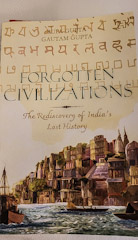
RUPA GUPTA AND Gautam Gupta have written a fascinating book with an intriguing title: “Forgotten Civilisations. The Rediscovery of India’s Lost History”. It describes 15 British men, who came to India during the British colonial era, which ended on the 15th of August 1947 and explored the Subcontinent’s early history.

The authors have written short biographies of these interesting men, highlighting the contributions they made to documenting India’s long history. The book seems to be making the case that before the arrival of these men, filled with a great enthusiasm for unearthing the past, India’s history prior to the Mughals had been largely forgotten.

Now, I am not qualified to comment on whether or not Indians had forgotten about their early ancestors, but wonder whether this history had really been lost before the arrival of the men described in the book. In many cases, these men were reliant on help from pandits who could read ancient scripts such as Sanskrit. Understanding these texts was the key to many of the ‘discoveries’ made by the subjects of the book. The existence of these texts suggests that long before the arrival of the British, early Indian history had been preserved, but maybe not as systematically as modern European historians would have preferred.

Despite my reservations about whether India had really lost or forgotten its ancient past, the book by the Guptas is fascinating (even though I have some reservations about its rather repetitive formulaic style).

Suggesting that a country had forgotten its own history might pander to readers who still harbour patronising or colonialist ideas about India. Although I have not yet seen this book on sale in British bookshops, I suspect it would might well appeal to readers, who seem to have forgotten that Britannia no longer rules the waves. I doubt that it was the Gupta’s intention that their interesting text might possibly appeal to readers who still believe that Britain is superior to other nations.

Bringing India to Queen Victoria in England

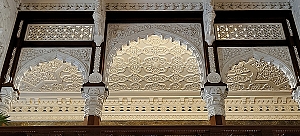
OSBORNE HOUSE ON the Isle of Wight was one of Queen Victoria’s favourite residences. Apart from one room within it, I was not overly impressed by the place. That room, which alone is a very good reason to visit Osborne, is the ornate Durbar Room. Entering this vast hall is like stepping inside an exuberantly decorated Maharajah’s palace somewhere in India. It is a superb example of the Indo-Saracenic style, which is according to one definition (on Wikipedia) was:

“… a revivalist architectural style mostly used by British architects in India in the later 19th century, especially in public and government buildings in the British Raj, and the palaces of rulers of the princely states. It drew stylistic and decorative elements from native Indo-Islamic architecture, especially Mughal architecture, which the British regarded as the classic Indian style, and, less often, from Hindu temple architecture.”

The Durbar Room was built not in India but in the country that ruled it at the time. It was designed not by a British architect but by a man from British India – Ram Singh (1858-1916), who was born in Rasulpur in the Punjab (now a village in Pakistan). His skills were recognised at a young age when he was seen working in a woodcarver’s shop in Amritsar. The man who spotted his talent was Rudyard Kipling’s father, the art teacher Lockwood Kipling (1837-1911). At the time, Lockwood was the first principal of the Mayo School of Industrial Arts, Lahore (established in 1875). He enrolled Ram as a student. Ram Singh was a successful student and soon became assistant drawing master at the school and Lockwood’s protégé. The two men collaborated in many important projects including designing Aitchison College in Lahore, the Mayo School in Lahore, and both the Indian Passage and ballroom at Bagshot Park (near Windsor). The work he had done in England led to him and Lockwood Kipling being given the commission to design the Durbar Room at Osborne.

The Durbar Room was designed to accommodate large ceremonial occasions and to reflect Queen Victoria’s exalted position as Empress of India, a role created by the British Parliament in 1876. This room, completed in 1891 as an extension of Osborne House, with its riotous array of mainly Mughal-style plasterwork decorations might have served yet another purpose. By the time it was completed, Victoria had never visited India, and at the age of over 70 years was unlikely to do so (and never did). In a way, the Durbar Room brought India to Victoria, and judging by its appearance, did so very well.