
Once a railway station in Kerala  but now a viewpoint for tourists

TOP STATION IS about 20 miles from Munnar (in Kerala) and 5500 feet above sea level.  Today, it is a popular tourist attraction, providing visitors with magnificent views of several ranges of hills. The place gets its name because it was the highest station on a railway that no longer exists.
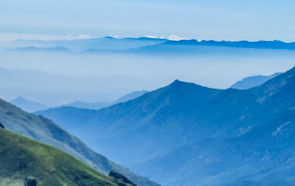
 

View from Top Station

Between 1902 and 1908, a monorail system used for transporting locally harvested tea was built to connect Munnar with Top Station. In 1908, this was replaced by a narrow-gauge railway  the Kundala Valley Railway. Tea was transported to Top Station, where it was loaded onto a ropeway that carried it down 3 miles to a village, Kottagudi, in Tamil Nadu.  From there, it was transported to other parts of India. Sadly, the railway was washed away during a severe flood in 1924, and was never replaced.


Top Station was not only important as a railway Terminus, but also as a place on a road that was improved by the British  in 1942, when it was feared that Chennai, which had been bombed, might be invaded by the Japanese.


Following the bombing, which caused little damage, people fled from Chennai, the wealthy to hill station,  and the less well-known off to villages and towns far from the east coast. Meanwhile,  the British built what became known as the Escape Road, which ran across the high mountains between Kodaikanal and Munnar. This 50 mile road linked roads from Madras with roads from Munnar to Kochi (Cochin), from where troops could leave India if necessary.


The Escape Road, which reaches 8140 feet was the highest road in India South of the Himalayas.  The road remained in use until 1990. After this date, it fell into disused because neither Tamil Nadu nor Kerala were prepared to pay for its upkeep.


As a result of the closing of the former Escape Road,  travellers between Munnar and Kodaikanal have to travel on other roads. The present road route is 105 miles instead of  50 miles taken by the disused road.

  Top Station is well worth visiting. The views from over the precipice are amazing. To see them, one needs to elbow aside the numerous people posing for photographs or taking ‘selfies’. Unfortunately,  the viewpoint itself is covered with litter left by tourists.
Moore than meets the eye

“HOW COULD YOU SPEND FIVE DAYS IN MOUNT ABU?”, someone asked me, adding that “one day is more than enough – you see the Jain temple, and that’s it”. How wrong this is. Even a fortnight would not be long enough to absorb all that Mount Abu (in Rajasthan) and its surroundings have to offer. I write this not because I was lucky enough to meet the amazing Dr Arun Sharma, but because even before we met him I had that idea.

Dr Sharma, a local medical practitioner, is an artist who expresses his ideas by composing music, painting canvases, as well as writing poetry and dramas. He is also a mine of information about the history of Mount Abu.

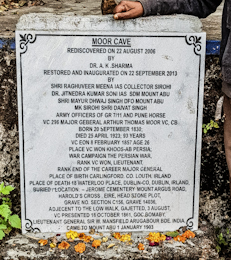
Major General Arthur Thomas Moore (1830 – 1913 or 1923) was a British officer in India. At the age of 26, and serving in the 3rd Bombay Light Cavalry, he was awarded a Victoria Cross for bravery at the Battle of Khushab in Persia.

Dr Sharma told us that for many years Moore’s whereabouts in India during a period of 3 or 4 years were completely unknown. After he resurfaced and returned to Europe, he died in his native land Ireland, where he is buried.

The regiment that Moore served has been renamed The Pune Horse, but nowadays it uses tanks instead of horses. Since 1947, it has been involved in over 60 skirmishes and battles and never been defeated. The members of the regiment believe that the spirit of the incredibly brave Moore is their guardian angel.

The regiment was delighted when in 2006, Dr Sharma accidentally stumbled on a cave near Sunset Point in Mount Abu. This cave had inscriptions carved in beautiful handwriting by Arthur Thomas Moore. These inscriptions include the date 1901, which was during the period that Moore had gone missing. What Moore was doing in this cave that Dr Sharma discovered we may never know, but at least we now know that Mount Abu was one of the places he visited during his period of disappearance.

Dr Sharma took us to see the cave, whose restoration he instigated, and proudly showed us the informative memorial plaque he created.

This cave and many more natural and man made historical sights and sites have convinced me that Mount Abu has more to see than most people realise.

I wish to thank Dr Sharma for opening my eyes to the exciting history of Mount Abu and its surroundings.