
Two boxers in a pub near London’s Leicester Square

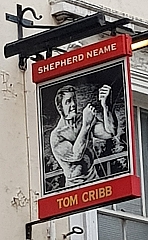
PANTON STREET RUNS between Leicester Square and Haymarket. The Tom Cribb pub, formerly known as the ‘Union Arms’, stands on the corner of Panton Street and Oxendon Street. The pub’s name commemorates a boxing champion Tom Cribb who lived from 1781 till 1848. A small plaque on the exterior of the pub commemorates another boxer, Bill Richmond (1763-1829).

Tom Cribb pub

Richmond was born into slavery at Richmondtown on Staten Island, New York. After witnessing Richmond’s fighting talent during a brawl at a tavern during the American War of Independence, a British commander arranged for his freedom, and took him to Yorkshire in England in 1777. There, he was educated and met his wife, Mary, while he was working as a cabinet maker. By 1795, Richmond and his family had moved to London, where he worked as an employee of Thomas Pitt, 2nd Baron Camelford (1775-1804), who happened to be a boxing enthusiast. According to Wikipedia:

On 23 January 1804, Pitt and Richmond attended a boxing match featuring experienced boxer George Maddox. After Maddox won the bout, Richmond spontaneously challenged Maddox to a fight, which Maddox accepted. When the fight took place, Maddox defeated Richmond in nine rounds.

Despite this, after Pitt died, Richmond took up professional boxing, and fought with many of the champions of the time, often winning these contests.

In 1805, after Richmond had defeated the Jewish champion Youssop and Jack Holmes ‘the coachman’, he challenged the great Tom Cribb, but lost. For many years Richmond and Cribb held grudges against each other. However, as the two men got older, they became friends. Often, they used to meet and converse in Cribb’s favourite pub, the Union Arms on Panton Street. It was in this pub on 28 December 1829 that Richmond spent the last evening of his life, relaxing with Tom Cribb. It is this that is recorded on the plaque outside the former Union Arms, now the Tom Cribb pub.
Richmond’s last night out was in a London pub…

IN “REGENCY BUCK” by the English novelist Georgette Heyer (1902-1974), we read in chapter II:

“Weighs something between thirteen and fourteen stone,” said Mr. Fitzjohn knowledgeably. “They say he loses his temper. You weren’t at the fight last year? No, of course you weren’t I was forgetting. Well, y’know it was bad, very bad. The crowd booed him. Don’t know why, for they don’t boo at Richmond and he’s a Black, too. I daresay it was just from everyone’s wanting Cribb to win. But it was not at all the thing, and made the Black think he had not been fairly treated, though that was all my eye and Betty Martin, of course. Cribb is the better man, best fighter I ever saw in my life.

This extract includes two names ‘Cribb’ and ‘Richmond’. Both were boxers of great renown: Tom Cribb (1781-1848) was an English world champion bare-knuckle boxer and Bill Richmond (1763-1829) was more than simply a boxer.

Richmond was an ex-slave born into slavery in Richmondtown on Staten Island, New York (USA). He was then a ‘possession’ of the Reverend Richard Charlton. Hugh Percy, 2nd Duke of Northumberland (1742-1817), an officer commanding British forces during the American War of Independence, saw Richmond involved in a fight with British soldiers in a tavern, and recognised the black man’s skill as a boxer. After arranging fights between young Richmond and other British soldiers, Percy bough Richmond his freedom and sent him to England, where he organised his education, and apprenticed him to a cabinet maker in Yorkshire. Richmond married in England and later moved to London, where, already in his forties, he began his largely successful and lucrative career in boxing.  He also owned a pub, The Horse and Dolphin, for a while. Today the Dutch pub in Soho, De Hems, stands on its site.

Soon Cribb was challenging and beating some of the best boxers of the time. However, in 1805, Richmond challenged Cribb, and lost. This led to bad relations between the two men, which lasted for years. Richmond met another former slave Tom Molineaux (1784-1818). Recognising his new acquaintance’s potential as a boxer, Richmond gave up boxing to train Molyneaux. After having narrowly lost two fights with Cribb, in 1810 and 1811, Molyneaux fired his trainer, Richmond.

After losing money on training and sponsoring Molyneaux, Richmond, by then aged 50, took to the boxing ring again. At this advanced age, he challenged and beat two younger champion boxers, Jack Davis and then Tom Shelton. After these two victories, he wanted to challenge Cribb again, but the latter had already retired. In 1820, Richmond founded a boxing academy for training amateur boxers. Amongst those he trained were two now famous literary figures: William Hazlitt and Lord Byron.

As he and Cribb aged, they became friends. It was in the pub that Cribb owned, The Union on Panton Street (near Leicester Square), that Richmond spent the last evening before his death. The Union still exists but is now named the Tom Cribb. A plaque on the outside of this hostelry commemorates Cribb’s achievements and another one records Richmond’s last night out, which was spent with his friend Tom Cribb.