
A sign on the pavement that points to a place that no longer exists

THE EAST SIDE of London’s Russell Square is lined by large hotels, one of which is the Imperial. On the pavement where Guilford Street enters the eastern side of Russell Square, there is some lettering, which reads:

“Turkish Baths”.

Beneath this is an arrow pointing southwards, and below that, the word:

“Arcade”.

Kimpton Fitzroy Hotel in the background

If you follow the arrow, you will pass the west facing side of the 20th century Imperial Hotel, but you will not neither an arcade nor any Turkish baths. You will pass a vehicle entrance to a courtyard within the hotel.  Being puzzled by this old, and it seemed redundant, writing on the pavement, I researched it on the Internet, and soon found out something about it (see for example: https://carolineld.blogspot.com/2012/11/turkish-baths-russell-square.html & www.londonremembers.com/sites/imperial-hotel-statues)

The current Imperial Hotel was built in the late 1960s on the site of an earlier hotel of the same name (built in 1898), which was demolished, rather than restored, in 1966. It was in this first Imperial Hotel that the Imperial Turkish Baths were located. These were demolished along with the hotel that contained them. However, some statues that used to decorate the highly ornate baths were rescued, and now surround the above-mentioned courtyard.

The lettering on the pavement is outside the entrance to a Pret A Manger café. This eatery stands on the site of the former Librairie International bookshop, which might well have been a place where Communist and Anarchist publications were sold. A web page that describes this shop (https://alondoninheritance.com/london-parks-and-gardens/russell-square-and-librairie-internationale/) revealed:

“I have found references to the Librairie Internationale selling copies of Karl Marx publications in the 1920s and in the 1930s as one of the bookshops in London where you could purchase pamphlets such as those produced by the London Freedom Group, whose paper “Freedom – A Journal of Libertarian Thought, Work And Literature” included the address of the Librairie Internationale in Russell Square as one of the London bookshops and newsagents where Freedom could be purchased.”

I had never heard of this bookshop or the Turkish Baths at the Imperial Hotel, and would not have known about either of them had I not noticed the lettering in the pavement. I spotted this after having met a person, whom I had not seen since 1968, when we were both pupils at north London’s Highgate School. We had just met for coffee at a café within the Kimpton Fitzroy Hotel, which was built as The Russell Hotel and opened in 1900. Unlike its neighbour The Imperial, it was not demolished and replaced by something newer. The old Imperial would have been built in the same flamboyant style. Having noticed my interest in signs, my friend from schooldays pointed out another sign on the north side of the Kimpton Fitzroy. It commemorates the fact that a house where the suffragette Emmeline Pankhurst (1858-1928) lived with her daughters (Christabel and Sylvia) between 1888 and 1893. The house was demolished – possibly to make way for the construction of the hotel, which began in 1898.

Everything I have described above lies within a stretch of road less than 200 yards in length. And I have said almost nothing about the historic Russell Hotel that lies along this stretch. This and many other parts of London are so rich in history, which is one of many reasons that I am happy to be a resident of the city.
Taking the plunge at the former YWCA in London’s Bloomsbury

MY MOTHER WAS ANXIOUS about water. Because I do not think that she could swim, I believe that she considered it very important that I should learn how to propel myself through water. As a result, my parents paid for me to have many private swimming lessons (usually on Saturday mornings) – most of them were a waste of their hard-earned money. I was a slow learner because I was frightened by the thought that I might sink and drown.

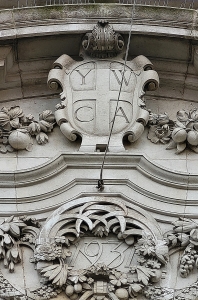
Today (the 4th of March 2024), we were walking from Tottenham Court Road Underground station to the British Museum via Great Russell Street. Along that thoroughfare, we passed a pre-WW2 brick building, which now houses the luxurious Bloomsbury Hotel. If you look above its main entrance, you can see carved stone masonry that indicates that the building, completed in 1933, was once a branch of the YWCA – it was The YWCA Central Club. The architect was Sir Edwin Lutyens of Hampstead Garden Suburb and New Delhi fame. It remained a YWCA until the 1970s, then became a hostel, and now it has been converted into its present reincarnation. While the building served as the YWCA it had a swimming pool in its basement. It was in this pool that I finally learned to swim – I was about 12 years old.

The Saturday morning classes were conducted by a Mr Brickett. Each of his pupils began by buying a set of his inflatable arm bands, which were worn on the upper halves of the student’s arms. Each lesson, Mr Brickett inflated the arm bands, and using these, we swam (or made our way) across the width of the pool – without letting our feet touch the bottom. On each successive lesson, Mr Brickett inflated the armbands less than on the previous lesson. Eventually, we were making our way across the pool with uninflated armbands. When we could do this, we had to swim one width (about 10 yards) without the armbands, and then we were given a fancy certificate with a Union Jack printed on it.

I have only just learned that Mr Brickett, who taught me how to swim, was Reg Brickett, who, along with his brother Sidney, was a founder member and then President of the Swimming Teachers Association of Great Britain. Reg was the inventor of the arm bands, which were sold as ‘Brickett’s Swim Easy arm floats’ (www.playingpasts.co.uk/articles/swimming/the-valuable-and-unremitting-services-of-swimming-coach-walter-brickett/). Reg and his brother were sons of the famous British Olympic swimming coach Walter Septimus Brickett (1865-1933). He was responsible for training over 100 British swimming champions. Well, I did not know any of this when I was awarded my (now sadly lost) certificate.

We entered the attractive lobby of the Bloomsbury to ask about the pool. The pool is no longer in use, but still exists. It has been covered by a floor, and the room that housed it has been redecorated, and is now used to host functions and meetings. Although I swim extremely rarely, I do not think that I will ever forget my lessons with Mr Brickett at what was once the YWCA.

Three Indian men in London’s Bloomsbury

MAHATMA GANDHI IS commemorated by a statue in Tavistock Square in London’s Bloomsbury. He is probably the most famous of three Indians with statues in Bloomsbury. Crafted by the sculptor Fredda Brilliant and presented by the Indian High Commission, it was unveiled by Prime Minister Harold Wilson in 1967.

The next most famous Indian represented by a sculpture in Bloomsbury is a Nobel Prize winner, the celebrated writer and polymath from Kolkata (Calcutta), Rabimdranath Tagore (1861-1941). The memorial depicts Tagore’s head. It was created by the sculptor Shenda Armery, and unveiled by the Prince of Wales, now King Charles III, on Tagore’s 150th birth anniversary year in July 2011. The bust stands in Gordon Square, close to University College London, where Tagore studied law briefly. His face looks away from the college towards the southeast. – towards India, his homeland. On one side of the plinth, there are some words written in Bengali script. On another side, there is a translation of this brief text (by Tagore) in English:
“Thou hast made me endless, such is thy pleasure. This frail vessel thou emptiest again and again, and fillest it ever with fresher life. This little flute of a reed thou hast carried over hills and dales and hast breathed through it melodies eternally new. At the immortal touch of thy hands my little heart loses its limits in a great joy and gives birth to utterance ineffable. Thy infinite gifts come to me only on these very small hands of mine. Ages pass and still thou pourest and still there is room to fill.”
This is from Tagore’s collection of poems – “Gitanjali”, translated into English from Bengali by the author in 1913. It was this collection that led to Tagore being awarded the Nobel Prize for Literature in 1913. In 1915, King George V awarded him a knighthood, but following the Jallianwala Bagh massacre of 1919, he renounced his knighthood to express his horror at the murders that had been perpetrated on innocent Indians by British troops in the Punjab.

Thiruvalluvar

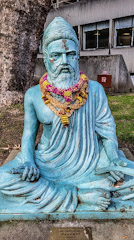
Call me ignorant but I had never heard of Thiruvalluvar, whose bust stands in a garden next to the School of Oriental and African Studies in Bloomsbury. According to a plaque next to the bust, this man was author of “Thirukkural”, which was a classic of Tamil philosophy and ethics. The bust was donated by the Governent of Tamil Nadu in 1996, and unveiled by the then Indian High Commissioner Dr ML Singhvi. Celebrated as he is in Tamil Nadu, little is known about his life. It is possible that he was born or lived in Mylapore (now a district of Chennai) in the south of India. According to Wikipedia:
“His work Tirukkuṟaḷ has been dated variously from 300 BCE to about the sixth century CE.”
As for his great work “Thirukkural”, the online version of Encyclopaedia Britannica remarked:
“…Tirukkural (“Sacred Couplets”), considered a masterpiece of human thought, compared in India and abroad to the Bible, John Milton’s Paradise Lost, and the works of Plato.”

I have described monuments to three notable men from India, but omitted one woman, whose memorial is close to those already described. The WW2 heroine Noor Inayat Khan (1914-1944) is commemorated by a bust, which, surprisingly, I have never noticed, in Gordon Square. Sculpted by Karen Newman, it was placed in the square in 2012. This artist also sculpted a bust of Violette Szabo (1921-1945), which is on the embankment of the Thames near Lambeth Palace. Both Noor and Violette worked for the British SOE, and perished in Nazi concentration camps.
Once the epicentre of the British Empire, it is not at all surprising that one comes across memorials to notable Indians whilst wandering about in London and other places in the UK.

A Marian mix-up and Mother Teresa

IN THE MID 1970s, I attended a series of evening lectures given by the art historian Ernst Gombrich. They were held in the Mary Ward Centre in London’s Bloomsbury.

Sign post at Loreto House School

In January 2023, we visited Sister Marilla, who works for Loreto House School and College in Middleton Row in the heart of Kolkata. My wife attended the school for several years in the 1960s. The two educational establishments are part of a larger organisation, the Loreto branch of the Institute of the Blessed Virgin Mary (‘IBVM’). When Sister Marilla told us that the IBVM was founded by Mary Ward (1585-1645), I immediately thought of the Mary Ward Centre in London, and was a bit surprised because I had always assumed that the Centre was named after a 19th century woman.

My assumption was correct. The Centre is named after the novelist Mary Augusta Ward (1851 – 1920), not the Mary Ward, founder of the IBVM.

The earlier Mary Ward (b 1585) was born in Yorkshire – Roman Catholic during the time that Roman Catholicism was outlawed in England. She felt the need to take up holy orders and instead of becoming yet another Catholic martyr, she wanted to do something worthwhile and practical. She went to Flanders where she joined the Poor Clares in St Omer.

To cut a long story short, she became, to oversimplify a lot, a female version of a Jesuit, but not a member of the Jesuit Order. After leaving St Omer, she founded the Poor Clare House for English women at Gravelines. There, and later elsewhere, she taught women about the Roman Catholic faith. In about 1609, she returned to England, where she gathered women to teach girls about the banned faith. Mary Ward suffered many hardships, including imprisonment in Germany, before succumbing to ill health in England

Leaping ahead in time, this group founded by Mary Ward, which had to surmount much criticism from the Jesuits and members of the Roman Catholic hierarchy, was the seed that germinated to become the officially recognised IBVM in 1877.

Followers of the group she had founded in 1609, established the Bar Convent in York in 1686. It was from here in 1821 that the IBVM Loreto branch was founded in Dublin by Teresa Frances Ball.

On the 12th of October 1928, 18 year old Albanian Agnes Gonxha from Skopje (now in North Macedonia) joined the IBVM at their Loreto Abbey at Rathfarnham in Ireland. She left Ireland on the 1st of December 1928, and landed at Kolkata on the 6th of January 1929. From there she travelled to Darjeeling, where on the 24th of May 1931, as a novice, she made her First Profession in Darjeeling’s Cathedral of the Immaculate Conception. In this church she made her Final Profession on the 24th of May 1937.

Next, Agnes was sent to the Loreto Convent at Entally in Kolkata. At first, she taught catechism and geography at Loreto St Mary’s Bengali School, which was on the campus of the convent. Eventually, she became the school’s headmistress.

On the 10th of September 1946, whilst travelling to a retreat in Darjeeling, she decided that her true calling was to work with the poor in the slums of Kolkata. By that time, she was known not as Agnes Gonxha but as the now much more familiar Mother Teresa. The order she founded, The Missionaries of Charity, maintained a warm relationship between it and the IBVM. Internationally famous, she died in 1997.

Had it not been for our visit to Sister Marilla and the informative booklets she gave us, it might have been a long time before I discovered the two Mary Wards and the connection that one of them had with both my wife’s school and Mother Teresa.