A bird with two heads in London’s Earls Court

COLEHERNE COURT IS a large block of flats located on the corner of Old Brompton Road and Redcliffe Gardens. The late Princess Diana lived there before she married Prince Charles. At the corner of the building there is an entrance surmounted by a carving of a bird with two heads each on a long neck.

A map surveyed in 1916 indicates that there was a bank at this corner, The two headed bird was probably above its entrance. The only British bank I know of that uses the double-headed eagle as its symbol is Hoare’s Bank. There may have been others, but I do not know about them.

If anybody knows any more about the double-headed bird on the corner of Coleherne Court, do please let me know.

Does it matter which cricket team you support?

IN 1960, THE CONSERVATIVE politician Norman Tebbit devised what has become known as ‘the cricket test’ to ascertain how well immigrants had become integrated into the life of the United Kingdom and how loyal they had become to their adopted home. It related to which team they supported when the team from their country of origin was playing test cricket against a British team. He suggested that those immigrants who support their native country’s cricket team rather than England’s  are not significantly integrated into the United Kingdom

My father was an immigrant. He was born, brought up, and educated in South Africa. He took a keen interest in professional sport, when it was presented on the radio (we did not have a television at home). I remember seeing him sitting at his desk in his study working with the radio on in the background. He delighted in listening to radio commentaries of cricket and tennis matches. I am not sure whether he was able to visualise the games in his mind, or whether he was only interested in the scores, or both. When, after apartheid was ended in South Africa, and the South African cricketers were once again playing the English team, he was asked which of them he hoped would win. He said:

“It does not matter to me,” he replied, “I support both of them.”

I wonder whether this counted as a pass or fail in Tebbit’s cricket test?

A sculpture in Central London that needs some care and attention

AT THE NORTHEAST corner of London’s Lincoln’s Inn Fields, there is a tall (15 feet high), wavelike, metal art work. I am undecided whether this sculpture by Barry Flanagan (1941-2009), who began studying at St Martins School of Art shortly before my mother stooped sculpting there, is a flattering addition to the historic Lincoln’s Inn Fields. Called “Camdonian” and constructed with a kind of steel, it was created in 1980.

It was restored in 2022, but now (April 2025), it is covered with graffiti and dirt including bird droppings. It needs to be cleaned up. As a sculpture, it appeals to me, but I do not feel that it enhances the locality where it is placed. Although it is large, it looks a bit lost where it is.

The church that became a boat in northwest London

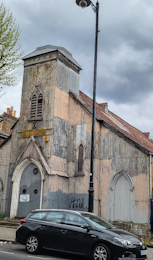
EVER SINCE THE early 1960s, I have travelled along Cambridge Avenue, which runs between Edgware Road and Kilburn Park Underground Station. I have always been in a car or bus. So, whenever I have passed what I am about to describe, I have never stopped to look at it carefully.  Yesterday (14 April 2025), we stopped outside it to change buses.


What I am referring to is an edifice made from sheets of corrugated iron, which looks like a Victorian gothic church. It looks slightly shapbby. Notices attached to it inform passers-by that it is a meeting place of the Sea Cadet Corps and it is now the ‘TS Bicester’, ‘TS’ standing for ‘Training Ship’. Known as the Tin Tabernacle, its history has been related on several websites including http://tintabernaclekilburn.org/history/ and https://englishbuildings.blogspot.com/2013/04/cambridge-avenue-london.html .


The church was erected as a temporary structure in 1863, when Kilburn was on the edge of the countryside. According to the Tabernacle’s own website, a local developer called James Bailey:

“… granted a lease to Rev. Woodhouse and the Trustees of Cambridge Road Chapel to build an iron church for Church of England worship at a cost of £1000. The agreement was to build a stone church or a row of 3 terraced houses by Michaelmas 1868. The church paid a yearly rent of £32.”

That deadline has long passed, and the tin church is still standing. The galvanised corrugated iron covers a timber and iron frame, and iron columns support the roof.


1863, the Tin Tabernacle was constructed and was initially called St James Church. It was probably intended to be a stop-gap church to be used while the nearby St Augustine’s Church was being built (it was completed in 1870). In 1948, the tin church, which was then known as ‘Cambridge Hall’, was assigned to the Willesden Sea Cadets for use as a social centre and training centre. In 1956, the HMS Bicester was scrapped. Between 1956 and the 1960s, the church was fitted out to reproduce the scrapped HMS Bicester, and the place was renamed TS Bicester. Sometime between 1960 and 1980, the church lost its spire. In 1998, the building was listed as Grade II, which gives it some protection against being demolished.


The Sea Cadets ceased using the church in 2011. Its naval interior has been preserved, and now the church is used occasionally for community and other events. Although I have seen its exterior, I would love to see inside this unusual edifice.

Do not throw it away because it might become valuable one day

AFTER MY DAD’S father died, his mother remarried Isaac, a merchant, who lived and worked in Port Elizabeth (South Africa).

In his holidays, both school and then later university, Dad, whose father had owned a general store (in Tulbagh, South Africa), helped his stepfather in his shop in Port Elizabeth. Once again, he was in an environment where he was acquiring first-hand experience of the workings of commerce, one of the foundations on which the study of economics is based. By all accounts, including the fact that Isaac could afford regular holidays in Europe, the business prospered. Dad told me that during his vacations, he used to help Isaac compile annual inventories of his stock.

The shop owned by my father’s father in Tulbagh

One day, Dad came across many large glass bottles filled with boiled sweets that had become unsaleable because the candies had fused together to form huge masses. My father asked Isaac whether these bottles should be thrown out. He was told that they were to be retained. A few years later, WW2 broke out and there was a shortage of glass. Isaac sold the bottles filled with inedible sweets because the glass, now valuable, could be sold (for recycling) during the glass ‘famine’.

Was it experiences in his father’s and stepfather’s shops that might have led him to eventually become a professor of economics, and helped him to understand the concept of futures markets? I wonder.

Boulders lodged in trees at a park in London

WHEN WALKING IN Kensington Gardens March 2025, I spotted three trees planted in an open space outside the Serpentine South art gallery on the west side of Kensington Gardens. Taller than many of the trees around them, they had not been there when I visited the area in November 2024. Without foliage and with few branches, they seemed dead when compared with the trees growing near them. We revisited these unusual trees today (13 April 2025), and they looked wonderful in the morning sunshine.

It does not take long to see that these trees have unusual features. Two of them have unwieldy granite boulders lodged in their branches. The third tree looks as if it has been split open by, for example. a lightning strike. Parts of the wood of this tree have been painted gold. Though in some respects these three tall objects look like trees, one realises quickly that they are not trees but artworks.

Created by the Italian artist Giuseppe Penone (born 1947), they are part of an exhibition of his works, most of which are housed within the Serpentine South Gallery. Penone was a leading artist in an Italian artistic movement known as ‘Arte Povera’, which focussed on exploiting the simplicity of natural materials with artistic techniques. According to the Serpentine’s website, Penone said of his exhibition:

All of my work is a trial to express my adherence and belonging to nature, and it is with this thought that I have chosen the works for the exhibition. The two paths that I have created—inside the gallery and outside of it, in the park—become two integrated gardens.”

The three tree-like sculptures both impressed and intrigued me. I have yet to see the works inside the gallery, but there is still plenty of time to view them as the exhibition continues until 7 September 2025.

Washing the dishes as a kind of therapy

SEEING A PILE of unwashed pots and other cooking utensils reminded me of my father, who died aged 101 in 2020. A couple of years ago, I began writing my memories of him as a father, but have never completed the work. However, here is an excerpt that relates to my father and the kitchen sink:

Many people who knew my father would not have associated him with household chores. And that would be largely correct. My mother was more involved than Dad with the practical running of the household. However, there were a few things that he did on a regular basis. One of these was washing the dishes after a meal.

Dad had a rather puritanical attitude to work. Often, I felt that he considered it to be unworthy to stop working to relax, yet he did, but sometimes in an unusual way. He liked standing at the kitchen sink doing the washing of dishes, cutlery, and cooking utensils. By doing this, he was relaxing by being away from his desk, but he was not wasting time by doing nothing. He felt that he was achieving something useful whilst at the same time he was relaxing or just thinking about his academic work. When we bought our first dishwashing machine in the 1960s, I felt that Dad regretted it, because this machine had reduced the amount of time he could pass standing at the kitchen sink. Because my mother refused to put pots and pans and cooking knives in our machine, he was not entirely deprived of his time at the sink.

Having shared this with you, I will now head for our kitchen sink, and tackle the task that confronts me.