When religious art was frowned upon

WE OFTEN VISIT the Tate Britain art gallery on London’s Millbank, usually to see special temporary exhibitions. Rarely, if ever, do we spend time looking at the Tate’s permanent collection. However, today, the 6th of July 2023, we met some friends who wanted to see the recently re-hung paintings in the permanent collection. The paintings are arranged in rooms in chronological order. Each artwork has an interestingly informative label, which describes the social conditions of the era in which it was created and other points about it.
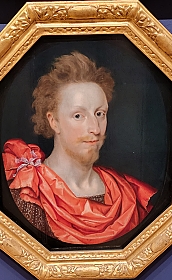
The first room of the series of galleries is dedicated to works created just before, during, and after the (Protestant) Reformation in 16th century England. I found it to be most interesting.  The radical rejection of Roman Catholic religious practices involved, amongst many other things, a profound disapproval of the artistic portrayal of religious subjects. A consequence of this was that artists switched from painting religious scenes to portraiture. Just as people love being portrayed in photographs today, those who could afford it in the 16th century were pleased to have themselves immortalised in well-executed paintings. What I had never realised before was that the Reformation unwittingly gave birth to the long tradition of British portrait painting. Maybe, most people know this already, but it was news to me.

The gallery dedicated to the Reformation era has many fine portraits, by artists both known and unknown. However, one of the paintings hanging amongst the portraits is a religious scene, “An Allegory of Man”, by an unknown artist. Painted in about 1596, it would have been a highly controversial subject given the Protestant aesthetics prevailing at that time.

Although the temporary exhibitions at the Tate Britain are usually well worth viewing, the permanent collection deserves many a visit, as we discovered today.
A battle and a window in Essex

IN THE YEAR 991 AD, the Anglo-Saxons fought a battle with Viking invaders in Maldon (Essex). The Vikings, who often raided for looting and plundering rather than conquest, won. Rather than continue to struggle with the Vikings, the Anglo-Saxon king Æthelred the Unready was advised by the Archbishop of Canterbury to pay them off. He paid the Vikings an enormous sum of money, which satisfied them.

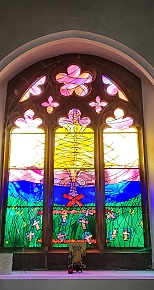
Recently, we visited the church of St Mary the Virgin in Maldon. It stands on a small hill that overlooks the mudflats and rivulets of the Chelmer River where the battle was fought. In its north wall there is a striking, colourful modern stained-glass window. Designed by Mark Angus, it was installed in 1991to commemorate the 1000th anniversary of the Battle of Maldon. It is a great addition to an otherwise unremarkable church.

The first and only Queen of Haiti

UNTIL FEBRUARY 2022, only very few people with specialised knowledge of history would have been able to point out the house in which Marie-Louise Christophe lived in London between 1821 and 1824. Now, there is a plaque on the house in Marylebone’s Welbeck Street that marks the house in which she resided. And by now, you might well be wondering why anyone might want to know.

Marie-Louise (1778-1851) was born into a free black family, which ran a hotel, in St Dominique (which is now Haiti). In 1793, she married Henri Christophe (1767-1820), who had been one of her father’s slaves before he had earned enough in tips to purchase his freedom. After several years of revolution, in which Henri Christophe was an important freedom fighter, Haiti gained independence from France in 1804. In 1811, Henri was crowned the King of Haiti and the following year, Marie-Louise was given the title of Queen of Haiti. After the death of her husband in 1820 and the assassination of her two sons, she fled from Haiti along with her daughters. Their escape was assisted by the British, and they settled first in Blackheath, where they were hosted by the Anti-Slavery activist (abolitionist) Thomas Clarkson. After several changes of address, the Queen and her daughters settled in number 49 Welbeck Street.

According to the British press of the time, she and her daughters were popular with British people in all the social echelons. In 1824, they left London for Europe. Marie-Louise died in Rome, where she is buried. She never returned to Haiti. It was only in February 2022 that the Nubian Jak Community Trust were able to put up the commemorative plaque which you can see on number 49 Welbeck Street. It correctly describes Marie-Louise as “First and Only Queen of Haiti.”

A gift of William the Conqueror

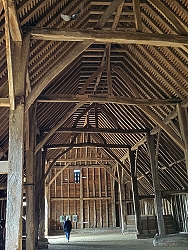
IF WE HAD NOT MISSED a turning at a road junction in Essex, we might never have visited Prior Hall Barn (near Widdington). Maintained by English Heritage, this well-preserved, huge timber-framed, wood-cladded 15th century barn. Constructed entirely of timber – without any metal, it has been estimated that its 900 pieces of timber were derived from 400 trees. Some metal structural elements have been added since the barn’s original construction, which judging by the date of the timbers commenced no later than about 1472. It remained in use as a barn until 1976.

A mediaeval barn such as this one is fascinating enough. However, the land on which it stands has a most interesting history. Just before William the Conqueror set sail for England, he assembled his fleet in the river port of Saint-Valery-sur-Somme. It is believed that he was made welcome in the town’s priory. As a gift of thanksgiving for his successful conquest of England in 1066, he gave the farm on which the barn stands to the priory in St Valery.

In the 14th century, lands owned in England by foreign owners became a drain on the economy, and properties such as the village of Widdington were confiscated by King Edward III. In 1377, the land where the barn and village stand were given to William of Wykeham, the Bishop of Winchester. In 1379, Wykeham founded New College Oxford and endowed it the farm, The college owned the farm from 1379 until 1920, when a local farmer purchased the freehold. It was resold in 1950, and in 1976 its owner, Mr Jeremy Dillon-Robinson placed the barn into the care of the Department of the Environment. Now, it is cared for by English Heritage.

Although I have no idea whether William the Conqueror ever set foot in Widdington, the place’s connection with St-Valery-sur-Somme adds to the excitement of seeing this historic barn. Had we stuck to the ‘beaten track’, we might well never have even heard of the barn, let alone the land’s interesting ownership history.

Survivors in Suffolk

IN 1975 I WENT to the town of Prizren in Kosovo, which was then part of the former Yugoslavia. I visited an old church in the town. Once, its internal walls had been covered with frescos. However, they had been badly defaced up to a certain height above ground level. Above that height and on the ceiling, they were intact. When the Ottoman soldiers arrived in Prizren, they used their spears to destroy the frescos, but only did so as far as they could reach. Being lazy, they did not use ladders to reach the higher parts of the church. So, the frescos beyond their reach survived.

In England, both the Dissolution of the Catholic religious establishments by Henry VIII, and later the defacement of churches by Oliver Cromwell and his followers, resulted in the destruction of many fine works of religious art. During a recent visit to Suffolk, we saw a few fine artefacts, which like the frescos in Prizren, have survived.

Bardwell

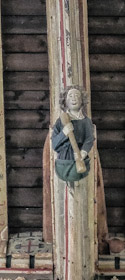
In accordance with Cromwell’s decree, many of the 15th century carved wooden angels that overlooked the nave of the parish church in Bardwell were destroyed. But, a few were left intact. Why was that? Did the workmen lose interest, or were they not paid enough? Who can say? And why was some of the 14th century stained glass left intact? Again, nobody can remember.

Over in the sleepy little town of Eye, the Parish Church contains a wooden rood screen containing beautifully painted panels that should surely have been destroyed by Cromwell’s iconoclastic vandals. Were they covered up with, say, wood panelling before the wreckers arrived, or were they removed and hidden? Luckily for us, these wonderful mediaeval paintings have survived.

Near Eye, there is a tiny church with a thatched roof in the village of Thornham Parva. It contains a rectangular wooden frame containing several mediaeval paintings that were created the 14th century. It was once the retable of an altar. Most likely, it was originally part of an altar in the Dominican Thetford Priory, which was dissolved during the reign of Henry VIII.

It is most probable that when the priory was dissolved, the retable was rescued by a Catholic family who put it in their private chapel. It passed through two other families before it was donated to the church at Thornham Parva in 1927. It is a rare surviving example of 14th century British religious painting. Interestingly, there is another series of painted panels in the Musée Cluny in Paris that resembles the Thornham Parva retable. Comparison of detailed aspects of these two sets of paintings suggests that they were both painted by the same team of artists, and were originally designed for the same location – most probably Thetford Priory.

In the space of three hours, we visited the churches at Bardwell, Eye, and Thornham Parva. All three contain artefacts of great interest and beauty which survived the religious upheavals orchestrated by Henry VIII and later by Cromwell. Once again, touring around in England has opened our eyes to its treasure house of history.

Asteroid at Genesis

AFTER WATCHING THE trailer for Wes Anderson’s latest film “Asteroid City”, which was released in the UK in June 2023, I could barely wait to see the movie. We chose to view it in a cinema that I had passed several times in the past, but never entered – Genesis in London’s Mile End Road, not far from Stepney Green Underground station. It has an Art Deco façade and a long history (described in full on https://genesiscinema.co.uk/GenesisCinema.dll/Page?p=3&m=mm).

In brief, the site occupied by Genesis was first the location of a pub called Lusby’s, which opened in 1848 and later became a music hall. After it was destroyed by fire, the Paragon Theatre, designed by Frank Matcham (1854-1920), opened in 1885. Matcham was responsible for the design of many of London’s theatres. Between 1912 and 1989, the theatre was used as a cinema, and had many different owners. It closed in 1989. The cinema’s website includes the following episode which occurred in 1963:

“Princess Margeret was scheduled to attend the royal premiere of Barbara Windsor’s film ‘Sparrows Can’t Sing’. However, as notorious East End gangsters, The Kray twins were also attending, royal protocol meant that her husband Lord Snowdon had to attend in her place. So, needless to say, everyone ended up at the afterparty at the pub over the road… the Kray twins’ Kit Kat Club.”

In 1998, Tyrone Walker-Hebborn, an electrician, fell in love with the deserted cinema, refurbished it, and opened it as the Genesis Cinema in 1999. Having seen multiplex cinemas in the USA, he converted Genesis into a multi-screen cinema complex. During the covid19 pandemic, Tyrone took advantage of the fact that nobody could enter his cinemas, and refurbished many aspects of the building including the foyer and bar. Today, Genesis is a pleasant place both to enjoy a drink and to watch a film – and the ticket prices are reasonable by London standards.

As for “Asteroid City”, which has received many rave reviews, I was disappointed. Although the film has many wonderful moments, I did not think it was as wonderful as Anderson’s films such as “Darjeeling Express” and “Grand Hotel Budapest”. On a positive note, the Genesis cinema complex is a place I hope to visit often.

Once it was a hospital, now it is a bar

I STUDIED AT University College London (‘UCL’) between 1970 and 1982. I was not there for so long because I kept failing examinations. Instead, I was a student there while I completed three different degree courses. Today (and during the years I attended UCL), the Students Union building is still located in a not particularly attractive building on the southwest corner of Gower Place and Gordon Street. Whereas it was a popular haunt of many of my fellow students, I hardly ever entered it except for a very brief period in the mid-1970s, when I was a PhD student in the Physiology Department.

During that short period, an Italian man opened a small restaurant on one of the floors of the Union building. His menu was limited to beautifully prepared beefsteaks that were accompanied by salad. This wonderful steak was priced no more than the often mediocre (or sometimes even poor) food that was available in the various subsidised student canteens in UCL. The reason for the Italian’s low priced, superb fare became obvious when after a few weeks, his eatery closed – or was closed. It turned out  (so I was led to believe) that he was using the Union’s premises, but not paying the rent that he owed.

Winding the clock forward to the 26th of June 2023, we walked past the Union building, and I noticed something that I had never seen before. The building has a commemorative plaque that reads:

“This building housed the London School of Tropical Medicine and the Hospital for Tropical Diseases. 1920-1939.”

The plaque was placed by the Seamen’s Hospital Society, based in Greenwich. I do not know when the memorial was affixed to the Union, but I feel sure that it was not there when I was a student. It is interesting that what was once a hospital has become a centre for hospitality.