
St Cuthbert’s extraordinary lectern in London’s Earls Court

HIDDEN IN A residential crescent, Philbeach Gardens, near Earls Court is a late Victorian church, whose exterior is far from attractive. However, St Cuthbert (completed 1888) has an interior which cannot fail to amaze the visitor’s eyes. The church contains what can only be described as an ‘over-the top’ array of decorative features. Some of them are typical of the Gothic Revival style beloved of Victorian church designers, and others that are typical of the Arts and Crafts Movement, which flourished in the last decades of the 19th and the first few of the 20th century.

One item in the church, which is particularly eye-catching, is made of wrought iron and hammered (repoussé) copper. It is a lectern with two large arms on either side of the leather-covered book holder. These are supports for large candles. The lectern is approached by a small set of stairs whose treads have studs on them. The studs are arranged to spell out words, which I found difficult to decipher. The part of the base facing the congregation is an intricately decorated folded screen with Arts and Crafts Style decorative motifs. Most probably handmade, the lectern, although fantastically crafted, has a very slightly amateurish look about it. It is more unusual and eye-catching than beautiful.

I would not have visited St Cuthbert had my friend, the excellent Olsi Qinami, not been conducting the London City Philharmonic Orchestra performing a concert there. The church with its colourful marble pillars and almost surreal interior is well worth a visit even if there is no concert being performed. It is a ‘must-see’ for lovers of Victorian church architecture.

A ladder by the sea

GENESIS CHAPTER 28 describes a dream experienced by the biblical Jacob. In it, he dreamt that there was a ladder set on the earth that reached up to heaven. In his dream, he watched angels of God ascending and descending what is now called ‘Jacob’s Ladder’.

The small town of Sidmouth on the coast of Devon has its own Jacob’s Ladder. Unlike the one seen in the dream, it neither reaches heaven nor is it being used by angels. Often rebuilt, Sidmouth’s Jacob’s Ladder is made of wood and consists of three flights of stairs which connect Connaught Gardens with the magnificent stretch of sandy beach (at the western end of Sidmouth). This lovely, gently curving strand, known as Jacob’s Ladder Beach, is flanked by red stone cliffs and is about a mile in length. The views from the top of the Ladder and the café in the Connaught Gardens are spectacularly beautiful.

The Ladder was first constructed in 1853 on the instruction of Mr Lousada of nearby Peak House. It was rebuilt in the late 19th century, and then again following WW2. The Connaught Gardens on the clifftop overlooking the beach were first laid out in 1934 by the Gardens Department of Dartington Hall Ltd.

It is unusual features such as Sidmouth’s Jacob Ladder that give many British seaside towns great character and individuality, and makes them fun to visit.

A post office in a church

WEST HAMPSTEAD, FORMERLY known as ‘West End’ in the time, before the 20th century, that Hampstead was a small town separated from London. Now, yet another of London’s numerous suburbs, West Hampstead has several churches as well as a synagogue. One of these places of worship, St James Church, is worth entering because it is not what it seems from its external appearance.

The large Parish Church of St James, built mainly with red bricks, was erected in about 1887 (www.lwmfhs.org.uk/parishes/6-middlesex/28-hampstead). It was designed by Sir Arthur William Blomfield (1829-1899), the fourth son of CJ Blomfield, Anglican Bishop of London between 1828 and 1856, who encouraged much new church building during the 19th century. This large church could seat 1000 people (www.british-history.ac.uk/vch/middx/vol9/pp145-152#h3-0007) and has some fine 19th century stained-glass windows.

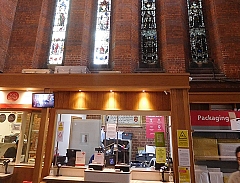
On entering the church through its electrically operated glass sliding doors, you will be surprised by what you find beneath its fine hammer beam timber ceiling. The west end of the nave is occupied by a post office, the first main-branch of a UK post office ever to be housed within a church. The north aisle of the church contains a children’s ‘soft play’ area, appropriately named ‘Hullabaloo’. The floor of the nave is filled with tables and chairs occupied by people of all ages, some enjoying refreshments from the church’s Sanctuary Café. All these things that you would not normally expect to find inside a church are part of The Sherriff Centre, a community organisation that began operating in 2014 (https://thesherriffcentre.co.uk/). The Centre’s activities also include a stationery store, a free food bank, live music as well as other events, free wi-fi, debt advice, and more.

Jesus is said to have thrown the moneychangers and others involved in commercial activity from the Temple in Jerusalem (“The Holy Bible”, John, Ch 2, v 13-16). However, he might have approved of the commercial activities within St James because profits from the sales outlets in the Centre are used to help finance charitable work. In addition to everything that I have already described about what goes on within St James, there is one more thing to mention. Despite the activities that you might not expect to find inside a church, regular religious Church of England services are held there. It is wonderful that St James, instead of becoming yet one more barely used Victorian church in London, has become a vibrant and beneficial part of a local community, catering to more than only just its by now small congregation.