An artist from China who is creating works of art using gunpowder

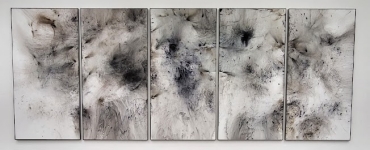
CAI GUO-QIANG IS an artist who was born in Quanzhou, Fujian Province, China, in 1957. Many of his artworks involve the extravagant and clever use of explosive materials, as can be seen in a documentary film being screened at the White Cube Gallery in Bermondsey (south London) until 9 September 2025. The film is accompanied by a collection of the artist’s images created on canvas, glass, and mirrors. Pleasing to the eye, these images have been created by an unusual method.

Guo-Qiang uses gunpowder, and ignites it, to assist him produce his pictures. The gallery’s website outlined his technique:

“… each composition is first mapped by sprinkling the powder, then covered and weighted before ignition, so that the blast disperses, recomposes and fuses matter into image.”

The unpredictability of the explosive material adds an interesting chance element to the finished product, but despite this, the composition was initially planned by the artist. In some of the works on display, not only was gunpowder placed on the base (i.e., paper, glass, etc) but also pigment powders. The explosions caused by igniting the gunpowder cause interesting spreading and scattering of the pigment.

The artist began experimenting with using explosives in his works on materials such as canvas and paper in the early 1980s in Quanzhou. Occasionally, the work in progress would ignite, and the fire had to be smothered to save the artwork. The works on display at White Cube were created after 2015, mainly in the 2020s. By now, he has refined his technique so that wholescale conflagration does not happen. However, as a gallery assistant told us, if you look carefully at some of the works, small burn marks can be found here and there.

Apart from being created in an intriguing way, I found the pictures being displayed in the gallery to be both attractive and beautiful.

Alien Shores in south London’s Bermondsey

THE ARTIST ANSELM Kiefer is said to have remarked:

“I think there is no innocent landscape, that doesn’t exist.”

By Nomoru Minata

For what we see when we regard a landscape is the result of millions of years of geological and meteorological evolution as well many millennia of interventions by biological phenomena including human activities: both constructive and destructive. As the writer and academic Robert Macfarlane wrote:

“We live on a restless crust of earth. Behind the façade of stability, everything is shifting, imperceptibly, but continuously.”

 Artists have been creating images of landscape for many centuries. The earliest known depictions of landscape include Minoan frescoes created in about 1500 BC. The genre of European art called ‘landscape painting’ began in Holland in the seventeenth century. The website of the White Cube Gallery in Bermondsey noted in connection with this:

“17th-century Dutch artists of the Golden Age, during which the genre ‘landschap’ was first named, turned away from religious subjects as an expression of Protestant values …”

Until 7 September 2025, the White Cube at Bermondsey is hosting an exhibition called “Alien Shores”. Curated by Susanna Greeves, this show:

“… explores landscape as a place of memory, imagination, yearning and belonging. Through painting, video, photography and sculpture, the artists included offer speculative, symbolic or surreal depictions of emotional terrain and voyages of the imagination, visions of the distant past or possible futures.”

The exhibition includes works by 37 artists, all of whom worked in the twentieth and/or twenty-first centuries. It is a display of modern and contemporary works of art that either depict landscapes or try to evoke thoughts of landscapes. The works are distributed amongst three rooms. In the first two rooms there are videos and kinetic sculptures as well as paintings. A video by Noémie Goudal is particularly fascinating and dramatic. The third and largest room contains a mixed bag of paintings and a sculpture by Noguchi. My enjoyment of the paintings in this room was not 100%. Some of the paintings looked like wall space fillers rather than great works of art. However, it his is not a room to be missed because it contains three outstanding landscapes by Anselm Kiefer. Seeing these in the company of many of the others served to emphasize (to me) what a great contemporary artist he is. Other ‘stars’ in this room were paintings by Minoru Nomata, Georgia O’Keeffe and Marina Rheingantz.  A three-dimensional screen depicting a leafless forest by Eva Jospin in the long corridor of the White Cube also impressed me.

Although I wondered why a few of the artworks were included in the show, the Alien Shores exhibition has much to recommend it. It was fascinating to see how in a time frame of well under 100 years, artists have been tackling their various portrayals of landscape, and the interesting varieties of ways they have done it.

Superb sculptures at a gallery in South London

HE WAS BORN in Chicago (Illinois) in 1935 and as a child was often taken by his mother to public galleries in the city. Maybe at least partly because of this Richard Hunt, who died in December 2023, became an artist. In 1953, he was awarded a scholarship to study at School of the Art Institute of Chicago. It was there that his interest in working with metal began and that he became acquainted with the work of the leading modernist artists of the 20th century. He taugh himself welding, and many of his fascinating sculptures that are on display at the White Cube Gallery in Bermondsey (until 29 June 2025) can be seen, beautifully displayed.

Many of the sculptures consist of bits of waste metal that Hunt salvaged, modified, polished, and welded together. Other sculptures are made of cast metal. Many of Hunt’s works are abstract, but suggest to the viewer that they might also depict transformations of organic forms. Each of the sculptures is intriguing and original. The influences of other artists might be subtly evident in some of them, but they are not at all obvious. The gallery’s website noted:

“Hunt developed a sculptural language that was both deeply personal and richly associative, drawing on a broad array of influences: the forms and rhythms of the natural world; the mythic narratives of Greek and Roman antiquity; his cultural heritage and global travels; the formal vocabulary of European modernism and the legacy of African American civil rights leaders who shaped his time.”

 As one looks at the works on display, many of the things in the quote above become apparent.

Although some of the works at White Cube are quite small, Hunt has produced many huge works – too large to be within the White Cube – that are displayed in public places. I thought that Hunt’s sculptures were wonderful, and was surprided that until visiting this show I had not been aware of his work.  The show at the White Cube was quite a wonderful eye-opener for me and I can strongly recommend seeing it.

Dali and Dante in London’s Bermondsey Street

EAMES FINE ART Gallery is in south London’s Bermondsey Street. It specialises in original prints and paintings by Modern and contemporary masters. Whenever we are in Bermondsey Street (usually to visit the White Cube Gallery and the wonderful Vietnamese eatery called Caphe House), we take a look at what is being shown at Eames. Until 18 May 2025, they are showing a collection of wood engravings that the surrealist artist Salvador Dali (1904-1989) first created as watercolours before supervising their transfer onto woodblocks to make prints based on these paintings.

In 1950, the Italian government commissioned Dali to produce a set of images to illustrate the “Divine Comedy”, which was composed by Dante Aligheri (c1265-1321) between about 1308 and 1321 AD. Dante’s work is one of the treasures of Italian literature, and the commissioning of Dali, who was not an Italian, was so controversial that it was debated in the Italian Parliament, after which Dali’s contract was cancelled. As the gallery’s website notes:

“Undeterred, Dalí, with the help of the French publisher Joseph Forêt, decided to complete the project himself and produced 100 sumptuous watercolours in a searing evocation of Heaven, Hell and Purgatory in response to Dante’s text..”

It was these watercolours that were transformed, under Dali’s supervision, into the prints, which are currently on display at Eames. I was interested to see them because usually the only works by Dali that I have seen have been his oil paintings. The images that have been created from these watercolours by Dali are more impressionistic and freer in form than the almost crystal clarity of the images in his oil paintings. I am pleased that we took a look inside Eames. We had no idea that they were showing such an interesting collection of works.

About Space at an exhibition in a gallery in south London’s Bermondsey

THE TROUBLE WITH temporary exhibitions is that they come to an end. So, if you miss it, you might never see the same works of art together again. I am very pleased that we just managed to catch a superb exhibition at the White Cube gallery in Bermondsey on its final day (1st of September 2024). Called “About Space”, it is a show of paintings by an artist, of whom I had not come across before: Al Held (1928-2005).

Al Held was born in Brooklyn (NYC). His Jewish family was impoverished during the Great Depression and had to survive on welfare payments.  Having served in the US forces during WW2, he was eligible (under the terms of the GI Bill) for financial assistance with his education after the war. He studied painting first in New York City, and then in Paris (France). Over the years, he explored different styles of painting, and after exhibiting at major art museums in the USA, his work began to be shown at prestigious galleries outside the USA.

The paintings on display at the White Cube date from the 1960s onwards. Many of them are huge, dwarfing the viewers. A few are smaller. All of them are visually spectacular. Although two-dimensional, they depict complex three-dimensional abstract imaginary constructions. Viewing these amazing compositions is like looking through a huge window at the kind of fantastical geometric abstracted landscapes that might now be produced by digital means. As the title of the exhibition implies, Held’s paintings are literally about space. Painted with precision, these compositions explode with energy.

I am glad that we did not miss the exciting experience of seeing these paintings created by a man, who had shown no interest in art until he left the US Navy in 1947. It was his friend the artist Nicholas Krushenick (1929 – 1999), who inspired him to take up art, and I am very pleased that he did.

Inverted images by an artist born in Germany at a gallery in London

CERTAIN IMAGES IMMEDIATELY come to mind when the names of some artists are mentioned. For Vincent Van Gogh it is sunflowers; for Claude Monet it is waterlilies; for Salvador Dali it is melting clocks; and for Edvard Munch it is “The Scream”. In the case of the German artist Georg Baselitz (born as ‘Hans-Georg Kern’ in Deutschbaselitz, Saxony, Germany in1938), mentioning his name conjures up inverted images: paintings in which the images appear to be upside down. He signs them with his signature, but it is not upside down.

Recently, we viewed an exhibition of this octogenarian’s latest paintings at the White Cube Gallery in London’s Bermondsey Street. The show is on until the 16th of June 2024. If you miss it, you will not have missed much worth seeing. As you can tell, I was not over-impressed by what I saw, but it did get me thinking about why the artist often chooses to paint his subjects – human and others – upside down.

Does he choose to do this because his childhood in Germany was spent in a country that had been turned upside down by the Nazi regime, the 2nd World War, and its immediate aftermath in the early years of the German Democratic Republic? The White Cube website quotes the artist as having said:

“I’ve got my early childhood drawings of eagles, stags, deer, dogs and so on in folders,’ Baselitz remarks. ‘Every now and then I look at them, and I think was it a good time, was it a bad time?”

Or does he paint his images upside down to attract the viewer – to make his artwork ‘stand out from the crowd’? Alternatively, does he invert his images so that the viewer is forced to consider not only the subject matter, but also his painting techniques (brush strokes, colour choices, and so on)?

I do not know the answers to these questions. However, I am glad I have seen the exhibition, which did not particularly thrill me, because it did stimulate me to consider his art a little more that I had expected.

Beautifully blown in Bermondsey

BERMONDSEY STREET IS only about 500 yards in length, and about 200 yards of it runs under the railway tracks and has no shops, eateries, or any other outlet open to the public. The remaining 300 yards of this thoroughfare is a delight to visit. It is lined with numerous cafés, restaurants, and a couple of pubs. In addition, there is a good picture framer, several art galleries, some fashionable shops, a church, and a museum of fashion and textiles. There are also a couple of open spaces – small parks. Apart from the magnificent Caphe House – a superb Vietnamese restaurant, one of my favourite places on this street is London Glassblowing (see: https://londonglassblowing.co.uk/).

London Glassblowing is a gallery dedicated to the display and sales of artistic glasswork creations. It was founded by Peter Layton, who was born in 1937 in Prague (then in Czechoslovakia). Fleeing the Nazis, his family moved to Britain in 1939. They settled in Bradford near his grandfather, a pathologist who was a colleague of Sigmund Freud. Initially specialising in ceramics, Peter went to teach at the University of Iowa in the USA. While he was there, Peter soon became fascinated with glass and studied in the institution’s glass blowing programme. After his return to the UK, where artistic glass blowing was not yet highly developed or even highly regarded, he opened the London Glassblowing Workshop in Rotherhithe in 1976. After moving to several different locations, it arrived at its present home on Bermondsey Street.

In addition to displaying fine works of art made with glass, visitors to the gallery can watch the glass blowers at work. This is fascinating to see. When we visited yesterday, the 16th of February 2024, there was a group of young children watching the glass blowers at work. A gentleman was patiently explaining what the glass blowers were doing and how they were achieving the exquisite multicoloured vase they were making. It was only when I got home that I realised that the person explaining was none other than Peter Layton.

An infrequently opened church in London’s Bermondsey

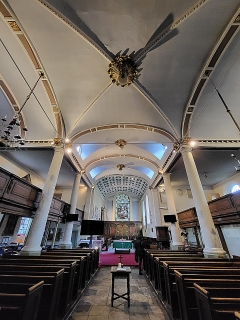
AS FAR BACK AS the 8th century, there was a priory in London’s Bermondsey district, just south of London Bridge. Like most other monastic institutions, it was dissolved during the reign of King Henry VIII. By 1296, there was a church close to the monastery, the ‘St Mary Magdalen Chapel’. This was built to serve the needs of the workers in the Priory and Convent of Bermondsey. It was the forerunner of the present church of St Mary Magdalen on Bermondsey Street. Please note that the name is Magdalen, rather than Magdalene.

In 1680, the church was deemed unsafe, and most of it was demolished. The late mediaeval tower was retained, and was encased in plaster, which hides its original surfaces. By 1690, a new church had been built. This incorporated the old tower, and is what can be seen today. There were a few later modifications made to the edifice, but most of what one sees, is how it was in 1690. The church was damaged both in WW2 and in a fire in 1971, but it has been faithfully restored. The wood carvings on the reredos beneath the Victorian stained glass eastern window might well have been created by the famous wood carver Grinling Gibbons (1648-1721), who was born in Holland and died in London.

The church feels spacious inside. We were lucky to have been able to enter it because apart from Sunday mornings, when a service is held, it is only open to the public between 12 noon and 2 pm on Fridays. We entered at about 1.45, having just eaten a tasty Vietnamese meal at the nearby Caphe House on Bermondsey Street.

Blowing in Bermondsey

IT IS UNNECESSARY to travel from London to Venice to see masterpieces of glass bowing. You need only make your way to Bermondsey Street in south London where you will find London Glassblowing. It is both a gallery and workshop set up by Peter Layton, who is now over 80 years old and still creating beautiful artefacts. Layton was born in Prague and grew up in England. After studying ceramics at London’s Central School of Art and Design, he taught ceramics at the University of Iowa in the USA. It was there that he discovered glass blowing and took to it. When he returned to England in 1976, he established his London Glassblowing in London. It has been located at its present address for about 15 years. Before that, he was in Leather Yard. Apart from creating works of art in glass, he also teaches and mentors other glass blowers.

Whenever we visit Bermondsey Street, we make a point of visiting Layton’s establishment. Always the works on display are both beautiful and highly inventive. Occasionally, if we reach the place at the right time, we can watch glass blowers at work in the invariably hot workshop behind the gallery. Unlike the workshops we have visited on the island of Murano (near Venice), the works produced in Bermondsey Street – both sculptural and functional – are tastefully contemporary and often avant-garde.

Anselm Kiefer at the White Cube in Bermondsey

TODAY, I MADE MY second visit to the Anselm Kiefer exhibition, which is on at the Bermondsey White Cube gallery until the 20th of August 2023. I was pleased to visit it again because after my first visit, I left it feeling oppressed and somewhat depressed. This might be what the artist (born at the end of WW2 in Germany) intended when he created the extraordinary series of scenes of dereliction and decay on show in Bermondsey. My second visit (on the 15th of August 2023) left me with a slightly more favourable impression, but my opinion that the artist has depicted an image of a world of confusion, conflict, and decay, remains unchanged.

The works, which are distributed in several rooms and the central corridor of the gallery, are, so I read in an information sheet, Kiefer’s reactions to, and representation of, a novel by James Joyce – “Finnegan’s Wake”. The artist has written short quotations from the book on many of the items that together make up the amazing art installations. As I have not read the book, I cannot comment on the appropriateness of what he has created.

In one room of the gallery, there are mainly huge paintings, which I found attractive. On close examination, one can see that the paint has been applied to that it is far from flat. The three-dimensional surfaces create interesting illusions, which change according to from where you view the pictures.

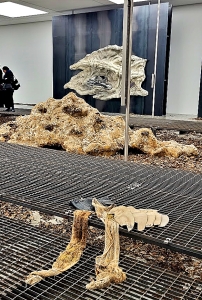
Another room has a huge pile of sand littered with discarded, corroded supermarket trolleys – an impressive but sad sight. In yet another room, most of the floor is covered with barbed wire and huge pieces of concrete – the ruins of a large building. As a friend of ours said, it looked as if it had been imported straight from a bombsite in Ukraine.

Would I recommend visiting this exhibition? It is certainly inappropriate for people who suffer from claustrophobia or depression. However, if you are of an adventurous frame of mind, do head for this show before it ends.