
End of an era near Smithfield Market

SAYING GOODBYE IS not always easy.
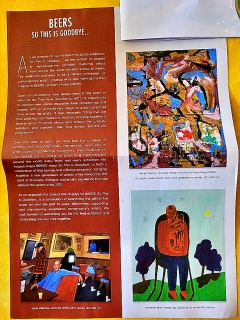
Soon, the Beers London art gallery in Little Britain (near London’s Smithfield Market) will be closing its doors for the last time. Its final exhibition, works by several artists, will end on 29 August 2026.

Over the years, we have been visiting Beers, and always made to feel welcome by Kurt, its owner and his assistant, Rebecca. He has a very good eye, and has been exhibiting works by promising, often not too well-known, artists. We have never been disappointed by what we have seen at his gallery.

A few days ago, we were invited to the private view of his final show, which we attended. Kurt welcomed us warmly, and explained that the art market in London is declining rapidly – there is little money around for buying art at present.

After viewing the show, we said goodbye to Kurt, and wished him well for the future.

As we walked away from the gallery, I had a lump in my throat. I had not imagined that the closing of an art gallery would have seemed so sad and affect me so much.
A female artist at a gallery near London’s Smithfield

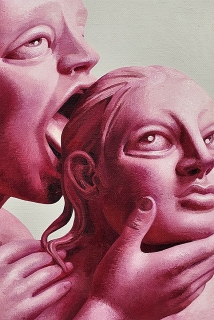
REGULARLY, WE PAY visits to London’s commercial art galleries, often to view contemporary art. Many of the galleries are in Mayfair, but one of our favourites, Beers, is near to Smithfield Market and the Barbican. Run by Kurt Beers, a retired Canadian Mountie, the gallery often has exhibitions of works by lesser known, but up-and-coming creators. The current show is a collection of paintings by Georgia Dymock, who was born in Derbyshire in 1998.

Georgia studied art at London’s Slade School of Fine Art, and was awarded a Master’s degree in painting. Since then, she has exhibited her works in the UK, USA, Turkey, Mexico, Dubai, and China. Her current show at Beers continues until 11 July 2026.

The paintings at Beers are figurative, and painted in muted colours. They depict intimacy with great sensitivity, and in some cases, humorously. One of them, which includes an apple, is a modern depiction of Adam and Eve in the Garden of Eden. Somewhat dreamlike, Dymock, to quote the gallery’s press release, often:

“… constructs scenes that resist fixed interpretation

Additionally, the gallery’s text points out:

Beneath the sweetness of the paintings lies a quieter instability where affection shifts uneasily between nourishment and surrender.”

Regardless of how the paintings are interpreted, they are pleasing to look at, and refreshingly different from much other art that I have seen in London’s commercial galleries.