
From sewer to seating on the streets of London

THE VICTORIA EMBANKMENT was constructed along the River Thames in the 1860s. It was built to enclose a newly constructed sewer: the Main Low Level Sewer, which was part of the grand sewage system improvement project designed by Sir Joseph William Bazalgette (1819-1891). The wall of the embankment facing the river was constructed from large brick-shaped, carved granite stones, each weighing about 1 tonne. Several of these have had to be removed to construct a new sewage conduit – the Thames Tideway Tunnel.

58 of the granite stones have been repurposed to become a series of open-air public art installations. This series was created by Matthew Barnett Howland, Oliver Wilton, and CSK Architects. Small groups of these have been placed in seven locations: St Peter’s Hill, Carter Lane Gardens, St Paul’s Cathedral, Christchurch Greyfriars Church Garden, King Edward St, Little Britain and Smithfield Rotunda. Today, the 31st of July 2024, we came across the group placed in Little Britain, which is not far from Barbican Underground Station. What we saw were 3 of the huge locks of granite arranged in a straight line. A gentleman was using one of them as a bench while he looked at his mobile telephone. Next to them, a wooden sign explained what is going on. This was useful because if there had been no sign next to them, we might not have given them a moment’s notice.

You might well be wondering why this series of stones were placed at seven places in London. I will leave it to someone else to explain:

“The idea behind the project is to stimulate discussion about reuse, material lifespan and cultural heritage, at a time when we can make a significant contribution to a more sustainable built environment.” (www.cityoflondon.gov.uk/services/streets/from-the-thames-to-eternity-installation)

I wonder what Bazalgette would have thought of this.
Letting off gas

THIS IS AN UNSAVOURY subject. So, you have been warned.

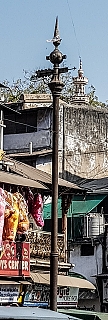
On our first visit to Baroda (Vadodara) in the western Indian state of Gujarat a few years ago, I noticed several tall cast-iron structures resembling lamp posts, except that they were topped with curious objects. Each of these tall streetside poles is topped with spheres, each with four cylindrical projections. Beneath each sphere, there is an arrow. I was puzzled by these objects. So, I posted pictures on Facebook and asked if any of my friends knew what purpose these things serve or used to serve. I received several ingenious suggestions, none of which turned out to be correct.

Baroda (Vadodara)

Having seen these items in Baroda (and also in Bombay and Ahmedabad), I began noticing similar structures in London. None of the examples in London are topped with the sphere and arrow, but in other respects they are not particularly different from those I saw in India. Eventually, I learned that they are all examples of ‘stink pipes’. There are many fine specimens, disused I believe, dotted around London. Recently, I was reminded of those I saw in India when I saw a couple near Chiswick Mall in west London.

It was not until after about 1858 that sewage began being channelled through enclosed sewers in London, an improvement instigated by London Metropolitan Board of Work’s Chief Engineer Joseph Bazalgette (1819-1891). Sewage is waste matter, which tends to decompose. The products of decomposition include noxious gases such as for example hydrogen sulphide, carbon monoxide, ammonia, and methane. Some of them are highly inflammable and all of them increase in pressure as the sewage flows through the sewers. The stink pipes serve(d) as vents through which the gasses building up could escape from the sewers. They tend to be tall so that the gases blow off high above ground level where there are more likely to be breezes that can disperse the gases. Without adequate venting, the gaseous vapours can become dangerously explosive. Returning to Baroda, where the stink pipes are topped with spheres. The gases escape through the conical projections and, I have learned, the arrows indicate the direction of the sewer running beneath them and which way the sewage is flowing.