
THE EMPRESS BRANDISHES HER REVOLVER DURING A BATTLE IN ETHIOPIA

THE BRITISH MUSEUM is chock-full of exciting exhibits. To view them all would take many months, if not years. During a recent visit in March 2014, we were heading through the museum on our way to view a special exhibition of drawings and prints by four post-WW2 German and Austrian artists when we passed a painting that caught my eye. The exhibition was fascinating but not as much as the painting we passed as we were heading towards it.

The colourful painting (oil on cloth) was created in Ethiopia sometime between 1940 and 1949. So, by the British Museum’s standards it is relatively modern. The picture depicts two large armies facing each other. On the left side of the image, we can see the Ethiopian forces, and they are facing the Italians on the right side. Between the two armies, there are several dead or injured combatants. And amongst this carnage, there are two armed men on horses – they are riding towards the Italians. The faces of the Ethiopians are not all the same in appearance, whereas there is almost no variation of the faces of their Italian opponents.

Although it was painted in the 1940s, the picture illustrates the Battle of Adwa, which raged on the 1st of March 1896. The Ethiopians defeated the Italians. By the end of the 19th century, most of Africa had been invaded and occupied by various European nations. The exceptions were Liberia and Ethiopia. In 1889, Italy, having occupied to coastal territory of Eritrea, signed a treaty with King Menelik of Shewa. It was signed in Italian and translated into Amharic. The Italian version made Ethiopia a protectorate of Italy – virtually, an Italian colony. However, the Amharic version read differently – it agreed that the Ethiopians could use the ‘good offices’ of the Italians in their relations with foreign powers, if they wished.

The Italians decided to go to war with the Ethiopians to enforce the Italian version of the treaty. The Battle of Adwa put an end to the treaty with the Italians, who then recognised Ethiopia as an independent state. This situation lasted until the 1930s when Mussolini decided to invade the country.

In the painting at the British Museum, Emperor Menelik II of Ethiopia is depicted in the top left corner in his royal crown. In the bottom left of the painting, seated on a horse, and surrounded by Ethiopian soldiers, sits Empress Taitu of Ethiopia. Look carefully, and you can see that this veiled lady is holding a large revolver.

The painting is in a short corridor, which also has exhibits relating to the Copts of Egypt. As the painting fascinated me so much, I took little notice of the exhibits near to it. So, as if one needs one, yet another reason to revisit the British Museum.
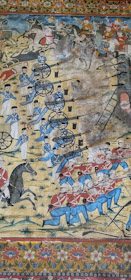
British soldiers on the wall in a house in Baroda

BY THE VERY EARLY 19th century, the armies of the Marathas had been beaten by the armed forces of the British East India Company. After this, from 1805 onwards until 1947, the State of Baroda was ruled by a Hindu Maratha dynasty – the Gaekwads of Baroda. Put simply, the Gaekwads controlled the internal affairs of the state in such a way that British interests were not damaged, and the British controlled the external affairs of the state.

Between 1849 and 1854, Bhau Tambekar (Vithal Khanderao) was the Diwan (prime minister) of Baroda. He lived in a large building, which was probably constructed in the early to mid 19th century. Known as Tambekar Wada, this typical Maratha-style mansion has three storeys and surrounds a courtyard. Currently, the first floor of the front (eastern part) of the building is the only part open to the public.

The part of the building that can be visited is a long rectangular hall with a wooden jaali (perforated screen) near one end of it. The walls of this room are covered with beautiful detailed paintings from floor to ceiling. Many of them depict scenes from the Mahabharata, Ramayana, and Hindu religious images. However, the north wall of the hall is even more fascinating.

Most of the north wall is covered with a mural depicting a battle between the British East India Company and the Marathas. Most of the picture shows features of the British forces in great detail. There are even several flags that resemble Union Jacks. Some British soldiers, dressed in red uniforms, can be seen riding elephants. Whoever painted this wall had a good eye for both detail and representation of battles.

On the same wall as the battle scene, there are several smaller paintings depicting European men and women. On one of these, a woman in European garb seems to be consoling another woman. In another, a man wearing a red jacket is looking at a European lady affectionately.

The purpose of the painted hall is not known for sure. It has been suggested that it was for entertaining guests. The small part enclosed by the screen might have been reserved for ladies. In its heyday, purdah would have been observed in the house. The hall has a set of windows through which one can access a narrow balcony that extends along the entire length of the eastern side of the house. This terrace has a perforated screen through which people on the balcony could look out onto the street without fear of being seen by passers-by.

Although this December (2023), we are enjoying our fourth visit to Baroda, we would not have known about the Tambekar Wada had our friend Nandita A not told us about it. I am very pleased that she introduced us to this gem hidden within the narrow backstreets of Baroda’s Dandia Bazaar district.