
Hearing Welsh being spoken one Sunday in London

KAFFEINE IS THE NAME of an excellent little café in central London’s Eastcastle Street. We go there often, always passing that intrigues me, but which I had never entered until the last day of May 2026. Built in 1889 with a brick and stone façade that includes some columns with Corinthian capitals, it bears the name “Capel Bedyddwyr Cymreig”. Designed by the architect Owen Lewis, it is The Welsh Church of Central London, or in Welsh ‘Eglwys Gymraeg Canol Llundain’.
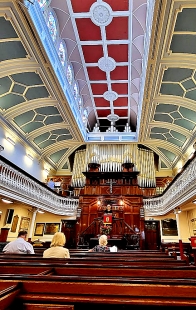
Inside the church, there is a vestibule with a mosaic floor. Within this space I noticed a Bible in Welsh lying within a glass case. A pair of doors leads into the main body of the church. This rectangular space has a centrally positioned set of organ pipes at one end, and beneath them, a pulpit (upon which the preacher was standing). A gallery with cast-iron balustrades and supported by slender pillars with Corinthian capitals. The ceiling curved gently upwards towards a centrally located set of windows that ran along the long axis of the church.

On the day we entered the church, there were no more than about 20 people in the congregation. Two services are conducted every Sunday, and occasionally the church hosts an organ recital.

I am pleased that after having passed this church many times and finding it closed, we were at last able to enter it. Also it was lovely hearing Welsh being spoken, even if I could not understand a word of it.

The church is used for Baptist services. When we entered it on a Sunday morning, a service was in progress. It was being led by a lady, who said things in Welsh, and then repeated what she had spoken in English. The proceedings were bilingual.

Although the church was fairly empty, the same could not be said of Kaffeine. Despite it being a Sunday morning in an area where most businesses were closed, this café was extremely busy, quite crowded.

Fading signs painted on a building near London’s Holborn

TWO FADED SIGNS CAUGHT my attention when I was walking along the east side of Southampton Row (just north of Holborn Underground station). The sign is on the southern side of the intersection of Catton Street and Southampton Row. The two faded, painted signs are separated by another which is carved on a stone plaque, and is clear to read. This sign reads:

“This memorial stone was laid by Alexander Maclaren, DD,, Litt D. President of the Baptist Union 1875-6 and 1901-2 on Wednesday 24th of April 1901”

Above this, there is a painted sign that can easily be read:

“To Kingsgate Baptist Church”

Below these two signs, there is another painted sign,a ‘ghost sign’, which has deteriorated considerably, but parts of it can either hardly be read or are illegible. Here is what I made of it:

“The CA[illegible] [2 more illegible words] Kingsgate House Acc[illegible] &(?) Warehouse Church Furniture”

An online article published in July 2020 in Italian (www.thelondonerd.com/tag/statua/) revealed that then, when the sign was more legible, it read:

“The Carey Kingsgate Press Ltd. – Accountancy – Warehouse – Church Furniture”

This web article also includes lovely photographs of the now re-purposed Kingsgate Chapel.

The three notices are on the corner of Kingsgate House, which was built between 1901 and 1903 for the Baptist Church. It was designed by Arthur Keen, architect for the Baptist Union of Great Britain and Ireland. The Baptists used the building up to 1996. Since then, it has been repurposed.

As for the Kingsgate Chapel (the ‘Kingsgate Baptist Church’ on the fading sign), this can now only be accessed by entering Kingsgate House. Constructed in 1856, it is attached to the northeast corner of the building. No longer accessible to the public and hidden away, it is an octagonal building that can be seen on detailed maps of today. When it was in use as a chapel, its entrance would have been just east of Kingsgate House on Catton Street (formerly known as Eagle Street). Close to where its entrance used to be, there is the entrance to the Baptist Bar, which is now housed in the former chapel.

The ghost sign mentions a warehouse and church furniture with an arrow pointing east along Catton Street. This must have been demolished many years ago. I spotted the fading signs whilst returning home late one evening. Now, having found out something about them, I look forward to returning to Kingsgate House and having a drink in the former chapel – if the bar is still open for business.