I have just seen a performance of the much-hyped, sold-out, “Lehman Trilogy” at London’s National Theatre. It is written by Italian playwright Stefano Massini and ‘adapted’ into English by Ben Power. Starring Simon Russell Beale and two other actors, the three-and-a-half-hour drama charts the rise and fall of the Lehman brothers and the financial establishments they created. It is in three parts separated from each other by intervals. The first part and the beginning of the second narrate the Lehman’s family saga clearly, entertainingly, and quite interestingly. Then, the latter part of the play seems to ‘lose the plot’.

Seligmann store in Barkly East, South Africa
The Lehman bank’s operations literally collapsed in 2008. Although I am the son of an eminent economist, I do not understand the subject at all. I was hoping that the collapse of the Lehman Bank might be explained in relatively simple terms as the “Lehman Trilogy” drew towards its finale, but it was not. Rather than explore the dramatic possibilities of what was surely a very dramatic demise of a great financial establishment, the playwright and his ‘adaptor’ merely hinted at the disaster but made no obvious attempt to depict the momentous events that led to a frightful ending that greatly impacted on worldwide news and financial affairs. So, as you can gather, I was not altogether satisfied by the play itself. However, it got me thinking about my own ancestors, who, like the Lehman brothers, left Bavaria in the mid-19th century to seek their fortunes away from Europe across the oceans.
The Lehman brothers, who migrated to the USA in the mid-19th century, were born in Rimpar (Bavaria), near Würzburg. Heinrich (later’ Henry’) Bergmann, my great-grand uncle, was born 50 kilometres south-east of Rimpar in Ditenheim (Bavaria). He was only a few years younger than the Lehmans. In 1849, aged 18, he sailed to Cape Town in South Africa. Soon after arriving, he became the manager of a general store opened in the newly-established town of Aliwal North in the same year. Like the Lehman brothers, Heinrich became very successful as a middle-man. Like the Lehmans, during bad times he gave the farmers (his customers) credit, which they repaid when the wool harvests were brought to his shop (to be sold on to wool merchants). By the early 1860s, soon after marrying the daughter of a Jewish banker in Frankfurt-am-Main, he became the manager of one of the Aliwal’s three banks. Eventually Heinrich’s bank took over its two rivals. For reasons that are not at all clear, young Henrich shot himself in 1866.

The grave of Heinrich (‘Henry’) Bergmann in Aliwal North, South Africa
Heinrich’s death was not the end of the story. During his time in the Cape, Heinrich was joined in South Africa by his brother and some of his cousins. The cousins in question came mainly from Ichenhausen in Bavaria, 163 kilometres south of Rimpar. Heinrich’s brother married Klara, a daughter of Jakob Seligmann, a successful merchant in Ichenhausen. Klara’s only brother Isak Rafael Seligmann and his wife had 18 children, of whom 15 lived to adulthood. One of the sons, Sigmund, Heinrich’s nephew, migrated to South Africa from Ichenhausen. He did not join his uncle, but began working for another German, a merchant in Lady Grey, which is not far from Aliwal North. Other young men from Ichenhausen including Sigmund’s brother Jakob and the Reichenberg brothers, one of whom joined Heinrich Bergmann, migrated to South Africa.
Sigmund Seligmann was offered a partnership in the business in Lady Grey but turned it down. He left Lady Grey to open his own shop in Dordrecht, a small place in the Cape. Soon after this, he opened a branch in Barkly East in the heart of a sheep grazing district. Like the Lehman brothers who bought cotton and sold it on, and also acted as bankers for the cotton-growers, Sigmund bought wool from his farmer customers and sold it on as well as lending money to the farmers when times were lean.
The Lehman brothers set their sights high. They moved from being merchants to becoming brokers, and then bankers. Their descendants continued the progression until, finally, others took over the running, and eventual ruining, of the business. Sigmund and many others like him, who went from what was to become ‘Germany’ to South Africa, more often than not retired to Germany when they had made their fortunes. In the late 19th and early 20th centuries, life in South Africa was a lot less comfortable than in civilised Germany or the USA, parts of which were becoming very sophisticated. Those who returned to end their lives in Germany had to face WW1 and then later the advent of Hitler’s regime. Sigmund and his children left Bavaria for Palestine, thereby escaping the fate of many Jews who remained in Germany.
Before Sigmund left to retire in Germany, he left the running of his by now very successful business in the hands of some of his very numerous nephews. One of these, who arrived in South Africa in about 1903, was my grandfather Iwan Bloch. Hardworking Iwan, like his father-in-law the future Senator, Franz Ginsberg (an industrialist in the Cape, who had migrated there from Prussia), maintained the successful running of his business as well as entering politics. Iwan became the first and only Jewish Mayor of Barkly East. His life was cut short by ill-health, but had he lived longer I feel sure that he would have entered national politics following in the footsteps of his father-in-law Franz.
With the exception of Iwan’s ill-fated uncle Heinrich Bergmann, this extended Bavarian Jewish family did not take the same road toward high finance as the Lehmans did, but they started at the same point.
Furthermore, the Lehman fortune began to be built from the labour of black slaves in Alabama. This is skirted around casually in the play. Although formally, there were no black slaves in South Africa when my ancestors arrived there, much of the dirty work required to make their fortunes was performed by black Africans, whose treatment by the white Europeans was very far from admirable.
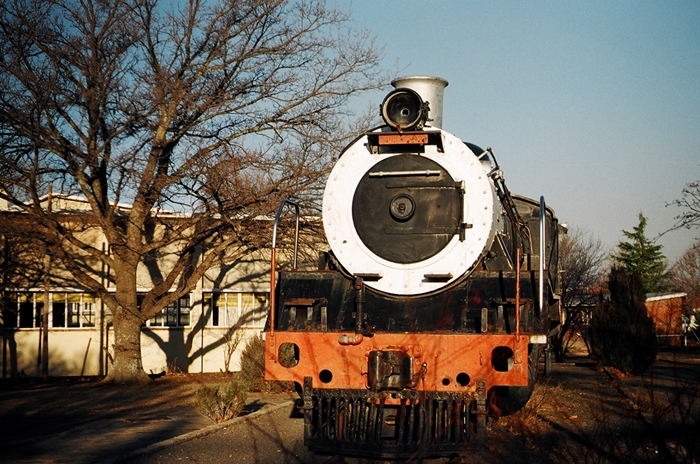
Adam Yamey’s grandfather, Iwan Bloch, brought the railway to Barkly East in South Africa
I am glad I saw the “Lehman Trilogy” because it is engaging and, although there is little acting, what acting there is was good. Also, it got me thinking about my own history. However, like the doomed bank, the quality of the plot declines gradually as the three and a half hours pass by. Would I recommend it? The answer is “no”.



 yamey
yamey 