
BANDHANI IS A METHOD of tie-dyeing that is frequently used by textile workers in the Kutch (Kachchh) district of the Indian state of Gujarat. Knots are tied in the piece of material that is to be dyed, and then the knotted fabric is dipped into a vat of dye. The dye colours all of the material except the parts tied within the knots.
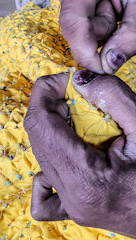
To go into a bit more detail, let me try to explain the procedure. Starting with the ‘raw’ cloth that is usually whitish in colour, craftworkers gather small amounts of the material using their fingertips, and tie these small bundles with thread. The bundles are tied according to a predetermined pattern drawn on the cloth. The tied cloth is then dipped into a dye. When the dyeing is completed and dried, a new set of knots is tied on the already knotted cloth. The cloth is then dipped into a different coloured dye. A new set of knots is sometimes then tied according to the kind of design that has been planned, and the cloth is then dipped into yet another colour dye.
This process of tying and dyeing can be repeated several times. After the several cycles of tying and dying are completed, the cloth is stretched, the knots undo, and a textile with a fascinatingly complex and beautiful pattern is revealed.

The bandhani process is complicated and very demanding. Consequently, the bandhani fabrics are quite highly priced.
On several visits to Mandvi in Kutch, we have stopped at an old shop where bandhani fabrics are made and sold. Its current owner, Mr Ashraf Katri, always remembers us when we stop at his shop. He told us that the business has been in existence for at least 150 years. That means the present generation of the family working in the establishment is the fourth or fifth since it first opened.
On a couple of occasions, Mr Katri has shown us some bandhani cloth that was made over 100 years ago. The patterning on this old cloth is far more intricate and finely detailed than any bandhani produced today. Mr Katri explained that it must have been made by someone with very tiny fingers, possibly a young child, because only someone with such small fingers would have been able to tie the minute knots needed to create such an exquisitely detailed pattern.
Although there are many organised tours offered to show tourists craftspeople at work, they are unnecessary if you are prepared to wander around the bazaar areas and small lanes in places like Mandvi and Bhuj. By doing so you will spot numerous people creating traditional items in their shops, and most of them are happy to let you watch them at work.
 yamey
yamey 