
An especially wonderful art gallery in a town in Cornwall

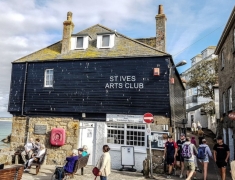
DESPITE BEING OVERRUN with tourists, the small fishing port of St Ives is one of my favourite places in Cornwall. Since the early 19th century, this picturesque place has attracted artists. With the decline of the pilchard industry in the 1880s, many of the buildings associated with this became vacant, and some of them were occupied by artists who converted them into studios. With the advent of the railway (in 1877), a means for easily transporting large canvases to London became available. It was not long before St Ives became an artists’ ‘colony’. In 1889, the St Ives Arts Club was founded as a place where artists could meet and socialise. It still exists. Its ground floor is used for temporary exhibitions. The upper floor is for members only, but I was lucky enough to have visited it with my friend, the late Michael Jacobs, who was writing his book, “Good and Simple Life: Artist Colonies in Europe and America”.

In 1927, the St Ives Society of Artists was formed. Its aim was (and still is) to raise the artistic standards of the artists’ colony and to exhibit works that they considered to be of significant quality. It was housed in various buildings in the town before 1945, when it moved into its present accommodation, the deconsecrated gothic church of St Nicholas. Exhibitions are held both in the church itself and in the crypt below it. The works of St Ives artists, who were considered avant-garde, such as Barbara Hepworth, Peter Lanyon, and Patrick Heron, were displayed alongside those of the town’s less adventurous artists, but were given less favourable positions in the exhibitions than the conventional creations. In 1946, several of the modernist artists held an exhibition in the crypt. They became members of a newly created Crypt Group. There were a couple more exhibitions by members of the Crypt Group in 1947 and the following year. Following a disagreement at an extraordinary general meeting of the Society in 1948, many of the members resigned including those who were included in the Crypt Group – some of Britain’s leading modern artists of the time.

In 1949, some of the modernist artists in St Ives, including Barbara Hepworth, Ben Nicholson, Peter Lanyon, Bernard Leach, Sven Berlin and Wilhelmina Barns-Graham, founded a new organisation – The Penwith Society. Later members included the sculptor Henry Moore, Terry Frost, and Patrick Heron. Because of its association with Britain’s pioneers of modern art, the Penwith is a tangible, important landmark in 20th century British art history. In 1961, the Penwith occupied a disused pilchard packing factory, and over the years it has expanded into neighbouring buildings. As its website (https://penwithgallery.com/about-us/) explained:

“Today the Penwith offers a year-round programme of exhibitions by Society Members and Associates, as well as those by other artists from Cornwall and further afield. The Penwith continues to be at the forefront of presenting contemporary work of quality.”

Every time we visit St Ives, we visit the Penwith. Of all the numerous (commercial) galleries in St Ives, the Penwith consistently contains artworks of the highest quality and greatest visual interest. The exhibition areas are spacious and well-lit.  One area in the gallery is called the ‘Hepworth Room’, which is used for exhibitions, but also contains a fine sculpture by Barbara Hepworth. A small courtyard, used to exhibit sculptures, contains a plaque, which reads:

“This foundation stone was laid by our friend and benefactor Dame Barbara Hepworth 10 January 1973”

It must refer to one of the many extensions made to the place since it was adopted by the Penwith in 1961.

I always enjoy visiting the Penwith. My advice to a visitor, who is short of time, is to forget the Tate St Ives, and instead make a beeline for the Penwith. Having said that, the Barbara Hepworth Sculpture Garden should also not be missed.
The good and simple life

A FEW DAYS AGO, we visited the Penlee House Gallery in the Cornish town of Penzance. After admiring its fine collection of art by painters who worked mainly in Cornwall during the late 19th and early 20th centuries, especially by members of the Newlyn School, I noticed a moss-covered stone in the gallery’s attractive gardens. It mentioned two twinned towns: Penzance and Concarneau.

St Ives Arts Club

Concarneau is a French fishing port in Brittany. Although I was probably less than ten years old at the time, I have some recollections of the family holiday we spent there along with our general medical practitioner, Dr C, and his family. Two memories of that holiday linger in my brain. One is of the excessively lengthy luncheons we had in our hotel’s dining room. Being a poor eater in my childhood, these meals with many courses did not appeal to me. I remember whiling away the time playing with discarded crab and lobster parts from which the adults had extracted the edible flesh. The other memory is of an unfortunate accident that occurred on the beach. Dr C was showing my young sister a sea urchin. Accidentally, it slipped out of his hand and fell onto my sibling’s bare foot. For many years, she remembered this painful experience.

Concarneau is remembered on the stone at the Penlee House Gallery because some of the artists, who spent much time painting in Newlyn, a fishing port next to Penzance, also painted in Concarneau. The French port, like Newlyn, also attracted French artists. Both places were home to ‘artists colonies’ at the end of the 19th and beginning of the 20th centuries (for some details, see: http://www.stivesart.info/brittany-links/). St Ives, which is near Newlyn and Penzance, was also home to a thriving artists colony in that period. Today, one of the attractions of St Ives is the fact that serious artistic activity continues there. Stanhope Alexander Forbes (1857-1947), a highly accomplished artist based for much of his life in Newlyn, wrote that this close neighbour, almost continuation of, Penzance was his:

“…sort of English Concarneau.” (www.sothebys.com/en/auctions/ecatalogue/2003/important-british-pictures-l03123/lot.31.html)

The artists colonies that existed all over Europe and also in North America at the same time as those in Newlyn and St Ives became the subject of research for my friend, the art historian and travel writer, the late Michael Jacobs (1952-2014). For some unknown reason, Michael never learned how to drive. As a result, he depended on public transport and his friends to get him around the many places that he visited. In about 1984, two years after I had gained my driving licence, I agreed to drive him to Cornwall where he was researching its two artists colonies. We stayed both in Newlyn and St Ives in bed and breakfast accommodation. I enjoyed accompanying my friend whilst he made his enquiries.

An organisation in Newlyn let Michael the notebooks (or diaries) of Stanhope Alexander Forbes, who lived from 1884 onwards in Newlyn and died there. Trustingly, the keeper of these original handwritten notebooks gave them to Michael to peruse overnight. He hardly slept that night because he spent most of it feverishly trying to read as much as possible of this source of information about life in Newlyn’s former artists colony.

Michael was a sensitive fellow, who never wanted to upset anyone. This admirable characteristic of my friend backfired the following day. Our landlady provided us with a lavish full English breakfast. The table was covered with an ocean of food, piles of bacon, sausages, eggs, baked beans, fried bread, toast, black pudding, fried tomatoes, and much more. After we had both eaten, there was still a vast amount of food on the table. Michael said to me that we should not leave it uneaten as that would upset our kindly hostess. I said that I could not manage any more. So, Michael, not wishing to risk offending our landlady, managed to consume the huge amount of food remaining. Thoughtful as this was, it was not without consequences. For much of the rest of the day, poor Michael kept clutching his stomach that was not grateful for the load of food with which it had to deal.

We stayed in St Ives. The bed and breakfast place that we had booked was on a steeply sloping narrow street in the old part of the lovely town. Driving my car through streets like these, barely wider than my vehicle and often dangerously steep, was no joke. After that, my first trip to St Ives, I promised myself never to attempt driving in the old part of the town. I have stuck to that promise.

Our visit to St Ives was made special because Michael had to interview various artists in their studios and members of the St Ives Arts Club. The latter, which is housed in an old warehouse, was founded in 1890. Its early members included the artists Sir John Arnesby Brown, Sir Leslie Stephen, Adrian Strokes and W Titcomb. The Club’s informative website notes:

“All but one of the original Committee hung at the Royal Academy.” (www.stivesartsclub.org/copy-of-history).

I do not recall whom we met there, but we were permitted to enter parts of the Club not normally accessible to non-members.

While we were in St Ives, we did not visit the Barbara Hepworth Museum (first opened in 1976) and the Tate St Ives was not yet in existence; it opened in 1993.

By the time that Michael and I visited the two towns in western Cornwall, my friend had already done a great deal of research about artists colonies abroad. What struck him at the time was that in each of the former artists colonies that he visited in a number of different countries including France, Russia, USA, and Germany, he met experts who could tell him much about the colony in which they specialised but few of them were aware, as Michael had become, of how much the artists moved between the different colonies.

Michael’s research culminated in the writing of his book “The Good and Simple Life: Artist Colonies in Europe and America” that was published by Phaidon in 1985. Sadly, I have mislaid, I hope temporarily, my copy of this book, in which I am sure that he wrote a personal inscription. When we visited the Penlee House Gallery in September 2020, I looked at their bookstore to see if they stocked Michael’s book. It was not there and also the otherwise informative gallery staff had never heard of it, which is a great pity because it shows how the Newlyn and St Ives colonies were part of an international artistic network or community.

It was the visit to the Penlee that brought us to Penzance, a place that we had not considered visiting before. I am pleased that we went to the town because it offers many delights that exceeded our prior expectations.

Michael passed away six years ago. Although in the last few years of his life we saw him less often than previously because he was often away travelling or spending time in his home in Spain, a country which he loved, we think of him often with great affection.