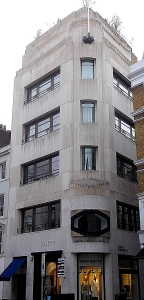
THE CORNER OF BROOK Street and Haunch of Venison Yard (in London’s Mayfair) is adorned with a fine building with a white Portland stone façade. It is built in the art deco style. The building, Greybrook House (28 Brook Street), was constructed in 1929 and designed by Sir John Burnet and Partners (https://historicengland.org.uk/listing/the-list/list-entry/1392996). Burnet, born in Scotland, lived from 1857 to 1938.
Greybrook House was built to house the showrooms of the piano company, Bechstein, founded in 1853 by Friedrich Wilhelm Carl Bechstein (1826-1900). In 1901, the firm opened a concert hall, Bechstein Hall, on Wigmore Street. In 1917, the hall was renamed the Wigmore Hall and is still used today. The hall was next to Bechstein’s showrooms, which were closed in 1916 because of its German connection. In 1928, Bechstein’s, which had been closed during and after WW1, re-established itself in the UK, and commissioned the building of Greybrook House to be used for their new showrooms. In addition to showrooms, the new building included practice rooms and office space.
I am not sure when Bechstein left its Brook Street premises. However, I noticed that beside the entrance to the flats there is a beautifully carved calligraphic inscription that reads “Allied Ironfounders Ltd”. This company had its showroom in Greybrook House in the 1950s. Judging by a photograph I have seen on the Internet (www.ribapix.com/allied-ironfounders-showrooms-28-brook-street-mayfair-london-the-showrooms-entrance-with-the-brick-mural-men-of-iron-designed-by-trevor-tennant_riba25422#), it must have been quite exciting visually.
Currently, the ground floor of Greybrook House is occupied by Joseph, an upmarket clothing retailer. The upper floors have been converted into luxury flats by Fenton Whelan and Vanbrugh Prime Property. This was done recently.
The lovely art deco façade of Greybrook House remains unaltered. By chance, or who knows, maybe deliberately, Bechstein’s Brook Street showrooms were almost opposite the house where the composer George Frideric Handel (1685-1759) lived from 1723 until his death. Finally, the company that had its piano showrooms in Greybrook House is currently constructing a new set of showrooms and a small 100 seat concert hall back in Wigmore Street where their first London premises were located (www.rhinegold.co.uk/international_piano/c-bechstein-returns-to-londons-wigmore-street/).
WIMBORNE IS A CHARMING small town in Dorset, a little north of Poole and Bournemouth. Famed for its Minster church with its mediaeval chained library, the place is rich in old buildings. One of these, looking less old than many of its neighbours, houses the Tivoli Theatre. It attracted my attention because of its (heavily restored) art deco features.
Housed in what was originally the 18th century Borough House, the theatre-cum-cinema was created in 1936 to the designs of Edward de Wilde-Holding, a prolific architect. The cinema was closed in 1980 and was threatened with demolition for a road scheme, which fortunately was abandoned. It was restored by a group called ‘Voluntary Friends of the Tivoli’ and reopened in 1993. In addition to showing films, the theatre is used for live events on its stage.
The Tivoli was not the only art deco cinema we spotted on our recent trip to the area around Winchester. 28 miles northeast of Wimborne, there is another one, The Plaza in Romsey, which was built in 1931 as a cinema but is now used as a theatre. Unlike the Tivoli in Wimborne, which occupies an old building, the Plaza in Romsey was purpose-built as a cinema.
IT WAS EERIE walking in Leicester Square today in early February 2021 at midday because we were almost alone. Normally, the square is full of people milling about and joining circles of folk watching street entertainers perform, sometimes with great skill. Apart from us, I saw no more than ten other people in this usually crowded popular focal point for Londoners and tourists alike. There was a sense of peace and calm that one customarily associates with spots deep in the countryside. I doubt that this square has been like this for many years, maybe since it was first laid out between 1630 and 1671, when it was then known as ‘Leicester Fields’.
At the north-east corner of the Square was Leicester House, which was named after Robert Sydney, 2nd Earl of Leicester (1595-1677), and was built in about 1635. It was home to members of some royal personages including, briefly, Elizabeth Stuart, Queen of Bohemia (1596-1662) whose life ended in the house, and later the huge natural history collection of Sir Ashton Lever (1729-1788), the last lessee of the house before it was demolished in 1791.
During the 18th century, the houses surrounding Leicester Square were occupied by several people, whom we still remember today. The artist William Hogarth (1697-1764) lived on the east side of the square on a site that was later occupied by the Sablonière Hotel, now demolished. The hotel’s plot is now the site of a twentieth century building housing the offices of several radio stations including LBC and Classic FM and a branch of TGI Friday. The famous surgeon and scientist John Hunter (1728-1793) lived in the house next to Hogarth’s from 1785 until his death. He kept his collection of specimens there as well as giving lessons in anatomy and dissection in rooms he added to the rear of his home. Hunter was buried in the nearby church of St Martin in the Fields. Across the square on its west side, the artist Sir Joshua Reynolds (1723-1792) lived and worked from 1761 until his death. His studio was an octagonal room. According to John Timbs, writing in 1867:
“… the sticks of his brushes were 18 inches long; he held his palettes by handle …”
In addition to his residence and studio, Reynolds built a gallery for his works. The row of houses that included that of Reynolds has long since been demolished. When I first knew Leicester Square, the east side of the square was occupied by a large office building, Fanum House, that housed the Automobile Association. Its appearance has been modified and is known as ‘Communications House’.
Other artists, who lived in the square, include Hans Huyssing (1678-1753/53), a Swedish painter; Jacques Christophe Le Blon (1667-1741); Michael Dahl (1659-1743), a fashionable Swedish portrait painter; and William Martin (1753-c1836), an English painter. Apart from artists, other notable people, several military and medical celebrities, lived around the square.
The square has a garden, in the centre of which there is a statue of William Shakespeare. This is a copy of an original made in 1741 by the Flemish sculptor Peter Scheemakers the Younger (1691-1781) who spent most of his working life in London. It was placed in the square in 1874 when the financier and member of Parliament Albert Grant (1831-1899), who was born ‘Abraham Gottheimer’, bought the garden and opened it to the public. During the 18th century, there was another statue in the square: a metal equestrian sculpture of King George I, sculpted by C Buchard.
The large Odeon Cinema on the west side of the square has a black tiled façade. It was built in the art-deco style in 1937, designed by Harry Weedon (1887-1970), who designed many other cinemas in the 1930s. It was built on the site of the big Alhambra Theatre, which opened as a music hall in 1858 and survived until its demolition in 1936. Today, there is a bar next to the Odeon. It bears the name ‘Lost Alhambra’.
The Empire Theatre, now a casino and a cinema, is on the north side of the square. With its neo-classical façade, it was built in 1884 as a variety theatre. Its architects were Thomas Verity (1837-1891 and Thomas Lamb (1871-1942). This stands roughly on the western side of the land occupied by the former Leicester House. To the east of this plot, there stands another cinema, a fine example of the art-deco style, the Vue Cinema, which was built in 1938 and opened as the ‘Warner Theatre’. Its architects were Thomas Somerford (1881-1948) and EA Stone. The façade includes two bas-relief sculptures, one representing the spirit of sight and the other of sound, which were created by Edward Bainbridge Copnall (1903-1973), who was born in Cape Town in South Africa.
The Swiss Centre that used to stand at the northwest corner of the square was demolished a few years ago and was replaced by a newer building. The Centre contained a couple of expensive but good restaurants where Swiss specialities were served. The steak tartare and cheese fondue, which were served at the Centre, were particularly good. A clock with a carillon adorned with the crests of the Swiss Cantons is all that remains of that fine Swiss establishment.
At the south side of the square, facing the cheap theatre tickets booth, stands the Hampshire Hotel, currently devoid of guests. Before it became a hotel, this building housed the former Royal Dental Hospital. Opened in 1858 in Soho Square (number 22), it moved to the premises in Leicester Square in 1874 (https://ezitis.myzen.co.uk/royaldental.html). In those days, the once fashionable Square had become a run-down part of London. In 1983, The Royal Dental Hospital was merged with Guys Hospital Dental School. When this happened, a dental friend of mine, who worked at Guys, suggested to me that the merged hospital should be renamed as ‘Roys’. In 1985, the Leicester Square hospital was closed. Soon after this, the former hospital was reconditioned to become a hotel.
Being the centre of London’s theatre and entertainment district, it is appropriate that recently the square has been adorned with life-size sculptures of famous entertainers such as Charlie Chaplin, Rowan Atkinson (with whom you can share a bench), Laurel & Hardy, Mary Poppins, and other familiar actors. I cannot decide whether these frozen figures enhance the square, but as they are fairly discreetly positioned, they do add something to a place that has been home to well-known people since the beginning of the 18th century.
Had Leicester Square not been as empty as it was today, I would not have spent so long there to take photographs. I realised that this square, through which I have always preferred to hurry, has some interesting architecture and such a lovely statue. Although I enjoyed Leicester Square without the crowds, I look forward to healthier times when people can mix there, freely and happily.
WALKING ALONG THE ALBERT Embankment upstream from Lambeth Bridge, most people’s eyes will probably be focussed on the River Thames and the lovely views of the Houses of Parliament, Millbank Tower, and the Tate Britain. However, it is worth turning your eyes inland in order not to miss a wonderful example of, in my uninformed opinion, art-deco or, if you are fussy about distinctions, art-moderne architecture, whose decorative façade faces the river. Just in case you were wondering how these styles of architecture from the same time period differ, deco lays emphasis on ‘verticality’ and moderne on ‘horizontality’ (http://theantiquesalmanac.com/chicvssleek.htm). Important as this distinction might be to connoisseurs, the building on Albert Embankment is worth at least a few minutes’ examination.
The building in question is the former London Fire Brigade Headquarters, still a functioning fire station. The structure is built of bands of bricks separated by thin horizontal lines of white stone that form the top and bottom frames of the lines of windows, each consisting of lattices of rectangular windowpanes which are wider than they are tall. These design features help define the building’s horizontal sleekness, which is why it is considered by at least one authority (https://historicengland.org.uk/listing/the-list/list-entry/1392337) to be ‘moderne’ rather than ‘deco’. However, it was not this that first attracted us to the building but its decorative panels at various levels and dramatic doorways at ground level.
The doorways, which are wide enough to admit the passage of vehicles are closed with sets of folding doors, consisting of four panels, each of which has a brass window covering (grille) with a geometric design. Some of the building’s decorative panels depict firefighters at work. These are in bas-relief and made of a white coloured stone. These were made by Nicholas Babb (probably Stanley Nicholson Babb; 1873-1957). Other panels, at a higher level, adorn the central section of the façade. These are also bas-relief in white stone but have backgrounds formed of gold coloured mosaic tiles. Created by Gilbert Bayes (1872-1953), who studied alongside Babb at the Royal Academy, their subject matter is borrowed from ancient mythology.
The building itself was designed by EP Wheeler, architect to the London County Council. He was assisted by G Weald. Wheeler also designed the ‘horizontalist’ building on Charing Cross Road in 1939, which was the former home of St Martins School of Art (www.designcurial.com/news/foyles-war-4354398), where my mother worked as a sculptor during the 1960s. The Fire Brigade building was opened by King George VI and his wife on the 21st of July 1937, not a moment too soon, given what was in store for London soon afterwards: the WW2 Blitz, which put great strain on the Fire Brigade.
To the left of the façade, there is a yard in which stands a tall brick tower. This is the so-called ‘drill tower’, used for training firefighters. The building, in addition to having been the Brigade’s headquarters, was also a training centre. The rear of the building, which I have not yet seen, has three layers of balconies, from which members of the public used to be able to observe parades and displays of firefighting skills. Today, the edifice is still used as a fire station but not as the HQ of the Brigade, which is now in Union Street, Southwark.
I enjoy seeing art-deco (and ‘moderne’) architecture. While there are plenty of examples of this in London, which you can spot if you keep your ‘eyes peeled’, the greatest concentration of this style of building that I have seen is in central Bombay in India. Both the Marine Drive and the Oval Maidan in south Bombay are treasure troves for lovers of this style. So, as a lover of this style that broke away from traditional architectural styles in the 1920s and 1930s, I was delighted to have stumbled across the wonderful Brigade building on the Albert Embankment.
UNLIKE MANY PLACES IN ENGLAND, Penzance in Cornwall did not get a mention in the Domesday Book published in 1086 although there is archaeological evidence of a bronze age settlement in the area. The first written mention of the town is in a document dated 1284, when it was listed as ‘Pensans’. The etymology of the town’s name derives from the Cornish words ‘penn sans’ meaning ‘holy headland’.
We discovered recently, on our first visit to the town, that Penzance in the far south-west of the British Isles is very pleasant and full of interesting buildings and other attractions. One of these is the long seafront promenade from which the visitor can see nearby Newlyn in one direction and St Michael’s Mount, Britain’s answer to France’s Mont St Michel, in another. Incidentally, Penzance is further west than anywhere in mainland France.
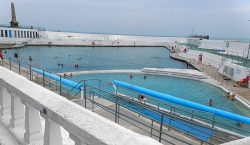
A row of poles carrying large flags, on which pictures of a diving ladies, dressed in old-fashioned blue striped bathing dresses, were printed, attracted our attention. The flags were fluttering vigorously in the strong breeze. They were placed next to the wall surrounding a large triangular open-air swimming pool two of whose walls project out into the sea. The pool was divided into two sections, one with a greater area than the other. Plenty of people were swimming in both parts. The design of the pool immediately made us think that it had elements suggestive of the art deco style that was popular in between the two World Wars.
The pool is known as the Jubilee Pool. A plaque at its main entrance informs that the pool was opened on the 31st of May 1935 (during the year of the Silver Jubilee of the reign of King George V), confirming our suspicion that it was built in the era of art deco. A website (https://historicengland.org.uk/listing/the-list/list-entry/1221190) contains the information that the pool was built to the designs of the Borough Engineer Captain F Latham, and it adds that the pool:
“… is now the finest surviving example of its type with the exception of the Saltdean Lido in Brighton (listed grade II). In Europe, lidos such as the Piscine Molitor in Paris of 1929 were the first to adopt the modernist style in order to embody the worship of sunlight and physical fitness. The seaside lido manifested the transformation of sea bathing in the 1920s from a predominantly health activity into a leisure activity, and because it was freed from the constraints in planning of more conventional pools it presented local authorities with the opportunity to emulate Continental fashions.”
The water in the two sections of the pool differs in temperature. In the lager part of the bath, it is unheated but in the smaller part, it is heated. Currently, a bather pays up to £4.25 to swim in the unheated section, and up to £11.75 to swim in the ‘Geothermal Pool’, whose water is between 30 and 35 degrees Celsius (https://jubileepool.co.uk/tickets/). Despite locals receiving a discount on ticket prices, many choose to swim in the sea amongst the Battery Rocks that surround the pool and the extension of the promenade that runs along the eastern edge of the bath. One local, who was dressed in a wet suit and had just been in the sea thought the ticket prices were a bit steep and told us that during September, the end of summer, the sea is actually quite warm.
The Geothermal Pool is filled with salt water heated by geothermal energy. The idea of installing this feature derives from Charlie Dixon, who in 2010:
“…had just returned from a trip to New Zealand where he had bathed in geothermal pools … Ten years and a £1.8m funding package later (not to mention an incredible amount of work by the Jubilee Pool Directors and staff) the first geothermally heated pool of its kind in the UK opens to the public on 1st September 2020 …
… The system operates by extracting warm water from one geothermal well (410m deep – the height of one and a half Eiffel Towers!!), taking heat out of that water using heat pumps and distributing it to the pool via a heat exchanger, before re-injecting the cooler water back into the ground. This combined system means that the temperature of the pool can be sustained with a very low carbon footprint. The initial pool heating results suggest that it’s about 80% geothermal but ultimately all the energy is coming from our geothermal well. We are using the heat pumps to concentrate that energy to the exact temperature required for the pool.” (https://jubileepool.co.uk/pool-info/geothermal/).
Although the Jubilee Pool geothermal system is the first of its kind in the UK, it was not the first pool or lido to use naturally heated water. The Romans heated the water at Bath with naturally warm spring water.
We wandered along the eastern side of the pool towards a carved stone obelisk that overlooks the triangular pool and the expanse of Battery Rocks. It stands on the site of a gun battery that was built in 1740 when Britain’s relations with Spain deteriorated. The obelisk, a war memorial, was designed by Sir Edward Warren and erected in 1922. It was unveiled by Mrs Bolitho on the 14th of May 1922. She was the wife of Thomas Bedford Bolitho (1835-1915), a Cornish politician (Liberal Unionist MP), banker, and industrialist, of Trewidden (Cornwall). Bolitho is a western Cornish surname and that of a prolific writer and biographer, Hector Bolitho (1897-1974), whose biography of Jinnah, the creator of Pakistan, was published in 1954. Hector was born in New Zealand and migrated to the UK in about 1924. Hector’s grandfather emigrated from Cornwall to New Zealand. It would be interesting to know whether Hector and Thomas were related, even remotely.
We saw plenty of folk bathing in the sea near the pool. They sheltered behind towels that flapped about in the breeze whilst they slipped in and out of their bathing suits. None of them, with whom we spoke, complained about the water’s temperature. In addition to humans enjoying the environment I spotted several cormorants contemplating the sea from their perches on the rocks. The Jubilee Pool and the rocks near it are some of the lovely features that make a visit to Penzance delightful.




 yamey
yamey 