
ONCE A VILLAGE ON THE MARMARA SEA, NOW A SUBURB OF ISTANBUL

THE FIRST TIME I visited Turkey was in about 1960. My father was participating in a conference organised by the Eczacibaşi Foundation. It was held in the then luxurious Çinar Hotel on the European shore of the Marmara Sea at a place called Yesilköy, which is about 9 miles west of old Istanbul. This April (2024), we visited Yesilköy both for old times sake and because we had read that the place has several interesting sights to be seen. Incidentally, it was in Yesilköy that I had my first piece of chewing gum.

After disembarking from the Marmaray train, which connects settlements on the coast of the Sea of Marmara, we enjoyed the best cheese börek we have eaten since arriving in Turkey. Then, despite constant rain, we walked along Istasyon Caddesi, admiring the many houses with decorative timber cladding that line the avenue.

We made a small detour to look at a Syriac Christian Church, which looked recently built. We could not enter because a service was in progress. Thence, we walked to the rainswept seafront, where we looked around a museum dedicated to the life of Ataturk. It was housed in a mansion once owned by Greeks. The ground floor is dedicated to the first decade of the Turkish Republic, which was founded in October 1923. The first floor has a display of ethnographic exhibits from Turkey. The second floor is a collection of photographs, items, and books relating to the life of Ataturk.
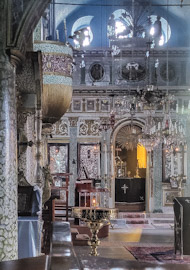
Greek Orthodox church in Yesilköy

Next, we came across a Greek Orthodox church. We could enter its covered porch in which candles were flickering. Through the windows of the porch we could see enough of the church’s interior to realise it is quite beautiful. Unfortunately, the church was locked.

Nearby, we found the huge Latin Catholic Church, which was open. Its interior was nothing special, apart from one religious painting which contained words in the Ottoman Turkish script. The size of the church suggests that there might once have been a large Roman Catholic community in Yesilköy.

Yet another church is a few yards away from the Latin church. It is an Armenian church, enclosed in a compound surrounded by high walls. The entrance was open, and after looking at the church, we joined the congregation (at least 40 people), who invited us to have tea and cakes. A couple of gentlemen began speaking with us in English. They told us that the Çinar Hotel was no longer in business, but it was still standing. They also told us that they are in the textile business. They are waiting for Indian visas because they are planning to visit Bangalore and Tiripur soon because they are looking to buy textile machinery there.

Several people told us that the Çinar Hotel is about a mile from the centre of Yesilköy. As it was cold and raining we decided against looking for it. Despite not revisiting the place I first stayed in Turkey more than 60 years ago, we saw Yesilköy and some of its fascinating sights. It is close to the railway tracks and not on most tourists’ beaten tracks.

A VILLAGE ON THE BOSPHORUS WAS ONCE HOME TO A JEWISH COMMUNITY

LONDON HAS ITS Hampstead. Budapest has its Szentendre. Paris has its Montmartre, and Athens has its Plaka. Like these cities, Istanbul also has an area where the city’s citizens meet to relax – Kuzuncuk. This is a village-like settlement on the Asian shore of the Bosphorus in the northeast corner of Üskudar.

We visited Kuzguncuk on a sunny Sunday morning, having walked along the coastal road that leads away from the centre of Üsküdar. As we walked, we watched competitors in a running event, struggling up and down the undulating road from which traffic had been temporarily excluded.

Kuzguncuk

The streets of Kuzguncuk run up hill away from the shore. They are lined with small houses, many of which are picturesque with their timber cladding, small balconies, and other ornamentation. Tables and chairs of cafés, snack bars, and other eateries occupy the pavements. Many of them had customers, who were eating tasty looking breakfast platters, cakes, and other snacks.

As far as we could tell, most of the visitors to Kuzguncuk are Turks. This has not always been the case. Jewish people, who had been expelled from Spain and Portugal, began settling on the village in the 16th century. The earliest tombstone in Kuzuncuk’s Jewish cemetery is dated 1562. The Jewish inhabitants of Kuzguncuk have mostly left – many in 1948. There are two synagogues – one heavily guarded by the police, and the other one more lightly guarded – in the village. Both were locked up.

Armenians began settling in Kuzguncuk in the 18th century. We spotted one of their churches, but it was locked up the service having finished. Following disturbances in 1955, most of the Armenians and Greeks, who lived in Kuzuncuk, left. We passed a couple of Greek Orthodox churches, both locked up. One of them located next door to the heavily guarded synagogue is still in use on Sundays, but we were too late to enter it.

The centre of Kuzguncuk did not have a mosque until 1952. Then, one was built in the courtyard of the Armenian Church of Surp Krikor Lusavoriç. The Armenian community contributed funds towards the construction of this mosque.

When the Greeks, Jews, and Armenians left Kuzguncuk, many of their homes were acquired by migrants from Anatolia.

After spending an extremely pleasant couple of hours in Kuzguncuk, we climbed up the vertiginously steep lanes behind the village, and eventually reached a long main road that led gently downwards to the centre of Üsküdar. As we struggled up a lane, a lady in her garden said to us “Yavaş yavaş” (loosely translated as ‘take it slowly’).

If you wish to escape the crowds of tourists in Sultanahmet and other well-known historic parts of Fatih (the older part of Istanbul in Europe), then head for Kuzguncuk for something delightfully different.

Armenian script in a church in Chennai

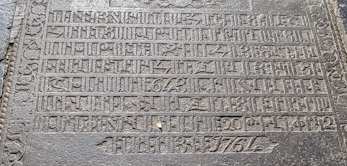
I HAVE VISITED ST THOMAS Mount in Chennai twice so far. The two visits were separated by at least a quarter of a century. Amongst the many interesting things to see and experience on this sacred hill are some examples of Armenian script. This characteristic lettering can be found both on several tombstones and on some framed paintings of saints. Also, there is some Armenian writing inscribed on an ornate pulpit.

The church on the Mount is dedicated to Our Lady of Expectation. There are several sculptures of the pregnant Mary in or near the church, which was constructed close to the spot where St Thomas (the doubter) is supposed to have died. The church was constructed by Portuguese Franciscan missionaries in the 1520s. None of this information provides any clues to the presence of the Armenian lettering.

Armenians began setting in Madras in significant numbers in the mid-17th century. There is an Armenian Street in Chennai, where one can find an Armenian church. This was built in 1712. The two funerary monuments I saw on the Mount are dated after 1712: 1739 and 1764. The paintings with Armenian script are far newer. I am no expert on Armenia, so can say little if anything about their religious practices. Many Armenians are Christians, and a few of them are of the Catholic variety. I can only assume that the graves on the Mount are those of Catholic Armenians, and that some Catholic Armenian donor provided the paintings.

If anyone can give me more information about the presence of Armenian script in this church on the Mount, please share it with me.