
A twentieth century American artist who seemed to have lost his way

THE EARLY WORKS OF artists, who became famous for their successful experimentation in style and expression (such as Matisse, Picasso, Van Gogh, Miro, and Hockney), began by making quite conventional figurative pictures – always competently executed. Such was also the case with the artist Philip Guston (1913-1980), who was born in Canada, son of Jewish parents who had migrated from Czarist Russia. Born ‘Goldstein’, he later changed his surname to ‘Guston’. His family moved to Los Angeles (USA) in 1922. His childhood was filled with trauma: his father committed suicide, and soon after that his brother was killed in a motor accident. He began to be involved with art as a way of dealing with these sad events. In the 1930s, he engaged with political activity, fighting racism and anti-Semitism at a time when the Ku Klux Klan was enjoying some prominence. Several of his paintings depict hoods, such as were worn by the Klan.

There is a retrospective exhibition of Guston’s works at London’s Tate Modern until the 25th of February 2024. The paintings are exhibited chronologically on the walls of eleven interconnecting display areas. Like the artists listed at the beginning of this piece, Guston’s early works are figurative and very beautifully painted. Many of these powerful images reflect his concerns about the adverse political developments he observed during the 1930s. Later, in the 1940s, he became friends with artists like Mark Rothko and Willem de Kooning, and he moved successfully from figurative painting to abstraction. He became well-known as an abstract artist. After that, in the 1960s, his art seemed to my eyes to go downhill.

Guston’s later works, which are partly figurative and partly abstract, and created in and after the late 1960s, were undoubtedly created to send messages to the viewer. However, I found them to be crudely executed in comparison with his earlier abstract and much earlier figurative works. Whether this crudeness was deliberate or reflected a decline in the artist’s ability I cannot say. These later works express the artist’s personal crises and his reaction to injustices and other global catastrophes, but they did not do much for me from an aesthetic point of view. Had I left the exhibition without seeing them, my admiration for Guston would have been higher than it is having seen them.
An American in a gondola

When I was young, before I was about 17, I used to visit Venice annually with my parents. We used to stay in a pensione called ‘La Calcina’. As breakfast and one meal were included in the room price, we used to take lunch in the dining room of La Calcina. Every year, we sat with other regular visitors, whom we got to know gradually. One of them was a somewhat silent American gentleman…


On the Canale Grande_500


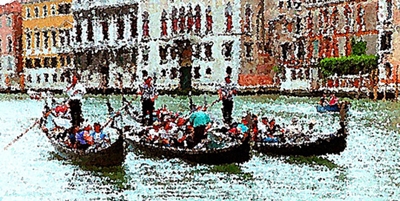
The Calcina’s neighbour, the Pensione Il Seguso, was located on a corner where a narrow side canal met the wide Giudecca Canal. One morning, we were waiting outside the Calcina, trying to decide what to do. It was a bit later than usual, which is possibly the reason that we spotted something we had never seen before. A gondola with green upholstery and other identically coloured cloth drapes appeared from along the side canal and drew to a standstill at the corner near where we were standing. The gondolier was dressed in a livery the same colour as the upholstery and the drapes. After a short delay, the American, who used to sit silently with us at lunch, left the main entrance of the Calcina and boarded the gondola. The gondolier set his vessel in motion. His American passenger sat reading his newspaper whilst he was rowed across the Giudecca Canal. We watched them disappearing along a canal that passed through the Giudecca Island towards the wide open lagoon beyond the island. Naturally, our curiosity was aroused.

That lunch time, the American sat down in his usual place. My mother could no longer contain herself. She asked the American about what we had witnessed that morning. He explained that the gondolier was the grandson of his late mother’s personal gondolier. Whenever he visited Venice, he would hire this same grandson for the duration of his visit. Every morning, he was picked up just as we had observed, and was rowed out into the midst of the lagoon. When they arrived there, he and his gondolier exchanged roles. The American had mastered the art of rowing a gondola, and took his daily exercise by ‘gondoling’ around the lagoon for an hour or so.

The American introduced himself. My father, a knowledgable amateur historian of art, was most excited to discover that our American lunch time companion was William Milliken, a former Director of the Cleveland Museum of Art in Cleveland, Ohio, and a famous historian of mediaeval art.

Later Miss Steiner, a humourless late middle-aged Austrian who managed the Pensione Calcina, told us that Mr Milliken stayed at the Calcina every year during the month in which his mother had died. He stayed in the room that she used to occupy during her visits to the Calcina. Whilst he stayed there, Miss Steiner informed us, the room was always filled with his mother’s favourite flowers, and furnished with the very same furniture that she used to use whilst she was a guest at the pensione.


Mr Milliken died in 1978, at least ten years after I last met him. About twenty years later, I bought a second-hand copy of his book, “Unfamiliar Venice”. This wonderfully illustrated and almost poetically written book, which was published in 1967, describes the magic of Venice beautifully, but makes no mention at all of any of the things we learnt about our solitary American neighbour in the dining room of the Pensione Calcina.