
A statue iņ Ahmedabad and a friend in Bangalore

I FIRST CAME ACROSS the name Indulal Yagnik when I was researching my book (“Indian Freedom Fighters in London:1905-1910”) about the less well-known Indian Freedom Fighter, Shyamji Krishnavarma (1857-1930). Indulal Yagnik (1892-1972), who was a writer and political activist, published a biography of Krishnavarma in 1950. Yagnik wrote many other things, amongst which were the first 30 chapters of Gandhi’s autobiography that were dictated to him by the Mahatma whilst they were both imprisoned in Yeravada jail.


Between 1915 and 1947,  Yagnik was active in the Indian struggle for freedom. Amongst his many activities,  he carried the first tricolour Indian flag from Germany to India. This flag had been designed by Madam Cama, a leading proponent of Indian independence, and had been displayed to the world (for the first time) at a meeting of socialists in Stuttgart (Germany). Yagnik was imprisoned by the British at least twice on account of his anti-British activities and publications.


After Independence, in 1956, Yagnik led the Mahagujarat Movement for a separate Gujarat state, which led to the separation of Gujarat from Maharahtra that occurred in 1960.
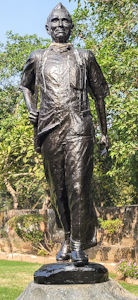
 

Close to the east end of the Nehru Bridge in Ahmedabad, the city in which Yagnik died, there is a small, well-maintained  park in  which there is a fine statue of Indulal Yagnik. It was created by the late Kantibai B Patel, who also made many other statues of well-known Gujarati people, including many of Mahatma Gandhi.  The statue of Yagnik depicts the man striding forward, his shirt pocket filled with a spectacles case and a pen.


I was keen to view the statue not only because I had read Yagnik’s biography of Krishnavarma  but also for another reason. His nephew,  who lives in Bangalore,  is a good friend, whom we got to know because his wife is related to members of my wife’s wider family.


Even if you do not have the sort of ‘connection’ we have with Indulal Yagnik’s nephew, the statue is worth seeing because it is a good piece of sculpture.

A fort and a temple in the heart of Ahmedabad

THE TEEN DARWAZA (a magnificent three arched gateway built in 1415) was an entrance to the Bhadra Fort in Ahmedabad.  The Gateway faces the main part of the fort, but is separated from it by a large rectangular piazza lined with shops, eateries, an auditorium designed by BV Doshi, and market stalls.


The Bhadra Fort itself was constructed by the founder of Ahmedabad,  Ahmed Shah, in 1411. Thus, it is one of the oldest surviving edifices in the city. Only a few parts of this imposing structure are accessible to members of the public.

One substantial part  of the fort is occupied by a busy Hindu Temple,   Nagardevi Shri Bhadrakali Temple. This has been in existence for many years. However, since our last visit to Ahmedabad two years ago, the temple has spread into the piazza, occupying an area that used to be filled with traders’ stalls. The expansion consists of an area covered by a colourfully decorated canopy.


In addition, many of the street vendors who used crowded and enliven the piazza between the fort and the Teen Darwaza have been cleared out. According to one shopkeeper, with whom we spoke, it was the Temple authorities who ordered their removal.


The Bhadra Fort was built by followers of Islam. It has now been used to accommodate a Hindu temple.  Seeing this reminded me of the Charminar in Hyderabad.  This place, which is of great significance in the Islamic world, like the Bhadra Fort,  has been encroached by a Hindu temple. Although less solid in appearances than that in the Bhadra Fort, that attached to the Charminar is here to stay.

Dining with the dead in Ahmedabad

IN CENTRAL AHMEDABAD, a large city in India’s state of Gujarat, there is a curious café called Lucky. This popular eatery, founded in 1950, is unusual not because it does not serve coffee but because its tables and chairs are placed between Moslem graves. Also, the trunk of an old tree is contained within the restaurant. Its base is within the eatery and it passes out of the place through a hole in Lucky’s ceiling.

Tree trunk and a grave at Lucky

Lucky’s is sited on an old Moslem graveyard, but this does not put off a steady flow of customers from enjoying a wide variety of vegetarian meals and snacks in this eatery. Closer to home, near the south side of London’s Lambeth Bridge, there is another café sited on a former graveyard.