An ingenious use of simple matchsticks in a work of art

FROM AFAR IT LOOKS like a small red and black oriental rug, but as you approach, it is not what it seemed at first sight. This artwork by Hadi Rahnaward, who was born in Afghanistan in 1986 and now resides in Belgium, is made with matches, glue, and other materials. The matches used are of two sorts. Some are tipped with black material, and the others with red.

The matches have been glued to a base so that each one of them is vertical and standing with its tip pointing upwards. They have been placed close to each other in such a way that their tips form a mosaic resembling a patterned oriental carpet or rug. The artist made this incredibly intricate creation in 2023. It is one of a collection of often intriguing artworks by young artists from south Asia and Afghanistan being exhibited at the SOAS Gallery (formerly known as the ‘Brunei Gallery’) in London’s Bloomsbury until 21 June 2025.

One of the other exhibits that intrigued me is an embroidery by Varunika Saraf (born 1981), who lives and works in Hyderabad (India). Called “The Longest Revolution” and made in 2024, this embroidery depicts many features of Indian women’s struggle for basic rights and parity with men. This busy looking artwork depicts many aspects of women’s political struggles, and in places reminds the viewer of some parts of the Indian Constitution that appear to have been considered less relevant than previously by some in India during the last few years. Even if the political content of this piece is ignored, it is an eye-catching work of art.

When two holy men meet in a picture from Afghanistan

VISITING CHRISTIE’S AUCTION house near London’s Piccadilly is never disappointing. There are usually items on display, waiting to be auctioned, which are of great interest. Today (25 April 2025), we viewed the items awaiting a sale that will be held on the first of May. The sale is called “Art of the Islamic and Indian Worlds Including Rugs and Carpets”. Standing alone in one room is a folio (page) with coloured paintings on its front and back. This item has been called “The Prophet Muhammad Meets Jesus in the Beit Al-Ma’mur and the Arrival at the The Fourth Heaven”. It was created in Afghanistan in about 1466, and is in remarkably good condition.

The images show two episodes in the Mi’raj, which as the Christie’s website explained is:

“… one of the most important moments in the life of the Prophet Mohammed. In the Qur’an, sura al-‘Isra alludes to the fact that Allah transported ‘his servant Muhammad by night from the Masjid al-Haram to the Masjid al-Aqsa, whose surroundings we have blessed, so that We may show him some of Our signs’. Though traditions vary, most take this to be a reference to the Prophet being miraculously taken from Mecca to Jerusalem and thence to Heaven.”

Muhammad is depicted as riding on Buraq, his quadruped mount. In the picture at Christie’s, Buraq has been shown as having a human head. In one picture, the Prophet Muhammad is dressed in green and can be seen riding on Buraq and meeting a man dressed in brown robes, who is Jesus (Isa) Christ. In between Jesus and the Prophet, there is a figure with wings, the angel Jibra’il (Gabriel). These holy men are shown meeting in the Beit Al-Ma’mur, which is a celestial form of the Holy Kaaba at Mecca. The picture on the reverse of the folio, we find the Angel Gabriel depicted again. He seems to be heading for a group of angels, followed by the Prophet dressed in green and riding on Buraq.  The angels in the picture are shown greeting the Prophet and Gabriel as they make their way through the tiers of heaven.

Apart from being amazingly beautiful, there were some details that caught my eye. Jesus is depicted with a face that could be Arabic. All the other faces, including that of Muhammad, have oriental eyes typical of Central Asia or further east. The faces of others in the pictures, including that of Buraq, are typically Far Eastern in type. I suppose that in 15th century Afghanistan, Central Asian faces were a familiar sight.  In the picture that depicts Muhammad moving towards the angels, much of the space surrounding the figures is filled with swirling golden clouds which makes the picture look like a Chinese creation at first sight. Another detail that interested me, and which I spotted in some other pictures on display at Christies, was that although the artist had drawn a frame around the image, one angel seemed to be standing partly outside the frame.

One of the delightful features about Christie’s is that if one asks a member of staff a question about an exhibit, he or she will go out of their way to answer it accurately. In the case of the pictures described above, a gallery assistant asked one of the specialists who dealt with it to come from her office to discuss it with us. This lady answered our questions and explained that what we were looking at is extremely rare. The folio at Christie’s was from a book, whose pages have been dispersed to many different places over time.  In Paris there is another very similar but slightly older example of that book, but the page with the episodes I have just described has been lost from it.  

The auction whose lots we saw on display contains many fine Mughal and other Indian pictures and objects, as well as items, such as the folio, which originated in Islamic countries such as Persia, Turkey, and places in Central Asia. Once again, a visit to Christie’s has proved most rewarding.

Drums in Afghanistan

RUDYARD KIPLING PUBLISHED his story “Drums of the Fore and Aft” in 1889 (www.kiplingsociety.co.uk/rg_foreandaft1.htm). Based on an incident that occurred in the Second Afghan War (1878-1890), most likely during a battle at Ahmed Khel in 1880, his tale includes the story of two drummer boys, who, fortified with rum and courage, march up and down the battlefield playing the tune of the song, “The British Grenadiers”, which, incidentally, we used to sing at school in the early 1960s. Although the British defeat their enemy, the boys are killed.  Well, I doubt that I would have ever known about this story had we not recently visited Woodbridge on the backwaters of the coast of Suffolk.

Much of Woodbridge is located on the slope of a hill. Its picturesque Market Hill is high up on this incline. It contains many buildings that have been in existence for several centuries. In the centre of the square, stands the Shire Hall, a rectangular brick building with stone trimmings and gables at both ends of its roof. The gables give the building a somewhat Dutch appearance. The edifice is believed to have been built in about 1575 by a local worthy, a politician and member of the court of Queen Elizabeth I, Thomas Seckford (1515-1587). Since then, it has been modified a little, but not to its detriment.

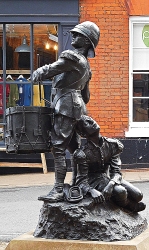
Just outside the eastern end of the Shire Hall, we found a sculpture depicting two young soldiers. One is standing, beating a drum, and the other is sitting on the floor looking upward, a discarded bugle at his feet. A plaque next to the sculpture reads as follows:

“’Drums to the Fore and Aft’. Gifted to the Town by the Duchess of Albermarle following her husband’s wishes in January 1980. Sculpted by Arnold, 8th Earl of Albermarle. Re-sited to this position in March 2018.”

When I saw this, I wondered about the aristocratic creator of this lifelike sculptor.

Arnold was Arnold Allan Cecil Keppel, 8th Earl of Albemarle (1858-1942), soldier, courtier, and Conservative politician (https://en.wikipedia.org/wiki/Arnold_Keppel,_8th_Earl_of_Albemarle). Educated at Eton College, he fought in the 2nd Anglo-Boer War (1899-1902) after having been an MP for Birkenhead between 1892 and 1894. On becoming the 8th Earl, he took his late father’s place in the House of Lords. His wife was born Lady Gertrude Lucia (1861-1943). As she died in 1943 and the town only received the sculpture in 1980, it seems to have taken a long time for her late husband’s wishes to be fulfilled. At least that is what I thought until I looked into the story behind this work of art.

As for the sculpture in Woodbridge, Wikipedia includes the following about Arnold Keppel’s relationship with it:

“He is credited with sculpting the statue of the two drummer boys from Rudyard Kipling’s story ‘The Drums of the Fore and Aft’ that now stands in Woodbridge, Suffolk.”

The Recording Archive for Public Sculpture in Norfolk & Suffolk, a database of sculptural works within the two counties, has the following information about the sculpture (http://racns.co.uk/sculptures.asp?action=getsurvey&id=373):

“8th Earl of Albemarle Sculptor(s). Private commission by 8th Earl of Albemarle. 1901, the cast may be later since the foundry only adopted the name A.B.Burton in 1902, after the death of the other partner, A.J. Hollinshead.”

An illustration in the Archive’s website shows a plaque, which I did not see. This provides the information that the sculpture was given to the town in January 1980 in memory of Walter Keppel, the 9th Earl of Albermarle (1882-1979). Another photograph shows that the sculpture is signed “Albermarle 01”. ‘Albermarle’ was Walter’s father, and ‘01’ refers to 1901. Having learned all of this, I now realise that the sentence I read on the plaque, “Gifted to the Town by the Duchess of Albermarle following her husband’s wishes in January 1980.”, refers not to the 8th Earl’s widow, but to the widow of his son, Walter.

The sculpture is well executed, showing that its maker was a competent artist. A search of the Internet revealed that in addition to the sculpture in Woodbridge, he also drew portraits (e.g. https://auctions.roseberys.co.uk/m/lot-details/index/catalog/299/lot/116339?uact=5&aid=299&lid=116340&current_page=0). Otherwise, I can find hardly anything else about his artistic output. That said, if the sculpture in Woodbridge is the only example of his modelling, it is something that the late 8th Earl must been pleased with.

Afghan cab drivers

Dolmus driver_240


A few years ago, we hired a mini-cab (a type of taxi) to take us from Kensington to Golders Green. When we entered the cab, we heard music being played on the car’s cassette player. It sounded Russian to me. I asked the driver about it and he confirmed that it was Russian. He told us that he was from Afghanistan and had lived in Russia for a couple of years before settling in London. We began chatting as we drove northwards towards Golders Green. He told us that during the day he sold shoes in his own shop and drove his cab in the evening. We engaged in an amicable conversation.

When we arrived at our destination, I asked how much we owed him. He said:

“Nothing at all.”

“But, we must pay you something,” I said.

“No, nothing. You are my friend. I cannot ask you to pay me,” he explained.

For a few moments, I was flummoxed, at a loss as how to proceed. On the one hand, he said he did not want to be paid. On the other, he had done a good job for us, which needed rewarding. Then, I said to him, handing over a £10 note:

“If we can’t pay you, take this as a present for your children.”

He accepted the money without objection. £10 was the normal fare for that journey in those days.

We booked another mini-cab for our return journey. By coincidence, it was driven by someone from Afghanistan. Although he was not as friendly as the outward bound driver, there was nothing to complain about him. When we arrived at our home, we asked him how much we owed. He answered:

“Anything you like.”

I paid him the £10, which we usually pid for that journey, and the driver was happy with that.

Shortly before that day of Afghan mini-cab drivers, I had finished reading a book about travelling in Afghanistan., An Unexpected Light: Travels in Afghanistan by Jason Elliott. In it, he describes shopping in rural Afghanistan. The customer is not quoted a price, but has to make an offer. If the offer is too low, the seller will look insulted and hurt. If it is too high, everyone else in the shop will laugh at the customer. I suspect that it was on this basis that the two mini-cab drivers operated with us. They must have detected our familiarity with eastern ways and customs. Had we been typical Anglo Saxon customers, they might have simply quoted a price.