
When the letters V and R did not refer to England’s Queen Victoria

THE SETUPARVARTIPURAM DAM, also known as the Kundala Dam, is a popular spot for tourists. This curved dam, built with masonry blocks, lies near the beautiful road that runs between Munnar and Top Station, a high mountain view point.

Kundala Dam

At the entrance to the narrow roadway that runs along the top of the dam, there are two commemorative plaques. Both of them bear the coat of arms if the former Kingdom of Travancore and the letters V and R intertwined.

One of the plaques informs the viewer that the dam was opened during the twenty-fifth year of the reign of “His Highness Sri Chitra Thirumal Sir Balaramvarma … Maharajah of Travancore”. Born in 1912, he died in 1991. He came to the throne in 1924. Therefore, the twenty-fifth year of his reign was 1948/49.

It was in 1949, that the Maharajah agreed to unite Travancore with Cochin (and the rest of India). Between Indian independence in August 1947 and 1949, Travancore resisted unification with the new republic of India. Between 1949 and 1956 Sri Chitra Thirumal served as the first and only Governor of the newly formed Travancore-Cochin Union. In 1956, this territory was incorporated into the state of Kerala.

As for the intertwined R and V, this has nothing to do with Queen Victoria (VR). Instead, it refers to Rama Varma, a set of rulers of Travancore, Cochin, and other parts of Southern India.

Having established the significance of the letters R and V, I must add that a visit to the dam is a delightful experience.

On the wall

IT IS ODD how seeing a mundane object can stimulate less than mundane thoughts. Embedded into a wall in Salcombe (Devon), I saw an official post box for depositing mail. At first, I took little notice of it. Then, when I saw it a second time, I noticed that its red-painted front bears the letters “GR”. This refers to a King George. Because the first letter boxes were installed in the reign of Queen Victoria, the GR on the letter box in Salcombe must refer either to George V (reigned 1910-1936) or George VI (reigned 1936-1952) because the other King Georges all preceded Victoria.

Possibly the GR on the box in Salcombe refers to George V because he was the first George to follow Victoria, in whose reign the boxes bore the letters “VR” (Victoria Regina). Even though Edward VII was the first monarch to follow Victoria, boxes installed in his reign include the Roman numeral VII. Likewise, in the case of other monarchs who followed Victoria, their initials on post boxes include numerals identifying which king or queen they denoted (i.e., E VII R, G VI R and E II R). Not having ever looked out for it before, I am not sure whether any post boxes installed during the reign of George V bear the logo G V R or, as I saw in Salcombe, simply GR. A rapid search of the Internet revealed that most George V post boxes illustrated on websites dealing with post boxes bear the letters GR, as was the case with the example I noticed in Salcombe.

I suppose that when Charles or his son William come to the throne, letter boxes, if they still exist in the age of electronic mail, will bear the logos “C III R” and “W V R” respectively, rather than “CR” and “WR”. Why the V (meaning ‘5’) was not included on the post boxes issued during the reign of George V but the VII (meaning ‘7’) appears on those installed during his predecessor’s reign is not clear to me.

The writing on the … lampposts

It is interesting what one can spot when walking leisurely along a street

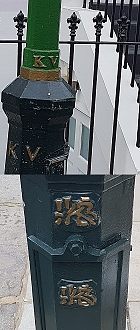
CALLCOTT STREET IN Notting Hill Gate is only 76 yards long. It contains two lampposts that provide evidence of Kensington’s administrative history. Once, this street was in the Borough of Kensington, which was incorporated into the larger Royal Borough of Kensington and Chelsea (‘RBKC’) in 1965.

Most streetlamps in RBKC, are marked with the letters R, B, K, and C, intertwined. However, one of the lampposts in Callcott Street is marked with ‘RBK’, without the ‘C’. The other lamppost in this short thoroughfare is marked with the letters ‘KV’. This stands for Kensington Vestry. In the 19th century and probably earlier, local affairs were governed by the local vestry. This was a meeting or council of parish ratepayers, which often met in the local parish church or its vestry. In the case of Kensington, there is a fine Victorian building, now a branch of the Iranian Bank Melli, which used to serve as the Kensington Vestry Hall. Before this was built (in 1852), the local vestry used to meet in a room attached to the nearby St Mary Abbots church.

In 1901, the Metropolitan Borough of Kensington was granted the status of ‘Royal Borough’ and was known as the Royal Borough of Kensington. So, the streetlamp marked with ‘RBK’ must date from between 1901 and 1965, and the one with ‘KV’ is even older.