
Modernist architecture on a popular shopping street in central London

AT GROUND LEVEL, London’s Oxford Street is lined with numerous retail outlets, many of which can be seen on shopping streets and in malls all over England. Raise your eyes above ground level, and you will notice that the shops are beneath buildings designed in a bewilderingly wide range of styles. Today (the 22nd of May 2024), I spotted a Modernist style building, number 219 Oxford Street, which is on the corner of Oxford Street and Hill Street. Its ground floor has become part of a Zara shop’s showroom.

The upper floors of the five-storeyed number 219 retain their 20th century Modernist style architectural features, and its Oxford Street facade is adorned with three bas-relief plaques. One of them, at the fourth-floor level bears the date ‘1951’ and a logo. Despite its date, the building has remarkably clean lines and an elegant simplicity. There is much information on the Internet about this edifice, but even though I have walked past it many times, it was only today that it caught my attention.

The Historic England website (https://historicengland.org.uk/listing/the-list/list-entry/1352668?section=official-list-entry) revealed that the building:

“… was designed by Ronald Ward and Partners in 1950 for the landlord Jack Salmon, who took the second-floor suite for himself. The scheme was revised in February 1951, but was not built until after August 1951 (explaining the plaques celebrating the Festival of Britain – an event which was held in the summer of that year), and appears not to have been completed until 1952, as evidenced by the dated tile near the door to the upper floors. Despite the delay in its construction the building was among the very earliest post-war commercial buildings to be put up in the capital.”

Another website (https://lookup.london/219-oxford-street-history/) provided some detail about what is depicted on the plaques. The plaque with the date 1951 also contains the (1951) Festival of Britain logo. Above this, the top plaque shows the Royal Festival Hall and next to it the Shot Tower from Lambeth Lead Works, which stood close to the Hall, but was demolished in 1962 to make way for the Queen Elizabeth Hall. The lowest plaque depicts the Skylon, which was also part of the Festival of Britain complex of structures (on the South Bank), but no longer exists.

Number 219 was threatened with demolition in 2004, but luckily for us it escaped this fate, and is now protected as a Grade II Listed Building.
Pleasure Gardens then and now

BATTERSEA PARK IS but a very few miles (only three!) from where we live in London, yet it is a place that until now we have hardly ever visited. Maybe, this is because it is across the River Thames on its south bank. To those who live on the north side of the Thames, anything across the Thames seems extremely far away and almost in another country. That sounds ridiculous, but it is the case. The river is like a psychological barrier to us ‘northerners’, but it is well worth crossing it. We parked our car in Chelsea close to the Albert Bridge, an elegant structure built in the early 1870s. A short stroll across the bridge brings you to Battersea Park, which stretches along the south bank of the Thames to Chelsea Bridge, which is downstream from the Albert Bridge.

Before 1858, when the park was opened, the land on which it now stands was marshland reclaimed from the Thames and used by market gardeners. Prior to the opening of the park, the area was a popular location for duels. The Duke of Wellington challenged the Duke of Winchilsea in this area in 1829.

The name Battersea is derived from the Anglo-Saxon name ‘Badrices īeg’, meaning ‘Badric’s Island’. In the Domesday Book, it was called ‘Patricesy’. Gradually, the name evolved into its present form. The park was laid out between 1846 and 1854 by the architect Sir James Pennethorne (1801-1871), but when it opened in 1858, the year that Chelsea Bridge was completed, it differed somewhat from his original plans. In 1889, the year when the Eiffel Tower opened in Paris, the park came under the control of London County Council (‘LCC’). Moving forwards to 1951, the year of the Festival of Britain, much of which took place near Waterloo Station on what is now called the South Bank, Battersea park was used to stage a part of the festival known as the ‘Pleasure Gardens’.

You can read much about the Pleasure Gardens on an interesting and informative illustrated website at https://alondoninheritance.com/eventsandceremonies/the-festival-of-britain-pleasure-gardens-battersea-park/ . In contrast to the rest of the Festival, the aim of the Pleasure Gardens:

“… was to balance the other events and add an element of fun to an otherwise mainly serious festival.”

Unlike other parts of the great event, the Pleasure gardens allowed commercial sponsorship. This was because the cost of these gardens was greatly in excess of what the government could afford. The Pleasure Gardens’ attractions included: a shopping area, ‘The Parade’; the Grand Vista with its fountains, arcades, towers, eating areas, and firework displays; a miniature passenger-carrying railway with two stations (Oyster Creek and Far Tottering); a fun fair; lawns and flower gardens; a dance pavilion; specially designated areas for children’s performances such as ‘Punch and Judy’; and a zoo. It must have been quite a wondrous place and a great relief for many people who had suffered hardships during WW2 and just after it. Many of the structures in the Pleasure Gardens were designed by well-known artists of the time including, to mention a few, John Piper, Osbert Lancaster, and Hugh Casson.

The former Pleasure Gardens were on the north side of Battersea Park close to the river. Little remains of what must have been a wonderful sight. The Children’s Zoo flourishes. It is the descendant of the zoo created in 1951. It nearly closed in 2003, but was rescued by Carol and Roger Heap, a couple intensely interested in wildlife education and conservation. Their son Ed is involved with the zoo’s management and his wife Claire is the zoo’s resident vet. I have yet to see the zoo, which we did not visit recently on account of the rain.

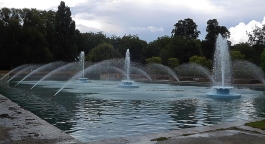
Hardly anything remains of the other parts of the Pleasure Gardens. The funfair that was opened in 1951 continued to operate until the early 1970s when an accident involving the Big Dipper occurred on the 30th of May 1972 hastened the fairground’s demise. What little remains of the Pleasure Gardens today has been conserved well by Wandsworth Council. This includes, The Parade (a tree-lined avenue running inside the park parallel to the riverbank), the Fountain Lake, and a few remnants of the Grand Vista. The prominent Peace Pagoda (erected 1985) with its gold coloured Buddha stands where once the Mermaid Fountain (sponsored by Lockheed Hydraulic Brakes) stood.

We visited Battersea Park on a grey weekday when few other people were in the park. The remnants of the Pleasure Gardens, where many people once congregated to have fun, was eerily empty, almost surrealist in appearance. Next year, it will be 70 years since the Festival of Britain. Being optimistic, it would be nice to imagine that maybe the pandemic will have subsided significantly, and we might be able to celebrate again, possibly with an element of ‘socialdistancing’ as one of the ‘attractions’.