
Regent: a cinema regenerated in a small town in Dorset

OVER THE YEARS, many cinemas that were opened in the first half of the 20th century have either been closed or converted to be used for other purposes. A substantial number of them were built in the Art Deco style, which flourished in the 1920s and ‘30s. Some cinemas, such as the Ionic and the ABC in Golders Green and the Odeon in Temple Fortune, have been demolished. Others became bingo halls or meeting places for religious groups. The Coronet in Notting Hill Gate began life as a theatre, then became a cinema, and is now a theatre again. During a recent visit to Christchurch in Dorset, I saw a cinema, designed in the Art Deco style, which is still in business.
The Regent Cinema stands on Christchurch’s High Street. It is in pristine condition – a fine example of Art Deco architecture and internal design – it looks as if it has been built recently. Opened on Boxing Day 1931, it continued showing films until it closed in July 1973. After that, like so many other cinemas, it was operated by the Mecca company as a bingo hall and social club. This functioned until it closed in 1982. Late that year, the building was purchased by Christchurch Borough Council.

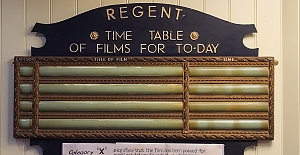
The local authority together with over 100 volunteers restored the Regent to its original Art Deco glory. In June 1983, the Regent Centre with its cinema were opened for use. Since then, the restoration of the cinema has continued and technological improvements have been made (e.g., digital cinema has been introduced). Very recently (in 2021) further work has been done to recreate the original cinema (e.g., the cinema’s seats, carpet and colour schemes, have been restored to their original appearance, and 35 mm projection has returned). Given all this loving care the cinema has received, it is no wonder that it looks like new. Now, it is mainly run by keen volunteers.  It is very heartening to discover a cinema that has survived closure and repurposing and lived to return to being used for the purpose it was originally designed. On the Sunday morning that we visited it, we were unable to enter the auditorium because it was filled with children enjoying the screening of a film. However, the ticket office contains a good set of photographs of the restored cinema’s interior.

Art Deco in Victoria

I HAVE WALKED past London’s Victoria Coach Station many times without looking at it particularly carefully. Yesterday, the 28th of September 2022, I was early for a meeting at the Embassy of Albania, which is not far from Victoria Station. So, I walked slowly, stopping to look at the Coach Station. I had never noticed before that it is a fine example of Art Deco architecture.

The Coach Station, which opened for use in March 1932, was designed by Wallis, Gilbert, and Partners.

I suppose that my interest in Art Deco buildings was initiated by visits to Bombay (Mumbai), where there are many splendid examples of this style of architecture. Gradually, I am discovering that London also has a rich collection of Art Deco buildings. The Coach Station is a fine and well-maintained example.

Black and white housing

WHEN DRIVING HOME after leaving our vacuum cleaner for repair at a small shop in Ealing, we passed a tidy estate consisting of houses and blocks of flats, all decorated with mock half-timbering painted in black and white. Near to West Ealing Underground station, this housing colony is called Hanger Hill Garden Estate.

During the period between the two World Wars, much residential building work was undertaken in London’s suburbs. Often, estates were built with features that mimicked rusticity. The idea was that the commuters, who lived there, might imagine that they were enjoying a village atmosphere, without being far away from the inner city, where many of them worked. To create this illusion, house builders adorned their constructions with decorative features that were supposed to make them seem older and more traditional than they were. The use of mock half-timbering on external walls was a commonly used decorative trick designed to evoke suggestions of ‘ye olde England’.

At Hanger Hill Garden Estate, there is a uniformity of style, which makes the use of half-timbering eye-catching rather than suggestive of rustic traditions. Interestingly, the mock half-timbering does not extend to cover the dull, pebble-dashed rear walls of some of the blocks of flats. These surfaces are less easy to see from the roads than the mock half-timbering. Overall, the result is attractive. When I first saw this well-maintained estate with neat gardens, I thought of early 20th century garden suburbs rather than old country villages, which are often delightful because they lack uniformity in their layouts.

The opening of the branch of the Central Line, which runs from Shepherds Bush to Ealing Broadway, in 1920, and especially the opening of West Acton Station three years later, were the stimuli for the construction of residential estates in the area. In 1925, the first bit of land was acquired by Hanger Hill Garden Estate Ealing Limited. The estate was built between 1928 and about 1932. The buildings, flats and houses, were all designed by the architectural practice of Douglas Smith & Barley. The resulting layout has considerable uniformity, and is attractive without being monotonous. A good feature in the estate’s design is that the blocks of flats stand in spacious lawns.

The Residents Association’s website has a good history of the place (www.hhgera.com). It noted that in the 1930s:

“…times were clearly pleasant and peaceful ones for all the tenants on the Estate. Occupiers of some of the four-bedroomed houses employed a maid, the fourth bedroom having been designed with this in mind. Whilst all the houses and many of the flats had garages, only a small number of people on the Estate owned cars … These were the days when goods were delivered to the home. Tradesmen were not allowed to call at the front doors of the houses or flats, but had to call at back doors using the service roads. Bakers, butchers, fish salesmen and greengrocers all called weekly, some attending earlier in the day or week to take orders. In the parking bays behind the flats, vans from Harrods, Dickens & Jones and the like, were to be seen drawing up.”

However, life on the estate was not free from regulations:

“Tenancies of flats were refused to people who had young children. No animals were allowed to be kept in the flats … House tenants were allowed to hang out washing only on Mondays and Tuesdays; flat tenants were not permitted to hang out washing at all.”

Currently, so two friendly residents informed us, the estate is subject to strict conservation regulations. This is a good thing because it would be a shame to spoil the appearance of this charming and unusual enclave of residential accommodation in this part of west London.

READ more about west London in Adam Yamey’s book “BEYOND MARYLEBONE AND MAYFAIR: EXPLORING WEST LONDON”, which can be bought from Amazon https://www.amazon.co.uk/BEYOND-MARYLEBONE-MAYFAIR-EXPLORING-LONDON/dp/B0B7CR679W/

Take me to the Tivoli

WIMBORNE IS A CHARMING small town in Dorset, a little north of Poole and Bournemouth. Famed for its Minster church with its mediaeval chained library, the place is rich in old buildings. One of these, looking less old than many of its neighbours, houses the Tivoli Theatre. It attracted my attention because of its (heavily restored) art deco features.

Housed in what was originally the 18th century Borough House, the theatre-cum-cinema was created in 1936 to the designs of Edward de Wilde-Holding, a prolific architect. The cinema was closed in 1980 and was threatened with demolition for a road scheme, which fortunately was abandoned. It was restored by a group called ‘Voluntary Friends of the Tivoli’ and reopened in 1993. In addition to showing films, the theatre is used for live events on its stage.

The Tivoli was not the only art deco cinema we spotted on our recent trip to the area around Winchester. 28 miles northeast of Wimborne, there is another one, The Plaza in Romsey, which was built in 1931 as a cinema but is now used as a theatre. Unlike the Tivoli in Wimborne, which occupies an old building, the Plaza in Romsey was purpose-built as a cinema.