
Some mouthwatering experiences on the stages of theatres in London

OVER THE YEARS, we have watched several plays, which are best seen after eating rather than when hungry. In all of these, the actors have prepared and even cooked food on the stage. Many years ago, we watched a play about the artist Van Gogh’s stay in London. The stage set for this drama, which we saw over 20 years ago, included a kitchen. During the show, a roast meal complete with meat and vegetables was prepared in front of the audience. It smelled great, but we were not invited to eat any of it.

More recently we saw a play called “The Arab-Israeli Cookbook” on the small stage of the tiny Gate Theatre, which is above a pub in Notting Hill Gate. The audience was seated only a few feet away from two ladies, one of whom was preparing Israeli dishes, and the other Palestinian food. The drama explored the ongoing conflict in that country beset by conflict and tragedy: Israel. What was being prepared on stage was delicious. I am pleased that we had eaten before watching the preparation of mouthwatering food, which we were not offered.

Today, the 21st of September 2024, we watched a play, “My English Persian Kitchen”, written by Hannah Khalil. Starring only one actor, Isabella Nefar, it is showing at the Soho Theatre in Dean Street until the 5th of October 2024. Throughout the 70 minutes of this one act play, Ms Nefar prepares an Iranian herb and noodle soup, Ash-e-Reshteh, on a kitchen unit placed in the middle of the stage. While she tells us the secrets of making this soup, she also relates the problems of being a married woman in Iran and how she fled from the country and her husband. She also describes her arrival in London and how she reacted to life there, and how others reacted to her. Every now and then, she has flashbacks to her difficult marital experiences back in Iran. As the play comes to an end, her soup becomes ready to eat. She invites the audience on the stage to taste what she had prepared while we were watching. All in all, it was a great piece of drama. My wife tried the soup, and said it tasted good. I did not try it because it contains beans and lentils, neither of which I particularly enjoy.

I went to Soho Theatre after having a lighter than usual lunch. As the actress prepared the dish, the cooking smells did increase my feelings of hunger. I should have eaten more before reaching the theatre.
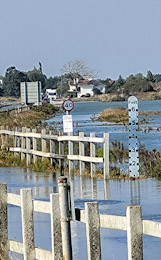
When nature challenges the flow of traffic.

THE ISLAND OF MERSEA is connected to the mainland of Essex by a causeway,  which was originally constructed before the medieval era. It is the only way that vehicles, motorised or otherwise,  can travel between Mersea and the rest of Essex.

Twice a day, the tide rises. When it does, not only do the mudflats close to the island become submerged beneath the sea but also the causeway.

The flooded causeway

After visiting East Mersey, we drove to the causeway and had to stop in a long queue of traffic. It was high tide, and the water had not only covered the causeway but also about 200 yards of the roadway approaching it. It was interesting to see how even in the 21st century,  a simple thing such as high tide can bring life to a standstill.

From Flanders to Devon and  thence to an island in Essex

FROM FLANDERS TO DEVON AND THENCE TO ESSEX

THE MEDIAEVAL CHURCH of St Edmund King and Martyr in the tiny village of East Mersea, on an island close to the coast of Essex, is a joy to visit.

The south wall of the church has some relatively modern windows, which are mostly glazed with clear glass. However, parts of the windows contain small pieces of stained glass, which look quite old. Chris Parkinson at the museum in West Mersea told us that these small fragments of what had once been larger window range from the 15th to the 18th centuries. They were brought to Essex from Devon by the Sunnock family, who came from Topsham and nearby Exeter.

The Sunnocks were a prosperous family. In the 19th century, after the Napoleonic Wars, English gentlemen toured France and the Low Countries, buying up antiques including bits of stained glass from religious establishments. The Sunnocks acquired a large collection of old stained glass this way, and brought it with them when they bought a home on Mersea Island.

During WW2, their Essex home was requisitioned by the military, and the glass was stored in a truk. After the war, some of the glass was restored in Norwich, and then installed in the windows of the church in East Mersea, where it can be seen today.

Memories of the Italian city of Udine in a restaurant in Essex

LAST NIGHT I ENJOYED a pint of Moretti beer in a pizzeria on Mersea Island (Essex). The beer company was formed in 1859 in a town in northeast Italy: Udine. The company logo is a man wearing a hat and holding a glass tankard of beer.

In the 1960s, a young lady from Udine, Adriana, came to London to teach Italian at the LSE, where my father was a professor of economics. My parents, who loved Italy and Italians, used to invite Adriana to our home. Soon, she became a family friend.

After her return to Italy, we used to visit Adriana and her hospitable parents in Udine. In Udine and all over the region of Friuli-Venezia Giulia, in which the city is located, there were advertising hoardings for Birra Moretti. The images of the hatted beer drinker were as ubiquitous as were images of Tito in Yugoslavia or of Lenin in the USSR.

As I drank my pint of Moretti in West Mersea, happy memories of Adriana, her family, and trips made to Udine came back to me.

By the way, the Waterfront Pizza in West Mersea, where I drank the Moretti, is a superb place to enjoy an evening. Not only are the pizzas high quality, but also the ambience and management of the place is excellent. Although we were eating on an island next to the coast of Essex, it felt as if we were hundreds of miles away on the shores of the Mediterranean.

The moving story of St Martin’s School of Art

THE MOVING STORY OF ST MARTINS SCHOOL OF ART

MY INTEREST IN the St Martins School of Art derives from the fact that my mother made sculpture there during most of the 1950s and in the first half of the 1960s.

St Martins was founded in 1854 by the Vicar of St Martins in the Fields, Henry Mackenzie. It was first housed in Shelton Street (formerly, ‘Castle Street’), near to the Seven Dials and Covent Garden. In 1859, it became independent of the Church. By the 1930s, the school had moved into a Modernist building designed for the London County Council by E. P. Wheeler and H. F. T. Cooper, about whom very little is known. It was in this building, now occupied by Foyles bookshop, that my mother worked as a sculptor.

Central St Martins today

In 1989, St Martins merged with the Central School of Art and Design. The new entity is called Central St Martins. Since 2011, it has been housed in a converted warehouse complex on Granary Square at King’s Cross. Today, the 17th of September 2024, I visited its splendid, spacious premises, which combine well-preserved elements of its industrial precursor with excellent 21st century architectural features. I was there to look at material in the archives, which proved most interesting, and about which I will write in the future.

Whenever I think of St Martins, I am moved, not because it has shifted several times, because I am moved remembering my mother’s association with it.

William Morris lived here in Oxfordshire but did not make wallpaper

THE NATIONAL TRUST looks after a house in Oxfordshire, which was once owned by William Morris. When I came across this property, Nuffield Place, I was surprised, because I believed that the artist and socialist William Morris (1834-1896) had lived in properties in Hammersmith, Walthamstow, Bexleyheath, and Gloucestershire, but not in Oxfordshire.

Nuffield Place was the home of another William Morris, who became Baron Nuffield in 1934, and later in 1938, Viscount Nuffield. He lived from 1877 until 1963. At the age of 15, he set up his own bicycle repair business. By 1901, he had a bicycle repair and sales shop on the High Street in Oxford. Two years later, he was manufacturing motorcycles. In 1903, he married Elizabeth Anstey (1884-1959), a seamstress whom he met when both were members of a cycling club. They never produced children.

By 1909, he had set up the Morris Garage in Oxford, and was selling and repairing cars. In 1913, he and his small team of workers had built the first car he had designed. By the time the First World War had begun he had acquired larger premises in Cowley on the edge of Oxford. He was already producing cars that were affordable to the popular market, but during the war, his factory switched to producing products needed for the war effort. While doing this, which was not very profitable, he developed much experience in the techniques of mass-production. One of the many models turned out by the Morris factory was the Morris Oxford. This car has made its mark in India because it was the prototype for the Hindustan Ambassador, which was made in India between 1957 and 2014.

After WW1, Morris began making huge numbers of affordable Morris cars, which sold well. William Morris became incredibly rich. However, he was a modest man and extremely generous. He spent most of his money on philanthropy, particularly in the medical field. Many of the institutions he paid for, which bear the Nuffield name, including Oxford’s Nuffield College, still exist. The number of ways in which he helped are far too numerous to be listed. As a child, he wanted to study medicine, but economic circumstances did not allow that to happen. However, because of all he did to promote healthcare and medical research, he was made a Fellow of the Royal College of Surgeons in 1948.

Nuffield Place, the house which William Morris purchased in 1933 and lived in for the rest of his life, was built for the shipping magnate Sir John Bowring Wimble, also chairman of an insurance company, in 1914. It was designed by Oswald Partridge Milne (1881-1968), who worked in the office of Edwin Lutyens between 1902 and 1904. When Sir John died in 1927, his widow sold the house, which was then called ‘Merrow Mount’, to Morris in 1933.

The house is spacious and must have been comfortable to live in, but it is remarkably modest to have been the sole residence of a man as wealthy as the automobile manufacturer William Morris. We were shown around it by a knowledgeable lady, who helped us to appreciate how modest were the lives led by William and Elizabeth Morris. Among the many things that interested me was William Morris’s bedroom. In one corner of it, there is what looks like a wardrobe. However, when the doors are open, it can be seen to be filled with tools and a workbench. Morris had his own workshop in his bedroom. His wife continued her seamstress skills, and many chairs were covered with textiles she had worked on. The house contains many books on a variety of subjects including history and politics. One bookshelf is filled with medical treatises. Morris, although he never became a doctor, was interested in reading about medicine.

Nuffield Place contains an iron lung machine, such as was used to help sufferers of poliomyelitis to breathe. On learning that there was a shortage of these machines in Britain, Morris used his factories to produce many of them to distribute to hospitals that needed them. The model he helped design, and his factories manufactured, has some curious details. The handles that were used to adjust the apparatus look just like car door handles. And some other components on the iron lung look very much like the hinges of car doors. These iron lungs were a valuable contribution to the treatment of diseases such as polio.

I could describe much more of what we saw at Nuffield Place, but it would be better if you visit the it. Lovers of gardens will also enjoy visiting this house owned by a William Morris, who did not design flowery wallpapers.

Is SITE-SPECIFIC art really such a new idea

RECENTLY, WE HAVE viewed two exhibitions, one in Cambridge and the other in Dulwich (South London), which contain site specific works. The website of New York’s Guggenheim Museum (www.guggenheim.org/artwork/movement/site-specific-artenvironmental-art) defines site specific art as follows:

“Site-specific or Environmental art refers to an artist’s intervention in a specific locale, creating a work that is integrated with its surroundings and that explores its relationship to the topography of its locale, whether indoors or out, urban, desert, marine, or otherwise … No matter which approach an artist takes, Site-specific art is meant to become part of its locale, and to restructure the viewer’s conceptual and perceptual experience of that locale through the artist’s intervention.”

It seems that site-specific art is the name given to a relatively recent artistic trend or movement.

By Megan Rooney

In Cambridge’s Kettle’s Yard, we saw a room whose walls were entirely covered by paintings created by the artist Megan Rooney. She spent several days painting on the walls. When the exhibition is over (on the 6th of October 2024), the walls will be whitewashed, and her site-specific creation made especially for the room will disappear. At Dulwich Picture Gallery, there is a room whose walls have been decorated by the Japanese artist Yoshida Ayomi. Her beautiful evocation of cherry blossom was made specially for the room in which it can be seen. Her site-specific work will be removed when the exhibition is over on the 3rd of November 2024. These two artworks, like those of the artist Christo Vladimirov Javacheff (1935–2020), who temporarily covered buildings with sheets of various materials, are classed as site-specific. Currently, it seems to me that site-specific artworks are usually temporary in nature.

Michelangelo covered the walls and ceilings of Rome’s Sistine Chapel with paintings. Likewise, the ceiling in the Residenz, a palace in Würzburg, were covered by paintings created by Giovanni Battista Tiepolo and his sons specially for the room. Should these examples and many others like them be considered ‘site-specific’ art, or is the term only to be applied to creations of artists made during the 20th  and 21st  centuries?  Probably not, because those who commissioned frescoes and murals for rooms many centuries ago, usually hoped that the artworks would outlast them and their creators. The artists who have made site specific art currently and in the recent past do not always expect them to last for as long as those made several centuries ago.

Opera performed by puppets in a restaurant in Chicago

When I was eleven years old, we stayed in Chicago (Illinois) for three months.

One evening, our parents took us to something wonderful. It was at the Kungsholm Restaurant in the centre of Chicago. After dining at its self-service Danish ‘smörgåsbord’ (a kind of buffet), we were ushered into a small theatre. The lights went down, and the curtains of a small stage opened. Then we watched a whole opera performed by puppets operated by people out of sight below the stage. I do not recall which opera we watched, but I do remember at the end of the performance, the puppeteers raised their heads above the stage. As my eyes had become used to the short puppets during the opera, the heads of the puppeteers looked gigantic.

For more information about Kungsholm, see:

https://www.chicagohistory.org/smorgasbord-and-a-show/

A hidden oasis close to Piccadilly in London’s Mayfair

WE VISIT DOVER Street in London’s Mayfair frequently to view exhibitions at the commercial art galleries along it. Laid out in the late 17th century, the street is named after Henry Jermyn (c1636-1708), 1st Baron Dover, who was a member of the syndicate that developed the area in which it is located.

Despite having walked along this street countless numbers of times, it was only this September (2024) that we spotted the entrance to a narrow alley way on the west side of the street between numbers 41 and 43. The alley is called Dover Yard. The first 12 yards of this passageway are covered by a high barrel vaulted, brick-lined ceiling. Then, after a short stretch open to the sky, one enters a wide yard made attractive with plenty of plants.

The yard itself is surrounded by modern buildings. In the 1970s, the yard, which has existed since the 18th century, was bought by developers and used as service area and parking lot (www.ianvisits.co.uk/articles/londons-alleys-dover-yard-w1-64590/). It was redeveloped recently, and is now flanked by the elegantly designed Nightingale coffee bar and restaurant (part of 1 Hotel Mayfair) on the north side, and Dovetail, a Michelin-starred restaurant, faces it.  West of the wide yard, there is another narrow alleyway leading to Berkely Street. It has become a peaceful, almost hidden oasis in the heart of a busy part of Mayfair not far from Piccadilly.

As is often the case when revisiting places we thought we knew well in London, we come across places like Dover Yard, which we have passed often but never noticed. Although we did not try it, the Nightingale looks like it would be a very pleasant place to stop for refreshment.