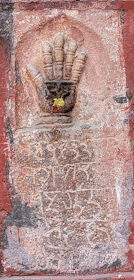
The hands of women about to be consumed by fire

ON THE WALL NEXT to one of the several gates, the Daulat Prole, that leads into the Junagarh Fort in Bikaner, you can see a set of what look like the impressions made by pressing hands into a soft material. Each of these hand prints is labelled in Hindi (Devanagari) lettering. These impressions are amongst the last actions of widows about to commit sati.
Sati was the usually forced self-immolation of widows. Sati was the tradition in India that involved widows being forced to throw themselves on their husband’s burning funeral pyre. Sometimes, they did it apparently voluntarily. It was a tradition often practised by Rajputs, but not restricted to them. During the British occupation of India, there were various attempts to outlaw sati, but incidences of it continued into the 20th century. Finally, in 1987, the Government of India passed an Act criminalising the practice of sati and its glorification.

Returning to the hands at the Junagarh Fort, one of the officials guides told us the following. Prior to being caste onto her spouse’s funeral pyre, the noble Rajput widow would dress in her finest clothes and jewellery, and approach the Daulat gate. By this time, her hands would have been covered with henna (mehndi). She would then press the palm and digits of her right hand on a stone slab, leaving a print of her hand on it. Later, an artisan carefully carved a three-dimensional impression of the widow’s hand. By that time, the poor woman had been incinerated.

In Rajasthan, various of the Princely States abolished sati in the first half of the 19th century. In Bikaner, the last Maharani to die on her husband’s pyre was in about 1825, so we were told by the guide at the fort.

My eye was immediately attracted to the sati memorials. I wonder how many other visitors to the Junagarh Fort stop and contemplate these tragic memorials before proceeding with taking photographs of each other at the many picturesque spots within the fort.

Going Dutch in the fort at Bikaner

UNLIKE JAIPUR, JODHPUR, and Jaisalmer, the city of Bikaner in Rajasthan is not (yet) overrun with tourists. We have been in Bikaner for three days and apart from at the Junagarh Fort (Bikaner’s most significant historical attraction), we have seen only one European visitor. Bikaner differs from the three Rajasthani cities mentioned in the first sentence in that its streets are not lined with shops designed to attract tourists. Apart from the fort the rest of the city is a fascinating, busy working environment, which someone, like me, who enjoys observing everyday scenes of life in India, has plenty to see.

Many of the older buildings that can be seen in the streets of Bikaner have jharokas – decorative, stone-framed windows that project over the street. They are commonly seen features of the Rajput style of architecture and are still being constructed.

The Junagarh Fort is rich in jharokas. Many of them overlook courtyards within it. One of them is of great interest. From a distance it looked to me like it was decorated with blue and white tiling, like Portuguese azulejo work. Close up, it can be seen to be something else.

A huge consignment of Dutch blue and white Delft ceramic plates had been ordered for the royal family of Bikaner. When that was, I do not know. While they were being transported to India by sea, they were damaged, and arrived broken. Instead of throwing them away, the thrifty maharajah had them cut up to produce tiles, all of which bore details from the pictures that had decorated the plates. The tiles were then used to decorate both the inside and the outside of the jharoka overlooking a courtyard that contains an elaborate water feature: a pool with fountains.

Although there is much more to be seen in the fort, this example of repurposing broken plates intrigued me. The Junagarh Fort is definitely a must-see attraction in Bikaner, but it it is now merely a museum-like remnant of the past. Visitors to the city should see this, but also set aside at least a few hours to absorb the busy atmosphere of enterprise, both traditional and contemporary, in the older districts of Bikaner.

Looks like honeycomb and is edible, but it is something different.

GHEVRA IS A Rajasthani food preparation containing ghee, maida (refined flour), milk, and sugar syrup. This mixture is poured into a (usually) circular metal mould and heated vigprously until it attains a texture like honeycomb. Various sweet toppings can be put on the finished Ghevra. We sampled a piece topped with rabri (a sweet made by boiling down milk slowly).

A Maharaja at Versailles and his silver soup spoon

THE OLD FORT of Bikaner dominates the centre of the bustling city of Bikaner in Rajasthan. Visitors can view rooms and halls within the fort by joining a guided tour. The tour we joined was led by an intelligent, informative man. The architecture of the fort and much of its interior decorations are spectacular. Amongst the many exhibits we saw were some relating to Maharaja Ganga Singh (1880-1943), who was ruler of Bikaner from 1888 until his death.

The Maharaja’s full title was General Maharaja Sir Ganga Singh, which reflects his role during two world wars. During WW1, he commanded the Bikaner Camel Corps, which served in France, Egypt, and Palestine. Before that, he served in China during the suppression of the Boxer Rebellion. During WW1, he was appointed a member of the Imperial War Cabinet. Because of this, he was present at the signing of the Treaty of Versailles in 1919. He was the only Indian signatory, the only non-European, at this momentous occasion. Later, he represented India at the League of Nations. In addition to his military achievements, Ganga Singh did much to improve the living conditions and economy of his state.

The Maharaja’s soup spoon

Within the fort there are many memorabilia connected with Ganga Singh. The most intriguing of these is a silver spoon designed so that the Maharaja could eat soup without it touching his impressive moustache. The bowl of the spoon has a barrier that would have kept the moustache pushed away from the soup in its bowl.

Among many other souvenirs of Ganga Singh is a De Haviland DH-9E aeroplane. This was one that had been shot down during WW1, and given to Ganga Singh in recognition of Bikaner State’s services during the war. It was restored by Maharaja Karni Singh in about 1985, and is now housed in one of the fort’s huge assembly halls.

I have described two of the things that amazed me during my visit to the fort. I plan to describe more soon.

Swinging the royals in Jodhpur

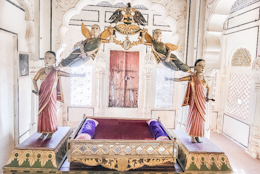
IT IS NOT UNUSUAL to find a swing (‘hichko’ in Hindi) in an Indian home. Often, they consist of a seat suspended from a frame by ropes or chains. The museum in the fort at Jodhpur in Rajasthan has a fine collection of hichkos that were once used by the former royal family.


Hichko presented by the PWD

One of the swings in the collection caught my eye both because it was quite different in design from the others in the collection and because it bore an interesting label, which had been attached by its maker(s). The wording on the label reads:

“With profound loyalty of Jodhpur PWD Employees Union”

(PWD: Public Works Department)


This hichko which is decorated with the royal crest of Jodhpur and almost lifesize models depicting two women in saris is not dated. The union still exists, but since 1947, the royal family has lost the power which it once possessed.

Tulsi trees and temples within the fort at Jaisalmer

 THE WALLS OF THE fort in Jaisalmer (Rajasthan) contain a living city that has been in existence since the early 18th century,  but the fort itself was established in the 12th century. It is enjoyable to wander the narrow lanes that thread their way between houses, many of which are decorated with elaborate, Rajput style carving.


The only thing that can cause the visitor some concern is the regular passage of motorbikes and scooters along the thoroughfares which are severely limited in width. These vehicles, often driven by impatient people who sound the horn loudly and frequently, squeeze past one, narrowly avoiding injuring pedestrians. I suspect that these motorists find the tourists as irritating as the pedestrians regard them. That said, like Venice, whose main thoroughfares are crammed with visitors,  Jaisalmer, like Venice,  has byways that are almost deserted apart from the few residents who dwell in the houses lining them.


A tulsi tree

Today, we made a second visit to the fort and tried to avoid the busiest lanes as much as possible.  In so doing, we stumbled across two lovely old mandirs (Hindu temples). Both were constructed in the 15th century, long before the fort became a residential area for civilians. 


Both mandirs are still used for worship. In one of them, the Laxmi Narayan mandir, two pandits (priests) were having a heated argument  yelling at each other across the courtyard.  At this mandir, there was a tulsi (holy basil) tree, growing in a container, which has small alcoves in which lighted diyas (oil lamps) can be placed. I watched a man walking clockwise around the tulsi tree several times. When he had done this,  he plucked one of its leaves and touched it reverently  against his forehead.


The tulsi tree is of religious significance to devout Hindus. I read somewhere that when the Portuguese were occupying Goa and trying to encourage people to become Roman Catholic, tulsi trees were outlawed in that former colony.


The courtyard of the Laxmi Narayan was partly shaded by a peepal tree, whose leaves are heart shaped. Like the tulsi tree, the much larger peepal  tree is also of religious significance.


The other old temple, which is smaller than it’s neighbour (Laxmi Narayan), is called the Ratneshwar Mahadev. I did not notice any tulsi plants associated with it. However, a peepal was growing next to it.


Although both mandirs had visitors,  both locals and tourists, they were less crowded than the much-visited Jain temple with the fort. When we walked past it yesterday, it was literally swarming with tourists.


Apart from the spectacular array of finely decorated buildings that can be seen, what makes the fort of Jaisalmer well worth seeing is that it is still home people who live their everyday domestic lives there. Interspersed amongst the many things designed to appeal to tourists, one catches frequent glimpses of local people living their daily lives.

Loads of balls to defend the city walls

THE WALL SURROUNDING the fort of Jaisalmer is about three miles in circumference.  It encloses a warren of narrow streets and small squares and is home to several thousand residents.


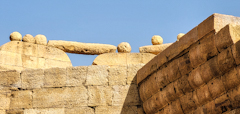
Balls on the walls

It was during the reign of Akhai Singh, 1723 to 1762, that people began leaving the town around the fort to establish homes within it. They began laying out streets and mohallas (neighbourhoods) within the well defended fort. This continued until 1891. Why it should have stopped in 1891, I  do not know yet. Suffice it to say that this fort, like that at Carcassonne in France, is one of the few forts in the world that is still home to a settlement of local people. It is a “living fort”, not a museum.


The fort and its contents form the main tourist attraction of Jaisalmer.  Like Venice in Italy, it feels as if the tourists outnumber the locals. Many of the buildings in the fort cater to the tourist trade: guest houses, shops, and eateries. And there are plenty of men who are keen to guide you around the fort for a modest fee. However, the services of a guide would spoil, rather than enhance, the pleasure of exploring this attractive place. The best way to enjoy the fort and the richness of its ornate, yellow sandstone buildings is to lose yourself in the maze of narrow streets.


The fort’s construction commenced in about 1156 AD. You do not need to be particularly observant to notice that upon many of the fort’s outer walls there are heavy-looking stone balls and roughly hewn stone cylinders.  These were placed, ready to be rolled down on enemies attacking the fort at close range. The fort has been attacked several times over the centuries. But I  hope that it will not be attacked again. In the unlikely event that another assault  will be planned, I  am pleased to report that the stone balls are already in place.


The wonderful dwelling of a Dewan in Jaisalmer

 ONE OF THE REASONS for our visit to Rajasthan in 2024 is connected with one of my wife’s ancestors: Laxmidas Sapat (also written as ‘Sampath’). He was my wife’s great great grandfather on her mother’s side. Trained as a barrister in London’s  Middle Temple   he was Dewan (Chief Minister) of Jaisalmer between from 1903 for about six years. After that, he became Chief Justice of Jodhpur.


As yet, we have not discovered where Laxmidas resided in Jaisalmer.  But today (8th of December 2024), we have just visited the spectacular haveli (mansion) that was constructed for one of Laxmidas’s predecessors: Mohata Nathmal, who was Dewan between 1885 and 1891. The haveli is called Nathmalji ki Haveli and it was built in 1895.


The facade of the edifice, built in the Rajput style, is a riot of intricately carved yellow sandstone. One interesting detail is a carving depicting a steam engine and a bicycle. I wonder whether this was carved because Nathmal was interested in what was then modern technology. An online article (https://www.rajasthanbhumitours.com/blog/rajasthan-tourism/nathmal-ki-haveli-a-symmetrical-marvel-of-jaisalmers-heritage-architecture/) discusses the haveli in detail and gives another explanation:

“One of one of the most fascinating aspects of the façade is the addition of contemporary aspects, such as bikes and also a European-style heavy steam engine, which were unheard of in Rajasthan at the time. These makings mirror the interested and forward-thinking minds of the craftsmens who created the haveli, mixing conventional themes with contemporary motifs that were brand-new to Jaisalmer in the 19th century.”

Whatever the reason for the presence of these carvings, the facade is a showpiece of the skill of the two brothers who were commissioned to erect the building. Today, visitors can enter the haveli to view and purchase the goods in the shops that occupy the building. The rooms within the mansion have wall paintings that were created in the 19th century, and there are also a few framed historical portraits, including one of King Edward VII of England.

I am pleased that I have seen the home of one of the Dewans of Jaisalmer. I would be even happier if I could discover where Laxmidas Sapat resided during his time as Dewan of Jaisalmer.

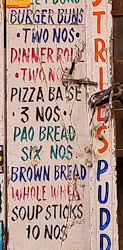
Burger buns two numbers, pizza bases three numbers

 THERE ARE MORE people who make use of the English language in India (over 130 million) than in the UK (53 million). The language is a ‘lingua franca’ in India. However, like North American English, Indian English differs in some details from British English. For example,  whereas an Indian says “I will do the needful”, a Brit says “I will carry out what is required ” or  “I’ll do it”


While strolling through the market area of Jaisalmer today, we passed a bakery that listed its wares in English on a board outside the shop. This notice employed a commonly occurring Indian use of the word ‘numbers’ (abbreviated as ‘nos’). Amongst the produce that was sold in the store were the following: “Burger buns two nos”, “pizza base 3 nos.”, and “soup sticks 10 nos” What this means is that the shop sells burger buns as a pair, pizza bases in threes, and packs of 10 soup sticks.


You can often find the same usage of the word ‘number’ in restaurant menus. For example, “pakoras (6 numbers)” means that the portion you will be served will include 6 pakoras.


This particular Indian English usage of the word ’number’ is widespread, as is the usage of  ‘avail’ as a verb. In India to avail something means to take advantage of an opportunity  or something offered, whereas in literary English it means to help or to assist, as in, for example, “no amount of struggle availed him”.


The English language is one of a few useful benefits of the centuries of British  rule in India. Yet, it has undergone some interesting adaptations by its users on the Subcontinent. I have described a few of these, but there are plenty more.

Tassels attached to trucks on the highway

 THE ROAD FROM Jodhpur to Jaisalmer is called a highway and tolls are levied along the way. In fact, most of the way it is a two-lane road without a central divider. The country through which we travelled from Jodhpur to Jaisalmer is for the most part as flat as a pancake The sandy landscape contains many trees and succulent plant bushes.  As one gets further and further away from Jodhpur,  villages and settlements become few and far between. Apart from agriculture,  there is no other industry.  However, as you get closer to Jaisalmer,  the countryside becomes filled with wind turbines and electricity pylons.


Although we did not encounter much traffic, we did meet a variety of animals using the roads: cattle, goats, sheep, horses, peacocks, and camels. Drivers are careful to avoid hitting them, often crossing over to the wrong side of the road to bypass them.


We stopped for a light lunch (vegetarian) at an isolated, small, unpretentious wayside eatery (a ‘dhaba’). The menu was in Hindi script only, and the waiter asked my wife to write down (in Hindi) the items we wanted. In addition to us, there was a family from Assam eating in the dhaba. The stuffed parathas we ate were well made and the buttermilk was refreshing.


Most of the trucks we saw on our way had tassels attached. Often, they are black, as we have seen all over India during past travels. However  some of the trucks we saw in Rajasthan sported coloured tassels, hanging from the rear. Those readers unfamiliar with India might be curious about the purpose of these usually unattractive tassels. In my book “CORACLES AND CROCODILES: 101 TALES OF INDIA”, I have written about these tassels, which flutter in the wind as the truck speeds along the highway.


Even if the scenery is not spectacular,  I  enjoy travelling by road in India. All along the way, there are scenes of rural life to be seen. For example, today we passed through a village in which piles of red chillies were out drying alongside the roadway. And often the country folk can be seen going about their daily routines dressed in traditional garb, whose design is centuries old. These fleeting glimpses of rural life enhance my enjoyment of India.

[The book mentioned above is available from Amazon: https://www.amazon.com/CORACLES-CROCODILES-101-TALES-INDIA/dp/B0DJZ6DMYB ]