
The ceiling of the nave of St Cyprian’s church in London’s Clarence Gate is almost 50 feet above the floor. Three swathes of indigo dyed cotton are suspended from it, forming three, parallel, giant, parabolic loops. Each piece of cloth is 88.6 feet in length and together the three strips are 8.4 feet wide, each one separated from the other by a narrow gap.
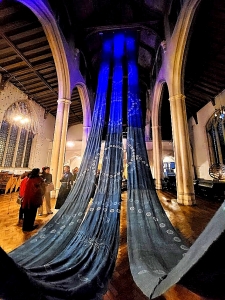
St Cyprian’s is a gothic revival church built between 1901 and 1903. It was designed by Ninian Comper (1864–1960). It is a perfect example of Perpendicular Gothic architecture, and has a beautiful, intricately constructed, gilded rood screen.
The indigo dyed parabolic swathes of cloth are made with ‘gedog’, a cotton cloth made in Indonesia with cotton grown there and spun by women in East Java. Onto these loops, the Mongolian multidisciplinary artist and silversmith Nomin Zezegmaa (born in Berlin in 1992) has created circular white coloured batik patterns, which relate to, as a handout explained: “… the cosmology of the Javanese world and Mongolian shamanism.” Additionally, the swathes of cloth contain networks of embroidery, which is almost the same deep blue colour as the loops.
The artist commissioned other artworks that can be seen on both sides of the impressive cloth parabolas. These include mask-like copper sculptures created by a craftsman called Erdenebileg Byambatsogt, who also made 108 tiny bells arranged on thin threads that are, like the masks and the loops, suspended from the ceiling. On the floor of the church, there were several cloth mattresses filled with Mongolian wool.
I have described what can be seen of Zezegmaa’s artistic installation, The church is filled with the recorded sounds of Mongolian musicians and singers. Although it was difficult to hear them on the opening night of the exhibition because of visitors chatting, the artist’s idea was to create a Mongolian soundscape, In her introductory speech, she explained that in Mongolia, songs like those being heard in the church are used traditionally to communicate messages over long distances. However, as she pointed out, these songs are usually sung and heard in the wide, open spaces of Mongolia, but she found it interesting to hear them in the enclosed space of a church, whose acoustics are completely different to those of the great Mongolian outdoors. I hope to return to the church to hear the sounds on a day when there will be fewer visitors than on the opening evening.
Although the parabolic, cotton swathes are themselves intrinsically interesting from both visual and intellectual points of view, it is their setting in the beautiful space of St Cyprian’s church that transforms them from being merely attractive to becoming spectacular. Just as the church enhances the artwork, the artwork, in particular the indigo parabolas add to the viewer’s appreciation of Ninian Comper’s superb edifice.
The show “You Who Sing Into Existence”, which is sponsored by the Bagri Foundation, continues until 24 October 2026.
Apart from seeing work by a Mongolian artist, visiting her show brought home to me the fact that in addition to the inherent beauty of an artwork, one’s experience and appreciation of it can be influenced by its surroundings – the environment it which it is viewed.

