
BEFORE THE YEAR 1729, a part of southern India, now part of the State of Kerala, was a collection of distinct small kingdoms. Often, they fought with each another, and life in that part of the world was disorganised and easy prey to the activities of hostile regimes, such as the Dutch colonists and armies from other parts of India.
In 1729, Marthanda Varma (1706-1758) became Maharaja of the Kingdom of Venadu in what is now the southernmost part of Kerala. A brilliant military strategist, who employed Europeans to update his army, he conquered most of the small states in southern Kerala, and created the Kingdom of Travancore, which existed from 1729 until about one year after India became independent in 1947. Just as Otto von Bismarck united the myriad German states, Marthanda did the same kind of thing in Kerala. Marthanda was not only a successful military man. He was also a successful ruler who brought orderly government to his kingdom. As with all rulers who have suppressed rival states, he had enemies, who plotted against him, but many of these were either banished or killed.
One of the problems that Marthanda solved successfully by both diplomatic and military means were the Dutch, who had settled on the Malabar Coast, and were desperate to purchase pepper. After the Dutch had conspired with the ruler of Cochin, which was never incorporated into Travancore, Marthanda defeated them at the Battle of Colachel in 1741. This was one of the few battles in which an Indian army defeated a European force. Following the battle and others, Marthanda often persuaded some of his enemies’ soldiers to join his army, and they helped to improve his military capabilities.
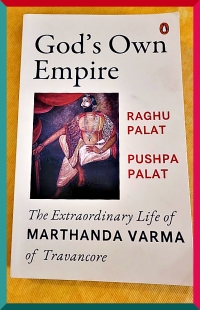
Marthanda was a canny fellow. Worried about whom would succeed him and also how to maintain the integrity of his kingdom after he died, Marthanda conducted a ceremony at a temple in Trivandrum during which he surrendered Travancore to the god Sree Padmanabhaswamy. This happened in January 1750. From then on, Marthanda ruled Travancore on behalf of the god. As the authors of a brief but excellent biography of Marthanda, “God’s Own Empire”, Raghu and Pushpa Palat, put it:
“Regardless of how one views it, it was undeniably a masterstroke. The nation and realm now belonged to Lord Padmanabhaswamy who was worshipped with the most profound reverence across the entire kingdom. It meant that anyone taking up arms against Marthanda was, in fact, taking up arms against the deity”
The strategy was successful.
Raghu and Pushpa Palat have achieved something remarkable in their short book. Not only have they described Marthanda’s life both beautifully and at times excitingly, but also, they have unravelled the extraordinarily complex history of southern Kerala, making it accessible to the lay reader.
 yamey
yamey 