
THE ARTIST RICHARD LONG (born in England in 1945) studied art first at Bristol’s West of England College of art, and then between 1966 and 1968, at London’s St Martins School of Art, where his teachers included Anthony Caro and Phillip King (my mother worked alongside these two sculptors in the early 1960s). He is described as a ‘land artist’, and his works include sculpture, photography and text, as well as performance. Since the 1960s, Long has been creating artworks based on his experience of long walks he has made in places including the UK, the Sahara Desert, Iceland, the Himalayas, and Australia. He plots his walks on maps, and these become works of art. He also takes photographs of the terrain through which he has walked. In addition, he creates sculptures where he has walked using local materials, and then takes photographs of them in situ.
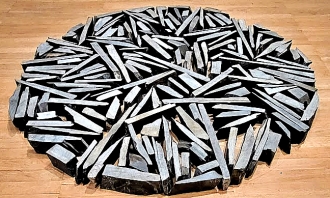
The Tate Modern is currently (March 2026, but I do not know when it ends) showing a collection of Long’s creations. This includes examples of his maps and photographs, text works (printed words), as well as three floor sculptures, each of which consist of pieces of stone arranged within the confines of a circle. One of them contains variously shaped chunks of Norfolk flint, another consists of pieces of red slate, and a third with Delabole slate, black in colour. Although they look almost randomly arranged, I imagine that the artist has placed them according to some design he had in mind. Seemingly simple, these sculptures are surprisingly striking.
I believe that what we saw at the Tate Modern’s exhibition is in complete harmony with what Richrd Long has said (quoted on the Tate’s website) about his art:
“My work really is just about being a human living on this planet and using nature as its source … I enjoy the simple pleasures of wellbeing, independence, opportunism, freedom, dreaming, happenstance; of passing through the land and sometimes stopping to leave (memorable) traces along the way.”
The exhibition is well worth seeing.
 yamey
yamey 