
AN OLD BUILDING stands near the Bhadra Fort in the heart of old Ahmedabad. This is the Himabhai Institute. Its origin dates back to 1849 when Alexander Kinloch Forbes, an administrator in the British East India Company, set up the Gujarati Vernacular Society which aimed at carrying out social reforms, enriching the Gujarati language and its literature, and to promote ‘useful knowledge’.
The Society set up a library in the building now known as the Himabhai Institute. A leading light in establishing the library was the Gujarati poet Dalpatram, a friend of Forbes and his teacher of the Gujarati language.
Dalpatram, whose full name was Dalpatram Dahyabhai Travadi, lived from 1820 to 1898. According to Wikipedia, he:
“… led social reform movements in Ahmedabad, and wrote articles against superstitions, caste restrictions and child marriage. He dealt with the problem of widow remarriage at length in his poem, Vencharitra … In 1885, Dalpatram was made a Companion of the Most Eminent Order of the Indian Empire.”
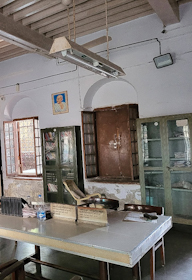
The library, named after the philanthropist Himabhai (Vakhatchand) who lived from 1785 to 1858, is one of Gujarat’s oldest. It contained a valuable collection of books and manuscripts. Today, unfortunately, the place is in a sad condition. The number of people using it has declined considerably. This is to some extent due to the Internet having become a major source of information, and as a consequence people depend less on books than they used to. The Institute has a peaceful rear garden and on the first floor there is a hall that can be used for meetings and other functions.
A preserved historical building, the now melancholic Himabhai Institute was known as the “Native Library” in the nineteenth century.
 yamey
yamey 