
THE EXPRESS TRAIN, Indian Railways number 22903 (the Bhuj AC Superfast Express), runs between Bombay and Bhuj (in the Kutch district of Gujarat). On its way, it stops at Ahmedabad Junction Station at 630 am. To catch the train, we arrived at Ahmedabad Junction at about 530 am – I always prefer being early at the departure point of a train, aeroplane, bus, etc.
It was dark as our autorickshaw drove speedily along the empty streets of central Ahmedabad. The sun only rises after 7 am in the west of India.
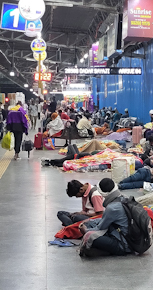
The well-lit station platforms were covered with rows of people wrapped in blankets, sleeping on the floor. The sight of these sleepers reminded me of the images that Henry Moore made of people sleeping on the platforms in London’s deep Underground stations during WW2. Of course, the people sleeping in Ahmedabad’s Station were awaiting trains, not sheltering from bombs dropped by the German’s Luftwaffe.
These sleepers were not disturbed by the endless series of train announcements, each of them were made in three languages: Hindi, English, and Gujarati. One of them that was repeated at regular intervals informed those who were listening that the Shalimar Superfast Express (it runs between Kolkata and Bombay) was running 12 hours and 50 minutes late. Fortunately, our train 22903, pulled into platform 3 almost exactly on time.
We had reserved places in the first class, air-conditioned carriage, and had a coupé (compartment) to ourselves. Although comfortable, it was a rather spartan little cabin. I believe that first-class rail travel in India is aimed at those who wish to travel secluded from the ‘madding crowd’. Frankly, I prefer travelling in a carriage in which one can see and, sometimes, interact with one’s fellow travellers and the endless stream of vendors, who move up and down the trains in India.
The six-hour journey from Ahmedabad to Bhuj is through terrain as flat as in the Netherlands, but much dustier. All along the route we passed factories, both small and large, many with chimneys emitting smoke. For the first half of the journey, we travelled past well-tended fields in which crops were growing. After crossing into Kutch, we passed numerous vast water features containg seawater that was being dried to produce salt. Every now and then, white, conical mounds of salt could be seen. The train runs for a long way parallel to a main highway in Kutch. This connects Kutch and its important port Kandla with the rest of India. An endless stream of large trucks moves along this road.
At Gandidham in Kutch, the train’s engine was changed. We began moving in a different direction as we travelled along the stretch of rail track between Gandidham and Bhuj, where we disembarked. Outside the station there was a sea of men offering to drive us in taxis, jeeps, and autorickshaws.
Eventually, our driver met us, and drove us through the hilly, almost arid hills between Bhuj and Kutch Mandvi, where we were going to stay with my wife’s cousins.
Even though train 22903 traverses terrain that few would regard as picturesque, I always enjoy long land (rather than air trips) journeys through the countryside of India.
 yamey
yamey 