
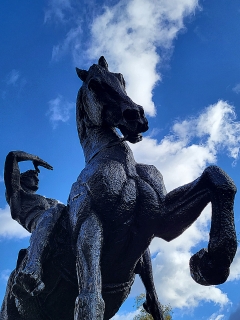
CAST IN BRONZE, he sits aside a rearing horse. He looks west towards Kensington Palace and uses his right hand to shield his eyes from the setting sun. I am describing a cast of a sculpture by George Frederic Watts (1817-1904), which bears the name “Physical Energy”. The sculptor was born on the birthday of the conductor George Frederic Handel – hence his two first names.
Watts began work on an equestrian sculpture in 1870, when it was commissioned by Hugh Lupus Grosvenor, who became 1st Duke of Westminster. It was to depict Hugh Lupus, 1st Earl of Chester. This was at Eaton Hall near Chester. In the early 1880s, Watts began working on “Physical Energy”, which was inspired by this sculpture. The first bronze casting of “Physical Energy” was made in 1902, and transported to southern Africa.
Watts had been principally a painter until the 1870s, when his interests moved towards sculpture. “Physical Energy” was the high point of his efforts. A plaque next to the bronze horse and rider explained that this sculpture depicted:
“… a universal embodiment of the dynamic force of ambition …”
One man for whom these words might well be applied was the mining magnate and a Prime Minister of the South African Cape Colony, Cecil Rhodes (1853-1902), who ruthlessly let nothing get in the way of his ambitions. Therefore, it was particularly appropriate that one of the casts of Watts’s “Physical Energy” (that made in 1902) was placed at Groote Schuur (in Cape Town) as part of a memorial to Rhodes after Rhodes’s death. Unlike a bust of Rhodes placed nearby, which was vandalised recently, the equestrian statue has survived … so far.
An article published by Artnet News (https://news.artnet.com/art-world/watts-sculpture-royal-academy-ideological-baggage-1155971) made the following remarks:
“Watts, like Rhodes, believed in British imperial might to back its right to rule … the artist “plied” a leading politician with suggestions that military service should be introduced. (The colonial statesman Lord Grey was the man who suggested Watts turn the equestrian sculpture into a memorial to Rhodes after he died…)
… Watts’s imperialism was “liberal” and that the sculpture’s ideological meaning is open-ended. Socialists used the image, too. In fact, Watts had multicultural references in mind when he first conceived the statue: It was due to be dedicated to great empire builders including Mohammed, Attila the Hun, and Genghis Kahn. (Trowmans adds that May Watts, the artist’s second wife and a fellow artist, was much more sceptical of Rhodes.)”
The quotation mentions that Watts married twice. His first wife was the young actress Ellen Terry (1847-1928). They married when she was 16 years old. They separated after 10 months. During that brief period, she met, and was photographed by the Victorian pioneer of artistic photography, Julia Margaret Cameron (1815-1879). I have written about both Watts and his young bride in my book about Mrs Cameron (“BETWEEN TWO ISLANDS: JULIA MARGARET CAMERON AND HER CIRCLE”).
In addition to the cast in Cape Town, at least two others were made. One of them was produced in 1959. It now stands outside the National Archives in Harare (Zimbabwe). The cast which stands in Kensington Gardens was cast by AB Burton (a founder) in Thames Ditton in 1905, and was put in its present location in 1907. It stands on a line that runs between a Henry Moore sculpture on the bank of the Serpentine and Kensington Palace. Another cast was made in 2017 to commemorate the 200th anniversary of Watts’s birth. Briefly, it stood in the courtyard at the Royal Academy. Now, it stands at the Watts Gallery near Guildford.
We pass “Physical Energy” on our frequent strolls through Kensington Gardens. From it, there is a fine view of Henry Moore’s tall concrete sculpture across the Serpentine Lake. Watts was a contemporary of the French sculptor Auguste Rodin (1840-1917). However, sadly, neither Watts nor Moore produced works as fine as those of Rodin.
[My book about Julia Margaret Cameron is available from Amazon, e.g.,
 yamey
yamey 