THE ARAL SEA which is a lake on the border between Uzbekistan and Kazakhstan was once the world’s third largest lake. From the 1960s onwards, it began to shrink because the rivers that fed it were diverted to be used for Soviet irrigation projects. Now it has shrunk to less than 10% of its original area. From the 1960s onwards, the decline of the sea’s size has been monitored by satellite imagery.
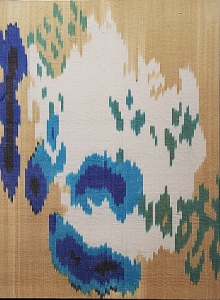
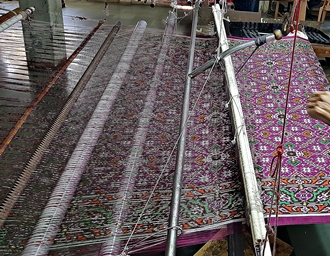
During March 2026, Vadehra art gallery has put on a temporary exhibition (at London’s Cork Street) of works by the Indian artist Himali Singh Soin and the British artist David Soin Tappeser, an artistic duo called ‘Hylozoic/Desires’. The show includes a series of images based on what can be seen of the Aral Sea in the satellite pictures that chart its decline. Their images are made of cloth woven using the traditional ikat method. Simplifying the technique, it involves weaving with threads that have been dyed in several colours in varying patterns along their length. We first saw this extremely complicated method of fabric production at Patan in Gujarat (India: see https://gujarat-travels.com/2019/02/05/weaving-in-patan/ for more about the technique). The ikat pictures at the exhibition were woven in Uzbekistan. By using this technique to capture the essence of the satellite images, the artists have produced a beautiful artistic representation of an environmental disaster that has take place over almost seven decades.
Although the ikat fabrics chart a tragic history, there is some good news. The Kazakhstan government has been able to increase the depth of the sea significantly, and as a result its salinity has dropped.
HUMANS HAVE BEEN weaving textiles for many centuries, for at least 12000 years, if not longer.
Today, while walking in the extensive grounds of a country house in Kachchh (Kutch) in Gujarat, we noticed something interesting about the decaying fronds that had fallen from palm trees. The fronds have long tapering stems that support the photosynthesising leaves of the tree. The stems are widest where they attach to the tree and taper as the distance from the trunk increases. The tree discards mature fronds to make way for new ones.
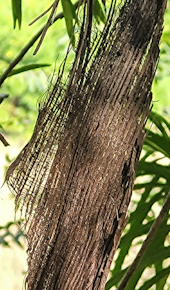
Woven by nature: detail of a drying, fallen palm frond
What interested us was that the drying fronds that have fallen from the trees shed or lose part of their external cuticle to reveal lattices of fibres that resemble woven textile. These lattices of drying palm fibres look just like sheets of sacking cloth. Nature achieves this natural weaving without requiring looms.
Palm trees have been around since long before Homo sapiens. Therefore, this natural form of weaving antedates human weaving activities. I wonder whether when our ancestors saw what we noticed today that they conceived the idea of weaving.
KENIA ALMARAZ MURILLO was born in Bolivia in 1994. She moved to Paris in France at the age of 11 years. Until the 30th of January 2025, there is an exhibition of her work at the Waddington Custot Gallery in London’s Cork Street.
All of the exhibits contain woven textiles. Many of them also have objects added to them, making them like three-dimensional collages. The objects she has added were salvaged from Parisian scrapyards whilst the yarns she has used are indigenous South American in origin. The resulting artworks are both beautiful and exciting.
I can strongly recommend seeing this well-displayed show in a gallery a few yards away from the northernentrance to Burlington.
LONG AGO PEOPLE in the Andes did not write. Instead, as Chilean artist Cecilia Vicuña (born 1948) explained in a note on the Tate Gallery website:
“… they wove meaning into textiles and knotted cords. Five thousand years ago they created the quipu (knot), a poem in space, a way to remember…”
After the Europeans conquered South America, they abolished and burnt the quipus. However, as the artist explained:
“… the quipu did not die, its symbolic dimension and vision of interconnectivity endures in Andean culture today.”
Cecilia has created two large sculptures which are hanging from the tall ceiling of the Tate Modern’s Turbine Hall until the 16th of April 2023. Each of these artworks consist of knotted strands of different materials, each of which is 27 metres long. They hang from circular metal structures looking to me rather like shredded laundry. Though they are undoubtedly deeply meaningful and attract the attention of many viewers, I felt the history underlying them was more interesting than their aesthetic qualities.
Abakanowicz
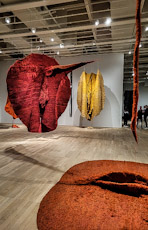
Elsewhere in the Tate Modern, we viewed an exhibition of the works of an artist, who knew how to write, but was creating during a time when the use of words had to chosen carefully to avoid being punished by the government. That artist Magdalena Abakanowicz (1930-2017), was born in Poland, where she created most of her art. After WW2, she studied painting and weaving the Academy of Plastic Arts in Warsaw. Her early works were created during a period when the Soviet-supported Stalinist regime in Poland imposed great restrictions on creative endeavours. During that harsh period, artists had to express any criticisms of the regime in a coded way in order to evade censorship. To some extent, this was necessary until Communist rule ended in Poland. In the mid-1950s, restrictions on art eased up a bit and experimentation became possible.
Magdalena moved from creating flattish conventional woven pieces to innovative three-dimensional artworks – woven sculptures of great originality. Photographs cannot do justice to these amazing creations. Videos can help the viewer appreciate the amazing way that these tapestries both fill and engulf space. However, the best way to see these works is to see them with your own eyes, which you can do at the Tate Modern until the 21st of May 2023. Included in the exhibitions are photographs of the lovely sculptures the artist created in later life and some videos of the artist talking about her work. There is also a film made in 1970 in which her tapestries are displayed on the sandy dunes of Poland’s Baltic coast. The artworks are suspended from poles and move gently in the sea breeze. It is clear from this film, which included scenes showing the fabric sculptures in galleries, that the artist seemed keen to have viewers explore them by touch as well as by vision. Sadly, and probably sensibly, the Tate forbids visitors from touching the lovely artworks.
Both the Vicuña and the Abakanowicz artworks use knotting and weaving to communicate ideas with the viewer. A window in one of the Abakanowicz exhibition rooms overlooks one of the quipu artworks. It intrigued me to see the juxtaposition of the works of the two fabric artists. Seeing these two exhibitions, one immediately after the other, made for a fascinating visit to the Tate Modern.

 yamey
yamey 