
ALTHOUGH THE ROYAL Academician John Zoffany (1733-1810) visited India and created paintings there, the younger and more famous Academician JMW Turner (1775-1851) never visited the country. Yet, an exhibition at the Tate Britain in London, which is showing until 12 April 2026, contains two of Turner’s depictions of Indian landscapes.
Both Zoffany and Turner lived and worked before the birth and full exploitation of photography. Travellers could record their impressions of places both by writing and by sketching or painting. Amongst the many who went out to India in the nineteenth and earlier centuries, there were plenty of officials (both military and civilian) who recorded what they saw by sketching and with paints. It would seem that these people were skilled artists probably because art was included in their education. The images created were important for surveying and topographical purposes as well as, perhaps, a way of passing time in outposts where there was little else to do when the work of the day was over.
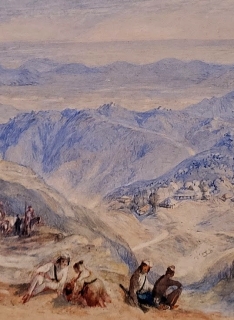
Turner, who had become a successful artist, was often commissioned by print publishers to create images that could later be reproduced as mass produced editions of engravings. He painted images of places he had visited as well as places he had never been to. India was one of the latter. However, he created beautiful watercolour depictions of Indian landscapes based on sketches that had been made by British army officers when they were based in India. The two ‘Indian’ watercolours on display in the exhibition are “Musooree and the Dhoon from Landor” (painted in 1835) and “Rocks at Colgong on the Ganges in Bihar” (painted c1835). Both are exquisitely executed and less ethereal than some of his better-known paintings.
Although Turner never travelled outside Europe, it is highly likely that the influence of British India made itself felt in his later works. In an interview recorded in the scroll.in website (https://scroll.in/magazine/827492/how-the-british-raj-in-india-brightened-the-palette-of-jmw-turner), Tate Britain curator David Blayney Brown is quoted as saying:
“Turner was a great and inventive colourist. If you look at his work from the beginning to the end of his life, the early works are quite dark and sombre, but the later ones are full of colour – brilliant yellow, red, blacks, crimsons, blues. Even if he hadn’t been to somewhere like India, he lived in a place where a lot of people had and they were bringing back descriptions of a more colourful place than England, which was smoky and dark and dull and raining all the time. People were coming back to this England with memories of a place that was full of colour. This was bound to change people’s ideas. In Sir John Soane’s museum in London, there is a bright yellow living room, almost an Indian yellow. That was a yellow that was introduced in Turner’s lifetime, much brighter than anything available before. The tastes for those colours would definitely have been brought back from the empire.”
Even if we cannot be certain, it is possible that some of the pigments brought back from India might have found their way on to his glorious canveses.
The two Indian landscapes form only a minute part of a large, well-attended show setting the works of Constable and Turner side-by-side. Yet, seeing them really helped make the exhibition a ‘hit’ for me. Soon, I will write about other aspects of this show that caught my interest.
 yamey
yamey 