
From Cairo to Kent and Karl Marx

IN RECENT YEARS, the seaside town of Margate in Kent has become much more of a “trendy” destination than it used to be. From being yet another coastal resort, it has become a magnet for those interested in contemporary art. This is because of the presence of the Turner Contemporary Gallery, Tracey Emins’s gallery, and the Carl Freedman gallery … to mention but a few places. With the influx of tourists with sophisticated tastes, the town has become home to a range of restaurants, which is more varied than in many other seaside towns in north and east Kent.
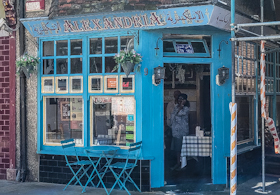
About 6 years ago, a husband and wife from Cairo (Egypt) set up a tiny restaurant on a corner plot in the old centre of Margate. It is called Alexandria Café. The owners chose the name not because they come from Alexandria, but because like the Egyptian city, Margate is by the sea.

Only open on Fridays, Saturdays, and Sundays at present, this restaurant serves beautifully prepared, tasty Egyptian dishes at very reasonable prices. We tried koshari, falafel, baba ganush, pickled tomato salad, and mint tea. Although these are all without meat, non-veg dishes are also available.

The tiny, comfortable eatery is decorated with photographs of Egyptian film stars. A small television screen was showing old Egyptian films.

A few doors away from the lovely Egyptian cafe, there is an ice cream parlour. What makes it special is that in 1866, Karl Marx stayed in the building.

We did not try the ice cream, but I can safely say that of all the places I have eaten in Margate, having visited the place many times, Alexandria is the best.

He painted artworks on the floor using a household broom

ED CLARK (1926-2019) WAS born in New Orleans. He was an Afro-American. In 1944, at the age of 17 he joined the US Army Airforces. After the war, he received US Government financial assistance for further education, help given to those who had served in the military during WW2 (the GI Bill). He studied art in Chicago before moving to Paris (France). He arrived there as a competent figurative painter, but soon became fascinated with abstraction, such as practised by Picasso, Matisse, and Braque.

Although he was a competent portraitist, Clark began to question the value of realistic figurative painting when photography could do the job so well. He moved to creating works that were mainly abstract. Many of his paintings are on display at the Turner Contemporary Gallery in Margate until the 1st of September 2024.

Ed Clark with a broom

The paintings that we viewed at Margate are exciting and most of them are almost, if not completely, abstract. For most of his creative life, Clark worked in an interesting way. First of all, he painted with his canvases spread out on the floor. This way, he explained in a film being shown at the exhibition, his paint was not subjected to gravitational pull. Most artists paint on surfaces which are far from horizontal – on easels, for example. This means that the wet paint is subject to gravitational pull before it has dried. By painting on the floor, Clark explained, this small but significant gravitational drag does not occur.

Another distinctive feature of the way Clark worked was his choice of brushes for applying the paint. He did not use artists’ paint brushes. Instead, he threw batches of paint onto his horizontal canvases and worked them into his pictures using ordinary domestic brooms, such as are normally used to sweep the floor. This is illustrated in the film, and the effects he produced using sweeping movements are beautiful and ingenious. In addition to brooms, he also applied paint with his hands, rubbing the paint into the canvas. Clark described that by working on the floor he became more intimately involved with his creations.

We had come to the Turner Contemporary to view some sculptures by Lynda Benglis, and had never heard of Ed Clark. However, after seeing the superb exhibition of his creations, we have become his fans.