
Mediaeval paintings on a wall in a church in Kent

ON OUR WAY to visiting friends, who live in Tonbridge (Kent), we stopped to look at the Church of St Thomas à Becket in the village of Capel. The saint lived from c1120 until his murder in 1170. An old tree in the churchyard at Capel is fenced off and alongside it, there is a label that informs the reader that the saint was:

“… supposed to have preached beneath this lovely old yew tree.”

Given that it is now the year 2025, the very latest that he could have preached beneath this tree would have been 855 years ago. As some yew trees can remain alive for several thousand years (https://fortingall-graveyard.org.uk/yew-tree), it is quite possible that the venerable yew at Capel was around when St Thomas à Becket was active.

The interior of the church offers visitors a wonderful surprise. The north wall of the church has many sizeable fragments of wall paintings that were uncovered in 1927. They had been covered with whitewash (paint) during the Reformation (sixteenth century) during which church decorations were largely removed, destroyed, or hidden. Experts believe that these paintings were executed in two periods: in about 1200 and then about 50 years later. The subject matter of these wall paintings was religious, designed to convey bible stories to those parishioners who could not read, and who did not understand Latin, then the language used during church services.

Amongst many other fascinating things in this small church, the communion rail caught my attention. Carved in the seventeenth century, it bears the date 1682 and the name “Michael Davis”. According to an informative leaflet in the church, in the 1630s Archbishop Laud (1573-1645) recommended installing such rails to prevent dogs from entering and defiling the sanctuary that contains the high altar. The simple stone altar was made in 1979 to replace a seventeenth century communion table that had been stolen. Like mediaeval stone altars, the modern one at Capel is inscribed with five crosses, which symbolise the five wounds made in the crucified Christ.

Although still consecrated, the church is not used often. It is now cared for by The Churches Conservation Trust and left open during the day for visitors to enter. For those interested in seeing mediaeval wall paintings in Kent, apart from at Capel there are fine examples at: Chiddingstone, Newington-next-Sittingbourne, Stone, and Barfreston.
Green hops and beer at a pub near Tonbridge in Kent

THROUGHOUT THE COUNTY of Kent, you will spot the conical roofs of oast houses in which the hops used to flavour beer are dried. Many of these curious looking buildings are no longer used for their original purpose. Many of them have been converted into picturesque residences. In late October 2025, we booked a table to eat lunch at the Dovecote Inn, a pub near Capel, which is not far from Tonbridge in Kent. We were advised that it might be noisy because there would be a beer festival going on when we were there.

The event was “The Dovecote Green Hop Festival”. Green hops, sometimes called ‘wet hops’, are hops harvested from the vines (the ‘bines’), and used to make beer within 24 hours of having been picked. The beers produced with these fresh, rather than dried, hops, have their own distinctive flavours, which are fresher and more vibrant than other beers. This is because the green hops contain ingredients that are lost when hops are dried out. However, to produce beer with the freshly picked hops, a far greater quantity of hops is required than when using the dried ones. I tried one of the green hop bitters, and it tasted wonderful.

The Dovecote Inn turned out to be a delightful, small late eighteenth century establishment. Its landlord was extremely friendly, as were his team of staff. Although we had to wait a long time for our food, it was well-worth waiting for. As for the noisy festival about which we had been warned, it did not seemed to have taken off by the time we ate there early on a Friday afternoon. We looked around at the customers and amongst about twenty people, only four of them were drinking beer. I suspect that had we stayed until the evening, the beer consumption level would have increased by then.

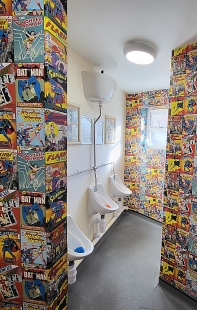
On the way out, I paid a visit to the men’s toilet. This was a sight to be seen. The walls of this part of the pub are covered with an eye-catching wallpaper whose design is a dazzling collage of American comic covers (“Bat Man”, “Wonderwoman”, Superman”, etc.).

Only a few miles from Tonbridge, The Dovecote Inn is well worth a visit, but if you plan on eating there, leave plenty of time.

The artist Marc Chagall and a church in rural Kent

A TRAGEDY OCCURRED on the 19th of September 1963. Aged 21, Sara Venetia d’Avigdor Goldsmid lost her life in a sailing accident. She was the daughter of Major Sir Henry Joseph d’Avigdor-Goldsmid, (1909-1976) of the Jewish faith and his wife Lady Rosemary d’Avigdor Goldsmid, an Anglican. The family lived at Somerhill, a Jacobean mansion (now a school) near to the church of All Saints at Tudely (just under 2 miles east of Tonbridge). Lady Goldsmid and her daughter Sara used to worship in this small church, which dates to mediaeval times, if not before. Much of the existing structure was constructed in the 13th and 14th centuries, but it was heavily restored in the 18th century.

After Sara’s death, her parents wanted to do something to perpetuate her memory. They and others decided to restore the church. Part of this operation was to replace the existing plain glass east window with a commemorative window, which they asked the artist Marc Chagall (1887-1985) to design for them. This Jewish artist was chosen because Sara and her mother had admired Chagall’s stained-glass at an exhibition they had visited at the Louvre in Paris (France). These included some of the windows that Chagall had created for the synagogue of the Hadassah Medical Centre in Jerusalem (Israel). They were installed in 1962 after having been exhibited not only in Paris but also in New York City.

Chagall created the drawings for the windows, and they were translated into stained-glass by Charles Marq (1923-2006) of Rheims (France). When Chagall visited Tudely, and saw his window after it was installed and dedicated in December 1967, he was so satisfied with it that he offered to create stained-glass images for all the other windows in the church. His offer was accepted. He managed to complete this work, but it was some years before the congregation at Tudely finally agreed to replace the existing Victorian stained-glass windows in the church with those created by Chagall. It was only some time after the church warden, Kenneth Stinton, had seen the Chagall windows on display at the Royal Academy of Arts in Piccadilly in 1985 that the idea of replacing the Victorian windows with Chagall’s became acceptable. They were placed in the church by December 1985.

Many of Chagall’s windows at Tudely are rich in dark blue colouring. Entering the church and finding it suffused with predominantly blue light is like entering an underwater space. This might be intentional as poor Sara d’Avigdor Goldsmid’s life ended beneath the water of the coast near Rye (Sussex). If she saw anything at all as she sunk beneath the sea, it might well have been such a dark blue light. I have visited Tudely’s church several times, and each time the same thought occurs to me. My first visit must have been in the 1980s after December 1985, because I have never seen the church without all the Chagall windows installed.

The church is in a rural setting, surrounded by fields. It has become a tourist attraction, and is occasionally used to hold chamber music concerts, one of which I attended in the early 1990s when I was still practising dentistry in north Kent. Although a little remote, this gem of a church is well worth making an effort to visit it.