
SEVERAL INDUSTRIAL CONCERNS have built towns or settlements to ensure that their employees have somewhere comfortable to live near to the factories where they work. An early example of this is Saltaire, which was constructed between 1851 and 1871 near Bradford for the workers in the mills of Titus Salt. In 1888, the Lever Brothers, who made a variety of products including soap, built Port Sunlight (in Cheshire), a model village for their workers. And in South Africa, my great-grandfather Franz Ginsberg was a founding father of Ginsberg Township, established near his factory in King Williams Town in 1901. I have visited these three places, but not Bournville, the Cadbury chocolate company’s workers’ village that was started in 1893. Outstanding as these examples are, nothing can compete with the workers’ facilities established in several countries all over the world by the Czechs Tomáš Baťa (1876-1932) and his son Thomas J Bata (1914-2008).
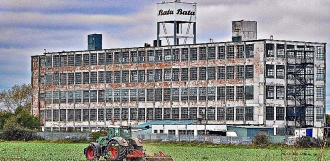
The Bata company was formed in Zlin (Moravia, Czechoslovakia) in 1894. It was concerned with manufacturing shoes, and continues to exist today. Soon, the business grew, and large factories were built. Accompanying these factories, and close to them, At Zlin, Bata built not a simple workers’ village, bu at large workers’ town. The company employed architects to design modernist buildings, including dwellings, shops, a cinema, a hospital, a hotel, restaurants, and other practical amenities. Not only did the company build these structures, but it also modernised industrial working conditions to make life more pleasant for their workers. In time, after WW2, Bata began expanding overseas. In the 1930s and 1940s, they established factories, each with their own workers’ model towns, in Poland, Yugoslavia, Hungary, Switzerland, Holland, England, India, USA, Canada, Chile, Kenya, Rhodesia (now Zimbabwe), and Brazil. In all their factories, Bata practised their advanced benevolent treatment of the workers. Apart from, improving working conditions, Bata made innovative developments in design and marketing.
To mark the one hundred and fiftieth anniversary of the birth of Tomáš Baťa, the Czech Centre in London is holding an exhibition, “Desire to Create: Baťa’s Architecture of Belonging”, until 12 June 2026. The small exhibition is filled with informative placards and historic photographs. Much of the show concentrates on the Bata town built around its factories at East Tilbury, on the Thames east of London. Although Bata closed operations there in 2005, many of the company’s buildings still survive (see https://londonadam.travellerspoint.com/43/, which describes my visit to East Tilbury in 2017). The exhibition at the Czech Centre is a collaboration with Bata Heritage Centre in East Tilbury. Although the exhibition is not large, it is fascinating and I am pleased I have viewed it because not only have I visited Zlin and East Tilbury, but also, I have bought pairs of comfortable shoes and sandals made and sold in India by the Bata company.
Finally, at the exhibition I learned two well-known personalities have had connections with Bata. The broadcaster John Tusa was the son of Jan Tusa, one of the first managers of Bata in Czechoslovakia, and the father of the playwright Tom Stoppard was a medical doctor in the Bata town in Zlin. When his parents fled the Nazis, the Bata family assisted them.

