
A mosque in south Kolkata and one of the heroes of India

THE TOLLYGUNGE CLUB in South Kolkata stands on land, which was once the home of members of the family of Tipu Sultan (1751-1799). He fought first the Marathas, and then the British valiantly until his death at Srirangapatnam. Had Tipu not been defeated,  the British might have had great difficulty maintai g a foot in India.


Four years before Tipu’s death, his youngest son Ghulam Muhammad Sultan Sahib (1795-1872) was born in Srirangapatnam. In 1806, he and the rest of his family were deported to Calcutta by the British, and were settled in Tollygunge, south of the city. Where they lived is now occupied by the Tollygunge Club (founded 1895).
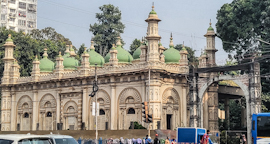
 

About 900 yards north of the Tollygunge Club’s clubhouse and across a very busy road, there is a mosque (on the corner of Deshparan Sasmal Road and Prince Anwar Shah Road). It stands within its own peaceful compound.


One of the first details I noticed when visiting the mosque and its grounds was that all of its outdoor lighting stands use old cannons for their bases. Maybe this is not surprising because this mosque is one of two  in Kolkata named after Tipu Sultan. The Tollygunge Tipu mosque was constructed in 1860 by Tipu’s youngest son, Ghulam Muhammad Sultan Sahib. It is designed in the Indo-Islamic style. Its exterior is attractive,  but its interior has very few visual attractions.


In the garden of the mosque, there is a raised rectangular platform. Upon this, there are five or six unmarked graves, each one looking dilapidated. One of these marks the burial place of Tipu’s youngest son. The walls of the platform have a few plaques engraved with words in a script resembling Urdu or Arabic. I  was told that these words are of religious significance,  rather than the names of the deceased.


At the east end of the compound, there are a few steps leading to a deep depression that was once a pond or small lake. An elderly caretaker told us that never in his long life had he ever seen water in it.


A review of the mosque on the TripAdvisor website described the place as not being somewhere in Kolkata that “must be seen”. This is correct, but as we often stay at the Tollygunge Club and have visited Srirangapatnam several times, I was keen to view the place with such an interesting link to Tipu Sultan.

Exclusion of Indians even after India became independent

WE HAVE STAYED in the guest accommodation at Calcutta’s Tollygunge Club several times. On our most recent visit, I spent a few minutes looking at the boards on which the names of the Club’s past Presidents are listed.

Between the year in which the Club was founded – 1895 – and 1968 – twenty-one years after Indian Independence- all of the Presidents had British surnames.
In 1969, the post was held by Brigadier RB Chopra. His surname is Indian. He was succeeded in 1970 by HA Whittle – someone with a British surname. Mr SP Achary, who was the next President (in 1971) had an Indian surname.

Mr Achary was followed by CJN Will CBE in 1973. Thereafter, most, but not all, of the Presidents had Indian sounding surnames. An exception was the President in 1979, who was AWG Macintyre, CBE. He was a senior executive in the Dunlop tyre company.

Seeing all of these Presidents with British surnames holding their positions so long after India became independent got me wondering. Already I knew that even after independence, some private clubs and other institutions in India restricted admission to Europeans and refused entry to all but a very few Indians. I became curious to know when the Tollygunge Club began welcoming Indians as members. The answer is that the colour bar was lifted in 1961. Indians were then admitted as “Associate Members”. They had no voting rights. The first non-white Associate Member was the then Japanese consul. In 1967, the first batch of 30 Associate Members (I.e., Indians) were made Permanent Members. The first Indian President, Brig. Chopra was amongst this batch.

Various factors must have swayed the Club towards admitting Indians. One of these might have been the slowly declining British presence in Calcutta. Another was more serious. Cutting a long story short, in the late 1950s, the West Bengal government, acting to some extent on guidelines from Central government, began to question the future of the elite clubs of India.

The government of West Bengal drew up a plan to construct a housing estate on the extensive grounds of the Tollygunge Club golf course. The clubhouse would have then been converted to some kind of communal amenity. These plans caused great concern to Calcutta’s British community. This plan was aborted. I have heard one explanation of why this happened, but it would be best if I do not reveal it.

Declining Club revenues and increased taxation must have also led to the Club enlarging its membership by accepting Indians as full members. During the very early 1970s, my father-in-law, a senior executive in a large company, was offered membership by the Tollygunge Club. He turned down the offer because he was reluctant to join a club that had refused membership to Indians for so many years after India became independent.

It is fortunate that the Tollygunge Club with its lovely grounds has survived because, although still quite exclusive, it is a wonderful place to relax and make new friends.

Horses and a golf course in Calcutta

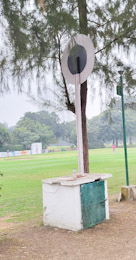
HAVE STAYED AT the Tollygunge Club several times, but it was not until yesterday (18th of January 2024) that my friend Prihvi Chaudhury made me aware of an interesting historical object. Near the club’s Shamiana refreshment area and partly hidden by the foliage of a tree, it is a circular metal plate mounted on a tall metal pole. Prithvi told me that it is all that remains of the former Tollygunge Club horse racing track. It was the finishing post.

The Tollygunge Club was founded by a Calcutta banker, Sir William Cruikshank. He established the club on land bought from the descendants of Tipu Sultan. The Club was originally founded for British colonialists to enjoy equestrian activities within easy reach of the city. The racecourse was laid out in connection with this.

In addition to the racetrack, much of the extensive grounds of the Club were develope into an 18 hole golf course. This is beautifully landscaped and provides many challenges to the golfers who play there.

The race course was ‘dismantled’ many years ago. However, the Club’s association with horses continues today. On the Club grounds there is an airy, well-maintained stable block, which is currently home to at least 36 horses. We visited the stables today and fed some of the animals with carrots provided by members of the friendly stable staff.

The horses are exercised twice a day either in a special paddock or on some of the footpaths that thread their way through the club’s grounds. Club members can join horse-riding lessons and can hire steeds for taking rides (not gallops) around the Club’s terrain. When taking a ride, the horse and rider are accompanied by a stable hand.

Had Prithvi not pointed out the historic finishing post, I doubt that we would have become aware of the stables for a long time, if at all.

Golden dogs on a golf course in southern Calcutta

THE TOLLYGUNGE CLUB in southern Calcutta has a beautiful golf course. Between the greens, bunkers, and other golfing features, there is a large variety of trees, many water features, and a profusion of bushes and flowers. It is a joy to stroll through the grounds, taking care not to get in the way of the golfers and their caddies. As you wander through the terrain, you can spot a variety of birds, the occasional dog, and a few pussy cats. However, the greatest treat is to come across the Golden jackals (Canis aureus) that live on the golf course land.

These jackals, usually only seen in the wild, seem quite at home on the golf course. During the day, they lope around or squat, watching the golfers and walkers like myself. Although not tame, they allow humans to approach quite closely before they wander away, but not hurriedly. At night, their howling can be heard if the Club is not holding a noisy social function.

A study by AK Sanyal et Al. (Rec. Zool. Surv. India III, 2010) revealed that when it was published there were 40 to 45 jackals living on the Club grounds. They tend to live some distance away from the Club house and its neighbouring buildings. This is probably because of the tame dogs that hang around close to the Club’s semi-outdoor eating areas. The study discovered that the jackals feed on a wide variety of creatures including insects, birds eggs, rodents, larger animals, and fruits. They are also partial to food produced by humans.

The above-mentioned study revealed that there have been rare attacks on humans, but only by rabid jackals. These incidents have happened in the wild, rather than in the Club’s grounds. And the most common way that the jackals can catch rabies is by being bitten by dogs.

The Tollygunge Club land is about one square kilometre and is home to about 7 families of jackals. In the wild, this number of families would occupy an area of up to three square kilometres. This suggests that the living conditions for jackals in the Club grounds is far better than in the wild.

Every time I have walked on the golf course land, I have seen some of the jackals. When I first saw them, I was wary of them, but now I realise that they have no inclination to interact with me or fellow members of my species. Even though I have seen them plenty of times, I am thrilled whenever I spot one of the Club’s Golden jackals.