
A short street in Kensington and social differences

AUBREY WALK IS a short street in Kensington. About 260 yards in length, it leads west from Campden Hill Road. Originally, it was the approach road to Aubrey House. Until 1893, when it was given its present name, the short stretch of road was named ‘Notting Hill Grove’ (https://www.british-history.ac.uk/survey-london/vol37/pp87-100#h3-0006).

St George, Aubrey Walk

Aubrey House, at first known as ‘Notting Hill House’, was completed by the end of the 17th century. It is at the western end of the street and was attached to some springs with medicinal properties: the Kensington Wells. In the mid-18th century, the house was enlarged by its then owner, Sir Edward Lloyd. The house and its extensive grounds passed through the hands of many different owners. Between 1767 and 1788, it was the home of the diarist and political observer Lady Mary Coke (1727-1811), the daughter of the second Duke of Argyll. By the mid-19th century, it acquired its present name, Aubrey House, to commemorate Aubrey de Vere, who owned the manor of Kensington at the time of the Domesday Book.

In 1863, the house became the property of a politician and Member of Parliament Peter Alfred Taylor (1819-1891). He was a radical, a supporter of the northern states in the American Civil War, and an anti-vaccinationist. A website, british-history.ac.uk, noted:

“Peter Alfred Taylor was M.P. for Leicester from 1862 until 1884 and was a noted champion of radical causes. His wife Clementia was also famous as a philanthropist and champion of women’s rights. They were closely involved in the movement for Italian liberation and Mazzini was a frequent visitor to Aubrey House. In 1873. Taylor sold the house to William Cleverley Alexander, an art collector and patron of Whistler.”

The Taylors opened the Aubrey Institute in the grounds of the house. This was to improve the education of poor youngsters.  WC Alexander (1840-1916), who bought the property, employed the artist James Abbott McNeill Whistler (1834-1903) to decorate the walls of the reception rooms of the house. Sadly, today, all that the public can see of the house, which is now a private residential complex, are glimpses over the outer wall of the roof and the upper storey windows.

Aubrey House used to be neighboured by the now demolished Wycombe Lodge and its large garden. In its place, there is a set of recently built houses arranged around a rectangular open space. This is called Wycombe Square.

Walking east from the wall of Aubrey House, we pass several places of interest including Wycombe Square. On the south side of Aubrey Walk is the club house of Campden Hill Lawn Tennis Club. This was founded in 1884, only seven years after the first championship competition at Wimbledon. Its twelve courts, six outdoor and the others indoors, are not visible from Aubrey Walk. Almost opposite the club, numbers 38-40, a 20th century art deco style building, contains the former home of the singer Dusty Springfield (1939-1999), who resided there from 1968 to 1972.

At the eastern end of Aubrey Walk there is the distinctive Victorian gothic church of St George (Campden Hill). In the middle of the 19th century, the area between Kensington Church Street and Campden Hill Road, the area containing Uxbridge Street, Hillgate Street and Place, and other small lanes, was a slum. It was where labourers in the nearby gravel pits and brickfields lived, often with several families in one tall, narrow house. Many of the folk living in this locality were destitute, which is difficult to imagine when you look at the place today. It was decided to build a church nearby to cater for the poor people living in this deprived area. This became St George’s on Aubrey Walk. The first church was an iron building, a large hut, which had been used by soldiers as a chapel on the Crimean War battlefields.  

In 1862, the Vicar of St Mary Abbots, the parish church of Kensington arranged to break up his huge parish into smaller units, one of which became the ecclesiastical district of St George. John Bennett, a local builder, financed the construction of a church to replace the iron structure. The first stone of the present church, which can accommodate 1500 people, was laid in 1864. Its architect was Enoch Keeling (1837-1886). The building he designed is a rare example of ‘continental gothic’, also known as ‘Eclectic Gothic’. This style makes use of brick and stonework of various colours, both externally and internally. Its exterior gives an Italianesque impression. This is especially the case when you look at the prominent bell tower at the southeast corner of the church.

St George’s was actively involved in providing education, and social work (including a soup kitchen on Edge Street) to its congregation who lived in the nearby slums. It also played a major role in the Temperance Society, which served Kensington, Notting Hill, and Shepherds Bush.  Before WW1, services at St George’s were well-attended, and a wide range of music was played. Writing in a booklet about the church, its authors, Tom Stacey and Ivo Morshead, noted:

“Elaborate settings for the choir were juxtaposed with favourites from ‘Hymns Ancient and Modern’ … The repertoire consisted of works by Stanford, Goss, Barnby, and Handel … St George’s was hardly classy at this time but it sang the same music as its more fashionable contemporary churches … Perhaps the music was above the heads of some of the congregation; yet St George’s remained a full church until the outbreak of the 1914 War.”

By the 1890s, the people that attended services at St George’s were becoming more similar to those living in other parts of Kensington because slowly but surely housing conditions were being improved and what had been a ‘down and out’ part of Kensington was ‘coming up in the world’. Many of the former slum dwellings just east of St George’s are still standing, but instead of being the residences of the poor, they are the much sought-after homes of the wealthy.

In nearby Kensington Place, east of the church, stands the parish hall, St George’s Hall.  In 1901, the Victorian building was, according to a plaque affixed above its main entrance:

“… acquired and altered to commemorate the glorious reign of Her Majesty Queen Victoria born at Kensington Palace May 24: 1819”

It is now used for residential purposes.

Aubrey Walk, although short in length, has several interesting sights. In the 19th century, it linked two social extremes. At the western end was the fabulous Aubrey House and at the eastern end, the poor of Kensington flocked to attend services in St George’s Church.
My sporting life

THE ONLY SPORTS PRIZE I have ever won was at a sports day held by my primary school in Golders Green sometime before 1960. I was in a relay race. Our team members were awarded a green badge. I have no idea whether we were first or just in one of the three fastest teams. Since that glorious day, my sporting ‘achievements’ have been anything but glorious.


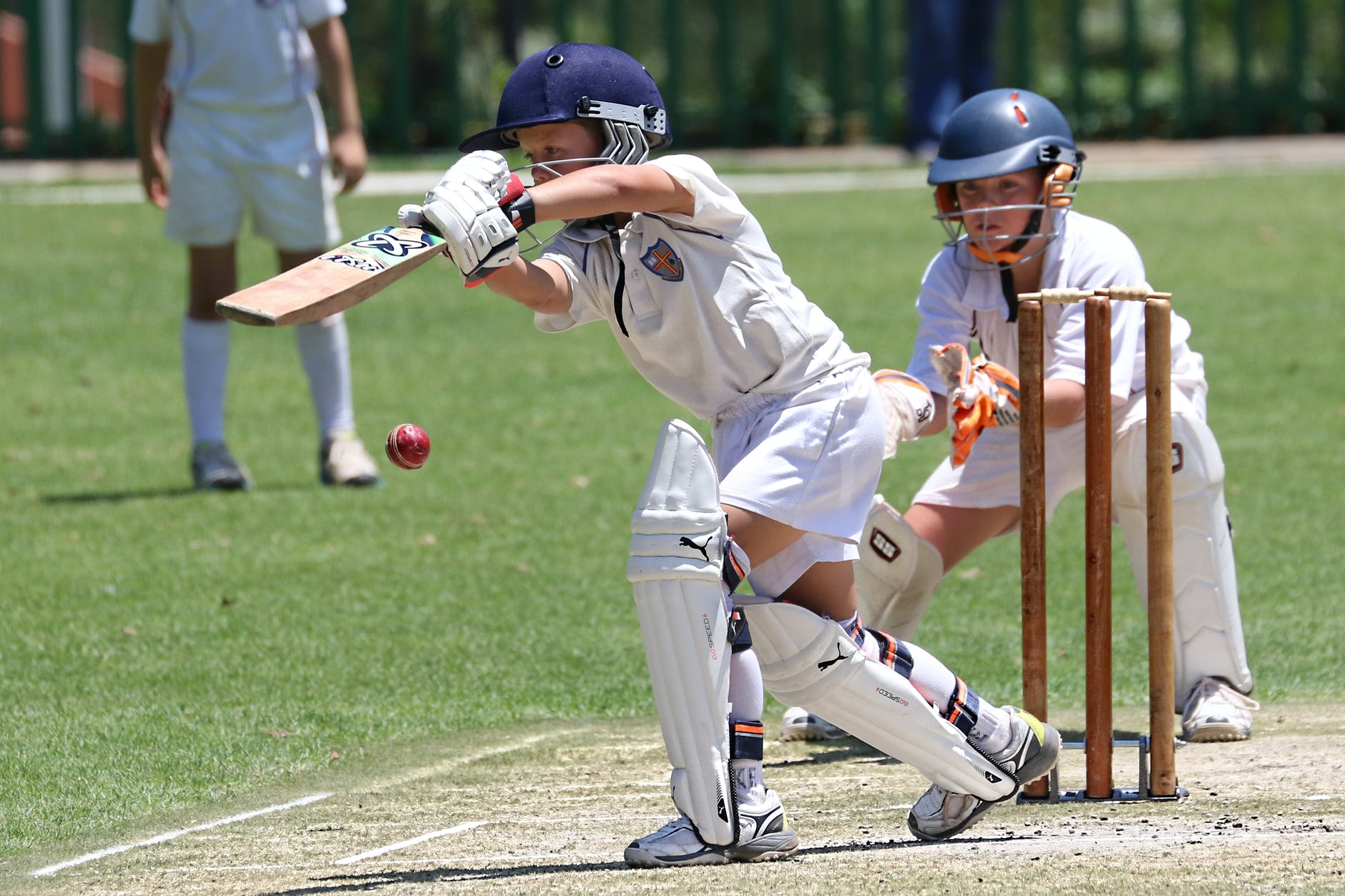
boys in white shirt and white pants playing baseball


Once, while playing football at the Hall School, which I attended from 1960 to ’65, I did manage to score a goal. The ball was coming my way, I put out my foot, and the ball bounced off it, into a poorly guarded goal. The only problem was that I had scored an own goal. My fellow team-mates were not amused.

I entered my senior school, Highgate School, in 1965, four hundred years after its establishment by Sir Roger de Cholmeley in the final months of his life. On the second day of my first term, I had to take part in a game of football watched by senior boys and teachers, who wanted to assess the playing skills of the boys new to the school. It was a very rough experience. The other players struck me as being very aggressive.  Twenty-four hours later, two senior boys, both much taller than me and dressed in the black blazers that only prefect wore, approached me. Very apologetically, they informed me that I was not good enough to play in our house football teams. They asked me to choose another sport instead of football. The choices included Eton Fives, which I had never come across before, and cross-country running. I chose the latter because I had heard of running.

It turned out that I had made a good choice. On most sports afternoons (Wednesdays and Saturdays), cross-country running was unsupervised. I used to change into my school running gear and wander over to the school tuck shop (a confectionery store) to buy some sweets. Then, I used to cross Hampstead Lane and enter the grounds of Kenwood, where we were supposed to run. After a respectably long enough leisurely ramble through the park, eating my sweets and maybe talking with someone else who was ‘going for a run’, I returned to the changing room, and got ready to go home. Showering was unnecessary because I never worked up a sweat nor roamed through muddy parts of the park.

Once a year, our housemaster (pastoral carer), Mr Bowles, took his boys for a run. This was a more strenuous event than my usual outings. We followed him off the paths and into the wilder parts of the park. Once, he stopped and turned to me, saying:

“Yamey, how is it that there is no mud on you?”

I replied:

“Mr Bowles, I don’t know. Anyway, I thought that the point of this was to get exercise, not to get muddy.”

He took this surprisingly well. Although he was the only teacher in the school not to have a degree from Oxford or Cambridge, he had more common sense that the rest of the staff put together.

Summer terms gave rise to another problem: cricket. This sport terrified me. I was constantly worried that I would be hit and badly injured by a hard cricket ball flying at speed. Also, I was useless at catching balls, hard or soft. So, when the school began recruiting pupils to be umpires, I volunteered. For a few days, I attended umpiring classes. Each of the new umpires was given a small pocket-sized blue covered book of the rules of cricket. None of it made any sense to me, but one thing stuck firmly in my mind: the umpire’s decision is final.

Fully ‘qualified’, I began my umpiring career. One of the umpire’s duties is to count the number of balls that have elapsed in each over of six balls. I had been advised that a good method of doing this was to place six coins in one hand and then after each ball ahs been bowled, to transfer a coin from one hand to the other. The only problem was that often during an over I forgot in which direction the coins should have been passed. Was it from left to right or vice-versa? Usually, the scorers pointed out when I had miscounted.   Often, the players questioned my decisions. My response was to withdraw the rule book slowly from my pocket and ask the petulant players:

“Have you read the very latest rules?”

This usually worked. On one occasion, the bowling team shouted “howzat” jubilantly. Without any idea why they did that, I declared that the batsman was ‘out’. This caused an uproar, but I knew that the umpire’s decision is always final, and I stuck to it.  Many of my decisions, I must now confess, were based on trying to get the game finished so that I could go home early enough. Had I been more scrupulous and better informed and more interested in cricket, the games that I umpired would have stretched on well after 5pm, which would have messed up my daily routine. At this point, it is only fair that I offer my apologies to anyone who felt aggrieved as a result of my umpiring activities.

Mr Bowles realised that sports was unlikely to do me any good at all. In the last two years of school, he allowed me to visit exhibitions in central London instead of getting in everyone’s way on the playing fields of Highgate. For example, during this period, I visited the exhibition about the Bauhaus three times at the Royal Academy.

When I was about 13 years old, an uncle, who was a keen bodybuilder, gave me a set of weights and a metal bar on to which these heavy metal discs fitted. It was a kind, well-meaning gesture. However, it was not a gift that appealed to me. It lay idle in my bedroom until a friend, who was keen on rowing, asked to borrow them. I lent them to him and was not perturbed that they were never returned.

At University College London, there was no requirement for me to do any kind of sport. So, I did not. While I was doing my PhD, I became good friends with my supervisor Robert and his wife Margaret. For thirty years after finishing my doctorate, I used to visit them at their home near Slough. They had a tennis court in their extensive grounds. Margaret was a fine tennis player, usually winning the finals of the tennis tournament played at the annual Physiology Department sports day held at Shenfield in Hertfordshire.

Whenever I visited Robert and Margaret, I was ‘roped in’ to playing doubles with Robert and Margaret and one other, usually their Irish son-in-law. I was reasonably good at serving and returning, but only if the ball flew towards where I happened to be standing. Margaret told me that I might have become quite a good player if I had bothered to run around the court when I saw where the ball was heading.

One weekend afternoon in early May 1984, while I was on the court with Margaret and Robert, I felt something slip inside one of my knees. As we walked back to the house for afternoon tea, I felt that I could not straighten my leg properly. I did not mention this to anyone for a good reason. It happened a few days before I was about to fly to Yugoslavia to begin a two-week tour of neighbouring Albania. I had been wanting to visit Albania for many years, ever since I was about 15 years old. I did not want to risk seeking medical advice just in case I was told not to travel. I decided that whatever the condition of my leg, I would travel to Albania. I believed that should my leg continue to trouble me, I could seek medical help in the country that had intrigued me for years.

After arriving in Albania and a few alcoholic drinks at various meals, my leg ceased to trouble me. One member of our group fell ill when we were visiting a hunting lodge in rural Albania. This lodge near Lezhë had been built in the 1930s for Count Ciano, Mussolini’s son-in-law. As if by magic, when the lady on our tour began feeling poorly, a doctor and two nurses dressed in white uniforms suddenly appeared to assist her. I imagine that our tour bus was followed closely by a medical team.

I mentioned the story of my leg because, contrary to all I have been told, I have noticed that sporting activities are not entirely beneficial. During the 35 years that I practised dentistry, I had several patients a week, who entered my surgery limping. Almost all of them had injured their knees or other body parts while attempting to ‘keep fit’.

Now, I do not want you to think that I am a slovenly ‘couch potato’, whose main form of exercise is breathing. I climb up and down the 50 steps leading to our flat and walk two to three miles a day on average. I walk mainly for enjoyment. If walking helps to keep me fit, that is a bonus.

So now, patient reader, you have been apprised of the secrets of my sporting life.

PS: you will be amused to learn that for a long time I thought that a ‘six-pack’ was a package of six cans of beer or lager. Now that I am better informed, I have looked in the mirror but fail to see any sign of my six pack; it remains hidden.

Photo by Patrick Case on Pexels.com