
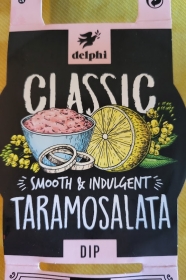
WE OFTEN BUY taramosalata (taramasalata) from the Athenian Grocery in London’s Bayswater district. They sell a brand called Delphi. It comes in a small plastic tub surrounded by a cardboard sleeve. Within the sleeve, there is a brief history of the company. The story begins as follows:
“It all started when our dad Tony started working in his family fruit and veg store on Goodge Street, London…”
Reading this brought back memories of shopping with my mother in the early 1960s. Being keen on Mediterranean dishes, we used to visit the shop in Goodge Street, mentioned above. Round the corner from this store, there was another Greek food shop, Hellenic Stores, in Charlotte Street. My mother preferred this shop, and only went to the one in Goodge Street if what she wanted was unavailable in Charlotte Street. It was close to the now long-since closed Schmidt’s German restaurant. Neither of these shops exists anymore.
Back in the 1960s and while I was at University College (until 1982), there were several Greek restaurants in Charlotte Street. These included Anemos, which was famous for its lively party atmosphere; Andreas, which I never visited, and is now called Ousia; the White Tower, which opened in 1938, and was highly regarded for its food, but is now closed; and Venus. My uncle, who worked in Bloomsbury, was fond of lunching there, and invited me to join him ther occasionally. It was less frenetic than Anemos, but pleasanter.
The reason that there were, and still are, many Greek or Greek Cypriot restaurants in and around Charlotte Street is more likely related to the huge demand for eateries in the busy area than to where Greek communities live in London. In London, the highest concentrations of Greeks (not Cypriots) is in Hyde Park, Regent’s Park, Chelsea and Kensington census districts. As for Greek Cypriots in London, some of whom run Greek restaurants, they are mostly living in Enfield, Haringey, Barnet and Hackney. In particular, they often live in Southgate, Palmers Green, Upper Edmonton, Cockfosters, Lower Edmonton, Tottenham North and Tottenham South. The Greek restaurants in the Charlotte Street area cater for the large numbers of students and office workers in the districr.
Returning to the story of the Taramosalata maker, Delphi, Tony decided to manufacture Greek food products. So, in 1984, he founded Delphi, which (according to the cardboard sleeve):
“Delphi is proud to be among the first UK producers of authentic houmous, taramosalata and many flavourful dips and salads …”
And the taramosalata they make is truly delicious.

 yamey
yamey 