ON OUR WAY TO LOOE (in Cornwall), where we hoped to buy fresh fish – and we did – we passed through an extraordinarily picturesque village called Lerryn, which lies on the banks of the River Lerryn (a tributary of the River Fowey). The shopkeeper in the village store recommended that we took a look at the church in nearby St Winnow (aka ‘St Winnoc’). On our way to this place, which is at the very end of a narrow country lane, we were first slowed down by a flock of pheasants which refused to get off the road, and then by some workers felling a tree.
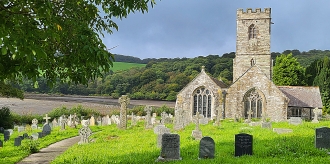
The parish church of St Winnow was built mainly in the 15th century and is positioned on a slope overlooking a stretch of the River Fowey. It is named after a saint, who is new to me. According to a website (www.anglozuluwar.com/images/Journal_10/St_Winnow_Church.pdf):
“St Winnow was one of the tireless band of Celtic priests and evangelists who consolidated and extended the Christian Church in Wales, Ireland, Cornwall and Brittany after the withdrawal of the Roman legions in the 5th Century. St Winnoc probably grew up in Wales and came here in about 670 AD to begin his missionary work, forming a small religious community and establishing a Lan or sacred enclosure. Eventually he moved to Northern France and founded a monastery at Wormhout, not far from Dunkirk.”
The church contains pews with beautifully carved endings. Two of its east windows have stained glass that dates from 1500. One of these windows contains a good display of the types of clothing worn at that time. The carved granite font, created in the 15th century, has bas-reliefs depicting angels with outstretched arms. All these features and others including the gothic architectural style make the church worth seeing. However, one thing struck me as being particularly unusual. It is an inscribed slate memorial on the north wall of the Lady Chapel.
The slate commemorated the death of William Sawle, who was buried on the 16th of February 1651. Beneath his name there is an anagram of it, which reads:
“I was ill: am wel”
‘Wel’ being a variation of the spelling of ‘well’.
Below this, there is the following verse:
“When I WAS sick, most men did deeme me ILL
If I had liv’d, I should have beene soe still.
Prais’d be the Lord, that in the Heav’ns doth dwell
Who hath received my Soule. Now I AM WEL.”
And beneath this, there is information, carved on the slate, that informs the viewer that Sir JSG Sawle Penrice repaired it “… out of respect to his Maternal Ancestors …” in 1838.
The Sawle family have lived in Cornwall since the time of William the Conqueror. By 1620, they were living at Penrice House near St Austell (see: http://www.sole.org.uk/sole2/penrice.htm). As for William Sawle, whose memorial bears an anagram, I cannot tell you anything yet because I have not found any information about him. However, his memorial in St Winnow is a great example of grave humour.

 yamey
yamey 