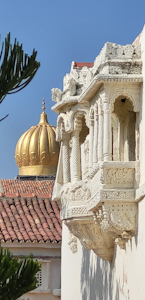
BUILT BETWEEN 1787 AND 1820, BRIGHTON PAVILION looks less like a hospital than most other buildings. Yet, during the First World War (‘WW1’), this decorative seaside retreat for British royalty was converted into a hospital to treat Indian troops. They had been wounded whilst fighting for the for the British Empire in the battlefields of Flanders. On the 14th of December 1914, the Pavilion was opened as a hospital with 724 beds. According to George Morton-Jack in his book “The Indian Army on the Western Front”, 14,185 wounded Indian troops were brought to Brighton on six “state-of-the-art” hospital ships. They were treated in the Pavilion and other hospitals specially established for the Indian wounded in Brighton and elsewhere. Over 2,300 Indians were treated in the converted Pavilion.

The Chattri
A few of the Indians did not survive their injuries. Of those treated at the Pavilion, 18 died, 10 of whom were cremated. Those who died, were given last rites according to their religious beliefs. Moslem corpses were buried in a purpose-built cemetery near the Shah Jehan Mosque at Woking (in Surrey). This mosque was completed in 1889 to the design of Gottlieb William Leitner (1840-1899), an orientalist of Hungarian Jewish heritage. The Hindus and Sikhs who succumbed to their injuries in the hospitals in Brighton were cremated on traditional funeral pyres. Between the 31st of December 1914 and the 30th of December 1915, 53 Sikh and Hindu soldiers were cremated at a specially demarcated spot on Holt Hill (near Patcham) in the South Downs, 500 feet above sea-level and then their ashes were scattered in the sea according to their rites.
Years ago, we used to meet the late General Misra (of the Indian Army) once a year for dinner when he came from India to the UK on his annual visits. He was a jovial gentleman, who seemed to enjoy life. All that we knew about his visits was that during them, he used to make a trip to Sussex to pay his respects to those Indian soldiers who had died during WW1. Apart from knowing him as a pleasant dining companion, we knew nothing else about him apart from the fact that he was related to some close friends of ours. We were not sure exactly why he used to go to Sussex in particular. Also, we were then unaware that our affable old friend had had a formidable military career.
During WW2, the General was attached to the 6th Rajputana Rifle regiment. A report (https://opus.lib.uts.edu.au/bitstream/10453/28086/4/MANIS002.txt) written during the British Indian campaign against the Japanese in Burma noted:
“Expediting the Jap withdrawl from the TENGNOOPAL Ridge and converting his retreat into a rout, the capture of a prominent hill to the east of Sibong, know(n) as Battle Hill, by a battalion of the 6th. Rajputana Rifles enabled us to have a grand-stand view of the retreating Japa on their LOC. The Rajputs singing and shouting made merry here as they sent MAG bursts on the jap LOC. In this battle and from the attack on Lone Tree Hill near Shenam, the Rajrifs [sic] have been commanded by Lt. Col. Dinesh Chandra Misra of Agra and a graduate of the Indian Military Academy.”
On the 5th of October 1944, the London Gazette announced that the then Captain (temporary Major) Misra had been awarded the prestigious Military Cross for his services in Burma. His distinguished military career (with the British before Indian independence) is summarised on the Imperial War Museum website (https://www.iwm.org.uk/collections/item/object/80017253):
“Indian cadet at Indian Military College, Dehra Dum, India, 1933-1935; officer attached to North Staffordshire Regiment in India, 1935-1936; served with 5th Bn Rajputan Rifles in India and Hong Kong, 1937-1941; served with British Army Aid Group Indian Section, China, 1942-1943, served with Rajputan Rifles in India and Burma 1943-1944; student attended Staff College at Camberley, GB, 1944-1945.”
From what my wife and I remember of this affable general, he never mentioned his brave exploits or even hinted at them.
Recently, a friend posted a photograph of a monument that he runs past whilst taking exercise on the South Downs near Hove. This small structure, which looks Indian in design, is what General Misra used to visit on his annual trips to the UK. A few days ago, we visited our friends in Hove and after eating a delicious lunch with them, we drove up on to the Downs near Patcham and walked through a field of well-fed grazing cows to reach a small enclosure containing the Chattri and a monument listing the names of the Hindu and Sikh soldiers who were cremated at this place during WW1.
‘Chattri’ is the Hindustani and Punjabi word for ‘umbrella’. The monument on Holt Hill consists of a small white marble dome supported on eight pillars made of the same material. This stone Chattri stands on a podium with stairs leading up to it from a lower platform on which there are three low granite slabs. The three granite slabs cover the spots where originally there had been three concrete slabs on which the funeral pyres were built and then ignited according to religious tradition. The ‘umbrella’ or ‘chattri’ symbolises, according to a plaque nearby, “the protection offered to the memory of the dead”.
Funded partly by the India Office and Brighton Borough Council, the monument was unveiled by the Prince of Wales in 1921. It was built to the designs of EC Henriques (died 1940, aged 51) a young Indian architect from Bombay. His work was supervised by Sir Samuel Swinton Jacob (1841-1917), an expert in the Indo-Saracenic style of architecture. I have eaten dinner at one of Jacob’s other buildings: Bikaner House, a palace he designed in Mount Abu (Rajasthan), constructed in 1893. Built as a summer palace for a maharajah of Bikaner, it is now a hotel. In January 2020, we ate a poor-quality meal there. We and the other diners sat dressed in padded jackets because the dining room was unheated, and the outside temperature was close to freezing point.
The bases of the eight columns of the Chattri interested me because they bear the same decorative motif seen on the bases of pillars in Hindu temples constructed well before the era of Moslem invasions of India began. The early mosques built in the 15th century in Gujarat (e.g. in Ahmedabad and Champaner), which borrow many structural features of Hindu temples, also contain pillars whose bases are decorated with the same motif seen on the Chattri. The same is true of the capitals of the pillars that support the dome of the Chattri. Also, the domes in those ancient Hindu temples and mediaeval mosques are always supported on eight pillars arranged in an octagon, as is the case at the Chattri. In brief, the small but elegant Chattri, which looks a little incongruous in West Sussex, would look very much at home in many parts of India.
The Chattri stands high on the South Downs in a pleasingly landscaped garden. It overlooks the surrounding hills and the ribbon of coastal towns including Brighton and Hove, and beyond them the sea. Part of the monument complex is a more recently (2010) erected concrete wall on which are carved the names of the 53 Hindu and Sikh men who were cremated at this spot, as well as their ranks and regiments.
To reach the Chattri, we walked along a path through a field in which cattle were grazing. As I looked at the cows, I thought that most of the Indian men whose lives ended in Brighton and were cremated on the Downs must have often walked amongst cattle in India before they left it to fight in Flanders for the Empire, which did their fellow countrymen few favours.
During our brief visit to the Chattri, there were a couple of families relaxing around it. Their children were playing cheerfully around the pillars and on its steps, blissfully unaware of what it represented. This did not bother us. We felt that their joy would have been appreciated by the men who sacrificed their lives for the future of families such as these and many others. The wide horizons, the lovely landscape, and the fresh air enveloping the monument, gave the place and its surroundings a special, maybe spiritual, atmosphere, a feeling of the continuum of life and beyond. Who knows, but any of us at the Chattri might possibly be reincarnations of some of the soldiers cremated there.
POSTSCRIPT: INDIAN SOLDIERS ON THE WESTERN FRONT
Many Indian soldiers fought for the British because they believed, or hoped, that by supporting the Empire in its struggle for survival, India would gain at least some autonomy, if not a generous dose of self-rule. In the last years of WW1, even the pacifist Mahatma Gandhi roamed around India encouraging Indians to enrol to fight for the British. Joseph Lelyveld wrote of Gandhi in his book “Great Soul. Mahatma Gandhi and his Struggle with India”:
“He implores wives to send their husbands to sacrifice themselves on behalf of the empire, blithely promising, ‘They will be yours in the next incarnation.’ Fighting for the empire, he now argues, is ‘the straightest way to swaraj’”
The Indian soldiers fought for the empire. Some were killed, others injured, but India did not reach swaraj (i.e. self-government) at the end of WW1. Remember, less than a year after the Great War ended, soldiers commanded by a British general killed at least 379 and wounded over 1000 unarmed Indian civilians in Amritsar in the Punjab, the district of India that supplied many troops to the Western Front and other battlefields. Even Winston Churchill, no lover of India, was genuinely outraged by the horrific nature of this murderous event.
India would have to endure many upheavals and another world war before independence was won.

 yamey
yamey 