
WHEN I WAS a child, I used to enjoy leafing through a book filled with black and white photographs of places in all the counties of England. One of them that stuck in my mind was of a wall covered with large horseshoes. It was only today (the 11th of August 2023) that I saw this wall in ‘real life’. It is in the great hall of Oakham Castle in England’s smallest county – Rutland. The hall, a fine example of Norman architecture, was built between about 1180 and 1190 for one of William the Conqueror’s grandsons – Walkelin de Ferrers. The name ‘Ferrers’ is related to the French word for iron and the English word ‘farrier’, who applies shoes to horse’s hooves.
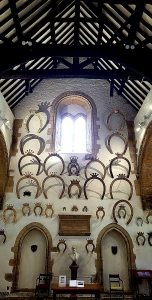
The Ferrers family held Oakham for about 130 years. It might have been during that time, or certainly by the early 16th century that a curious tradition was established. It was decreed that every peer of the realm who visits Oakham for the first time must donate a horseshoe to the lord of the manor. That tradition is continued even today. Some 245 larger than life horseshoes have been donated to Oakham and many of them can be seen within the great hall. It is likely that others were donated, and subsequently lost. Most of the horseshoes on display bear the names of the donors and the date when they were donated – that is, the year the donor first visited Oakham.
Three of the horseshoes all bear the date 1921, which was when their donors (the future King Edward VIII, the future King George VI, and Princess Mary – daughter of King George V) all visited Rutland as part of a hunting party. Also in 1921, Oakham was visited by Frederick Rudolph Lambart, 10th Earl of Cavan. In 1917, he took command of the British forces in Italy. His horseshoe is mounted on a wooden board. It surrounds a real horseshoe, which had once been worn by an Austrian pony, which he captured after a raid on enemy trenches in Asiago. Another visitor to Oakham was William Edwardes, 3rd Baron of Kensington, after whom Edwardes Square (in Kensington) was named. He visited in 1855. One could continue, but I will not because the biographies of the illustrious donors are too numerous to describe in this short essay.
Another special feature of the great hall is that it is still a working Crown Court. It is used occasionally. Of all the Crown Courts in England, this has remained housed in its original building longer than any others in the country.
Apart from the fascinating great hall, the tiny town of Oakham has many other interesting things to see including a market cross, a fine museum, a gothic parish church, and Oakham School (founded 1584). However, the hall full of horseshoes is by far the most interesting thing to visit. I was pleased to see it even if so many decades have elapsed since I saw a photograph of it during my childhood.
 yamey
yamey 